
https://falkentheater.substack.com/p/graphene-the-wonder-material-theyre?
GRAPHENE: THE WONDER MATERIAL THEY’RE DEPLOYING INSIDE YOU
THE BRAIN IS THE BATTLEFIELD — Article Series : Article 1 of 7
Mar 07, 2026
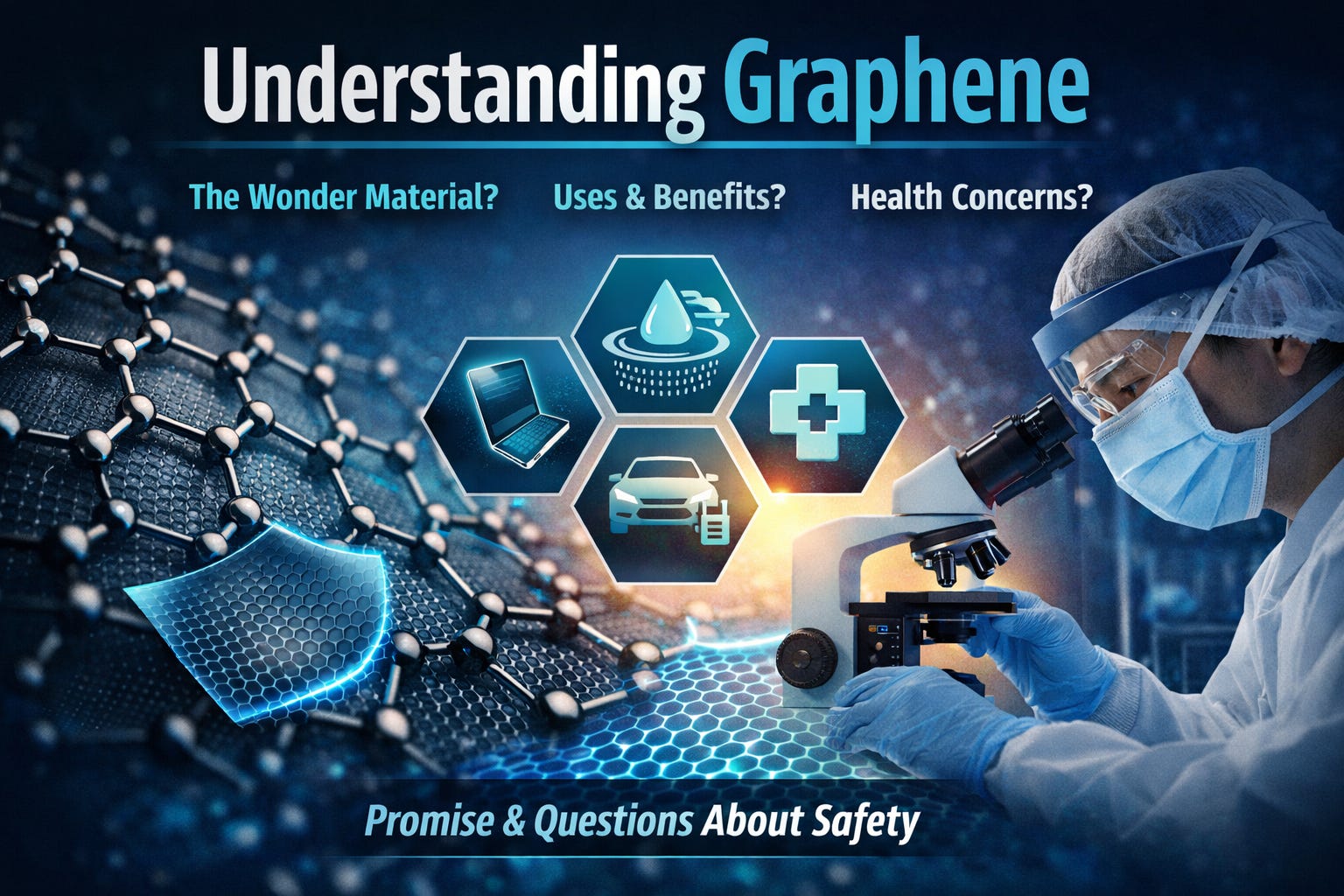
THE BRAIN IS THE BATTLEFIELD — Article Series : Article 1 of 7
Published as part of the investigative series synthesizing the documented research dossier ‘Homo Chimericus’ (January 2024) — cross-referenced with peer-reviewed literature, EU Commission records, and publicly available institutional documentation.
INTRODUCTION: The Story You Were Told
The story most people know goes like this: graphene is a revolutionary material — a single layer of carbon atoms arranged in a hexagonal lattice, first isolated in 2004 at the University of Manchester by Andre Geim and Konstantin Novoselov, who promptly won the 2010 Nobel Prize in Physics for their work. It is the thinnest material ever discovered, yet stronger than steel. It conducts electricity and heat with extraordinary efficiency. It is transparent, flexible, and in theory endlessly useful.
That story is true. But it is also, profoundly and deliberately, incomplete.
What the popular narrative carefully omits is the second, parallel chapter of graphene’s development: the massive, multi-billion-euro program to develop graphene specifically as a biological interface material — to introduce it into the human body, embed it in living tissue, and use it as the foundational substrate of a digital-biological control architecture.
This first article of the series examines graphene’s material properties with precision — not to celebrate them, but to explain exactly why this material was selected for this specific purpose, and what it actually does once it is inside you.
PART 1: What Graphene Actually Is — The Science
The Carbon Lattice
Graphene is a two-dimensional allotrope of carbon — a single layer of carbon atoms arranged in a repeating hexagonal pattern, sometimes described as molecular ‘chicken-wire’. At one atom thick, it occupies essentially no physical space in the third dimension. It is the flattest material in existence.
From this minimal structure emerge extraordinary physical properties. Graphene’s electron mobility — the ease with which electrical charge moves through it — reaches approximately 200,000 cm²/V·s at room temperature, far exceeding copper or silicon. Its thermal conductivity reaches 5,000 W/m·K — more than ten times that of copper. Its tensile strength is approximately 130 GPa, making it roughly 200 times stronger than structural steel.
These properties, separately, would already be remarkable. Together, in a material that is biocompatible, flexible, and manufacturable, they become transformative — and, in the wrong hands, something more concerning.
The Graphene Family
Research institutions working on biological graphene deployment draw on a family of related materials, each with distinct properties:
- Graphene Oxide (GO) — graphene chemically modified with oxygen functional groups. Water-dispersible, and therefore injectable in aqueous solutions. Extensively documented in biomedical delivery research.
- Reduced Graphene Oxide (rGO) — GO with most oxygen groups removed. More electrically conductive. Used in neural electrode and biosensor applications.
- Carbon Nanotubes (CNTs) — rolled graphene sheets forming cylindrical structures. Extraordinary tensile strength and electrical conductivity. Can penetrate cell membranes.
- Graphene Quantum Dots (GQDs) — graphene fragments at nanoscale (sub-10 nm). Highly fluorescent, demonstrably taken up by neurons, and capable of crossing the blood-brain barrier.
- Graphene Nanoribbons (GNRs) — narrow strips of graphene specifically used as plasmonic nano-antennas resonating in the Terahertz frequency band — the exact band designated for 6G wireless communications.
◆ KEY TECHNICAL POINT:
A graphene nanoribbon of 1 micrometer length and 10–100 nanometer width functions as a plasmonic antenna resonating in the Terahertz band (0.1–10 THz). This is not incidental. It is the structural backbone connecting graphene-based biological materials to 6G telecommunications infrastructure — a convergence explored in depth in Article 2.
PART 2: Graphene in Biological Systems
Blood-Brain Barrier Penetration
The blood-brain barrier (BBB) is among the body’s most critical protective filters — a specialized network of endothelial cells that tightly regulates what can pass from the bloodstream into the brain. Most pharmaceutical drugs cannot cross it. Graphene quantum dots, in specific size ranges, can — a fact documented in peer-reviewed animal studies and multiple review papers in journals including ACS Nano and Nature Nanotechnology.
Once inside the brain, graphene materials interact directly with neurons. Research published in Nature Communications documented that graphene substrates in contact with neurons modulate synaptic transmission — altering the frequency and amplitude of neural firing. The mechanism involves graphene’s ability to alter the potassium ion environment at the neuron-material interface, which directly governs electrochemical signaling. (See link for article)
________________
**Comment**
This website has posted material on graphene due to the fact a group of scientists and researchers sued the FDA under a FOIA to force the release of hundreds of thousands of documents related to the licensing of the Pfizer-BioNTech COVID shot. This forced the FDA to reveal the Pfizer COVID shots contain graphene and multiple researchers have shown they are in fact 99% graphene. The article points out that it is also in the following items: ( I highly recommend covidproject which has shown graphene in various applications, including micro-tech in all types of injectables via dark field microscopy)
- Any injectable medication administered or purchased in pharmacies or hospitals since 2018
- PCR test swabs, masks
- Dental Anesthetics
- Geoengineering (deployment of spider silk proteins having amyloidogenic domains are self assembling polymers used in synthetic biology. These have been linked to Morgellons, a Lyme-like illness with filaments in the skin.) Air from the Canadian wildfires has been tested and has been found to contain graphene oxide.
- Pain patches
- Therapeutic graphene garments
- Food packaging
- Water filtration
- Cosmetics
- Agricultural pesticides
- LED infrastructure
If graphene is accumulating in the body due to multiple exposure over years, the threshold for achieving functional nano-network density in tissue is lower than a single, identifiable event.
According to Dr. Bryan Ardis, both bee pollen (glucose oxidase, GOD) and apple pectin draw both graphene and aluminum out of the body.
For more:
- https://madisonarealymesupportgroup.com/2024/02/27/report-dangers-of-graphene-documentary/
- https://madisonarealymesupportgroup.com/2024/02/22/graphene-the-new-glyphosate-2-0/
- https://madisonarealymesupportgroup.com/2023/08/02/the-age-of-graphene-must-read/
- https://madisonarealymesupportgroup.com/2024/03/11/motherload-of-research-shows-graphene-oxide-is-harmful-but-new-report-suddenly-says-it-is-safe/
- https://madisonarealymesupportgroup.com/2021/07/07/what-is-in-the-pcr-tests/
- https://madisonarealymesupportgroup.com/2021/12/01/death-by-1000-cuts-graphene-hydroxide-in-covid-shots/
- https://madisonarealymesupportgroup.com/2021/12/14/german-chemist-dr-andreas-noack-found-dead-after-exposing-presence-of-graphene-hydroxide-in-covid-vaccines-not-the-first-time-a-doctor-has-been-persecuted-or-eliminated-also-free-resources/
- https://madisonarealymesupportgroup.com/2022/09/01/leaked-ema-documents-confirms-why-we-arent-allowed-to-analyze-vaccine-vials/ The vials are all different and the current “vaccination” campaign is an ongoing clinical trial with different research arms with people getting different ingredients and varying dosages.
- https://madisonarealymesupportgroup.com/2021/12/20/covid-shot-vials-become-alive-when-warmed-to-body-temperature-covid-passport-microchip-is-here/
- https://madisonarealymesupportgroup.com/2021/10/04/first-u-s-lab-examines-vaccine-vials-horrific-findings-dr-carrie-madej-another-microbiologist-speaks-out-i-dont-know-whether-to-cry-or-scream/
 Madison Area Lyme Support Group