
https://www.lymedisease.org/hhs-vector-borne-disease-strategy/
HHS releases vector-borne disease national strategy
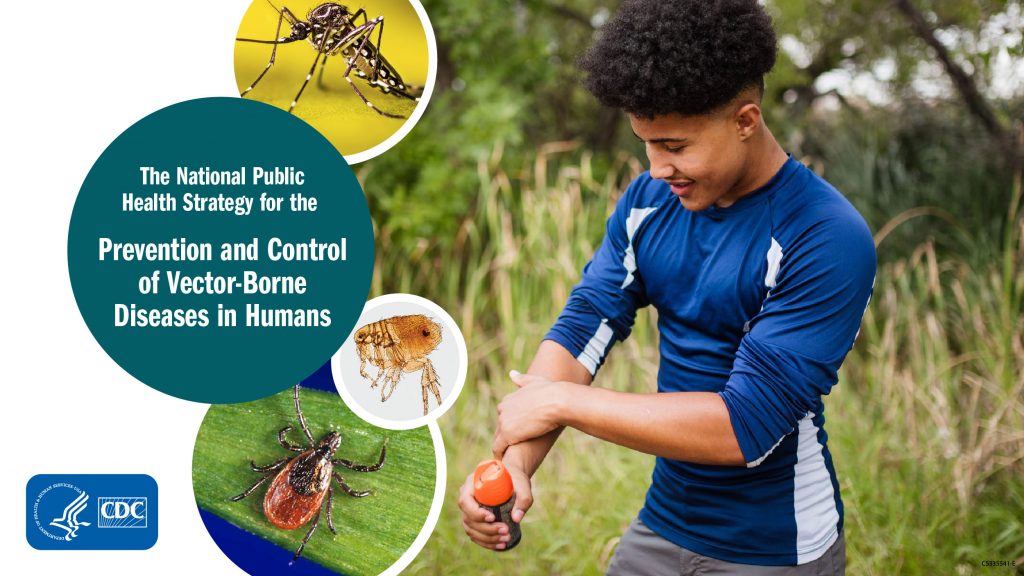
The U.S. Department of Health and Human Services has released the National Public Health Strategy to Prevent and Control Vector-Borne Diseases in People (VBD National Strategy).
As directed by the 2019 Kay Hagan Tick Act—named after the U.S. Senator who died due to complications from a tickborne illness—HHS led a four-year process with civilian agencies and defense departments to deliver this strategy.
Co-led by the HHS Office of the Assistant Secretary for Health and the Centers for Disease Control and Prevention, the strategy identifies and describes federal priorities to detect, prevent, respond to, and control diseases and conditions caused by vectors in the United States.
This VBD National Strategy represents the largest formal federal coordination effort focused on vector-borne disease prevention and control with contributions by over 50 representatives across 17 federal agencies. This collaborative effort will help
- Address the significant public health challenges related to vector-borne diseases;
- Incorporate a One Health approach to enhance coordination and communication across human, animal, and environmental areas; and
- Reverse the upward trends in illness, suffering, and death.
Growing Problem of Vector-Borne Diseases
Vectors—biting insects and arachnids like mosquitoes, ticks, fleas, and lice—can spread germs that make people sick. These diseases are major causes of death and illness worldwide, and they increasingly threaten the health and well-being of people in the United States.
Diseases and conditions spread by vectors include Lyme disease, Zika virus, West Nile virus, dengue, malaria, plague, Rocky Mountain spotted fever, and alpha-gal syndrome.
According to CDC, reported cases of these diseases doubled over the last two decades. Due to shifting land use patterns, global travel and trade, and a changing climate, the threat of existing and emerging vector-borne diseases continues to grow.
As geographic ranges of vectors expand, the number of pathogens spread by vectors continues to climb—yet only one vaccine is available to protect people against almost 20 domestic threats.
Goals of the Vector-Borne Disease National Strategy
The rising public health threat of vector-borne diseases requires a comprehensive and sustained national effort to protect people. In 2020, the U.S. government published a framework responding to this need, titled A National Public Health Framework for the Prevention and Control of Vector-Borne Diseases in Humans (Framework). A consortium expanded the Framework into this comprehensive strategy.
As stipulated in the Kay Hagan Tick Act, HHS and CDC consulted the Tick-Borne Disease Working Group while developing the interagency strategy. The strategy incorporates recommendations from the now sunset Working Group.
In addition to identifying challenges and opportunities to enhance the prevention and control of vector-borne diseases, the strategy lays out an ambitious national public health approach to develop diagnostics, drugs, and treatments for coexisting conditions. Although critical to public health and wellness, clinical and healthcare services, access to care, legal protections, and reimbursement or payment for clinical services are outside the scope of this strategy.
Implementing the VBD National Strategy
The federal government envisions a nation where vector-borne diseases no longer threaten the health and well-being of people. Agencies and departments are proactively working to protect people from illness, suffering, and death due to vector-borne diseases by
- Better understanding when, where, and how people are exposed to and get sick or die;
- Developing, evaluating, and improving tools, methods, and guidance to diagnose diseases and their pathogens;
- Developing, evaluating, and improving tools, methods, and guidance to prevent and control disease;
- Developing and assessing drugs and treatment strategies; and
- Disseminating and implementing public health tools, programs, and collaborations to prevent, detect, diagnose, and respond to threats.
Federal Government to Develop New Approaches to the Threat
Vector-borne diseases are a global threat, with national security, economic, and health implications for the United States. As the federal government continues to proactively strengthen its response to this threat, HHS and CDC plan to develop future iterations of the VBD National Strategy with opportunities for public engagement.
Read the VBD National Strategy.
SOURCE: US Department of Health and Human Services
______________
**Comment**
It’s quite easy to see where this is going.
- They emphasize there’s only 1 vaccine. Vaccines are the only thing these people care about because they are big business and quite lucrative.
- Despite more and more experts defying the climate narrative, and proof that the entire paradigm is corrupt, and being used for a much bigger agenda, it is mentioned here because it too is big business and quite lucrative.
- While the article mentions diagnostics, drugs, and treatments for coexisting conditions – they won’t lift a finger regarding Lyme/MSIDS, unless it’s a vaccine. No money in these other things.
- The buzz word of the day – ‘One Health’ has been hijacked by the corrupt WHO as an ultimate power grab, which would give them unlimited control over humans, animals, and the environment.
- Similarly to the completely unobtainable goal of a ZERO COVID policy, the federal government’s vision of a nation where vector-borne diseases no longer threaten the health and well-being of people is seriously a joke.
- The mention that vector borne diseases are a national security threat is code for: we are going to keep working on vector bioweapons.
Again, the only thing the HHS is going to release is a lot of hot air.
It is not going to do ONE thing to help the plight of Lyme/MSIDS patients. It will gladly spend even more of our tax-dollars to do yet more worthless research showing the same things they’ve been showing for 40 years.
 Madison Area Lyme Support Group