https://www.linkedin.com/pulse/quantum-world-rife-machines-lyme-disease-chris-newton/

The quantum world, Rife machines and Lyme disease!

Published on November 26, 2018

By Chris Newton
Research Director CIMMBER (Center for Immuno-Metabolism, Microbio… See more
rife
Why now an interest in the strangeness of the electromagnetic (EM) quantum world and what’s the connection with ‘Rife machines’ and Lyme disease………


Quite a number of years ago now an interest in the quantum world was sparked by reading Rupert Sheldrake’s book on morphic fields and formative causation (Sheldrake, 1982). There appeared to be an awful lot going on behind the veil. Sheldrake’s work suggested (and still does, see: The Presence of the Past: Morphic Resonance and the Habits of Nature) that life is directed by information fields that may or may not, be EM in nature.

Interest in the quantum world went dormant for a while as a career was developed in biochemistry and molecular biology. (Human endeavour, even science, is conducted on very much a need-to-know basis- one focuses-down on one’s speciality, often ignoring related disciplines). Whilst still working on cancer-related cell and molecular biology in the early 2000s, some fascinating work from the early part of the 20th century came to my attention. These were studies by Royal Rife. Rife was a pioneer in the field of ‘Electromagnetic Medicine‘. He worked with cancer patients and was convinced that cancer was due to a microorganisms with characteristics somewhere between virus and bacteria (pleomorphic). He developed a new type microscope and used radio frequencies to treat not only organisms in the lab., but patients with cancer. Rife’s story is described by Barry Lynes in his excellent book, entitled, “The Cancer Cure That Worked‘.

From being ‘the darling of US medicine‘ in the early 1930s his work was stopped and his ideas and treatments were forced ‘underground‘.

My interest in Rife’s work in the 2000s was from a perspective of microorganisms and cancer (we eventually reported work showing that microorganisms and their components might ‘activate’ tumour cells (Newton et al. 2011). Later-on that decade, a good friend of mine, Dr Beryl Beynon asked whether I could help with patients suspected of having Lyme disease. Following some more literature research, I realized that a variant of Rife therapy ‘had resurfaced‘ and was being used to treat individuals with Lyme disease. Unlike the device Rife used in the 1930s, Doug MacLean- an electrical engineer who had Lyme disease- built what has become known as the Doug Coil. This device uses a fairly hefty audio power amplifier to drive, instead of a loudspeaker, a large coil of wire from which a magnetic field emanates (for technical details see CIMMBER.org.uk). We discussed this in the Clinic and following some more prompting from a friend/patient, a device was built.

Strictly, this device is not a Rife machine, it uses audio frequencies (between 200 and 2000Hz). Although there are many mentions of resonance effects (at various websites), no details as to how EM at audio frequency might couple with biological systems have been worked-out (certainly in the form of an alternating magnetic field, at audio frequencies). Despite this, the clinic has noted some marked responses and these include Herxheimer reactions; responses typical of bacterial dye-off following antibiotic therapy.

A striking aspect of the response for some patients has been a physical sensation at one frequency and not another- even when the separation between these frequencies is only 1 cycle per second (1 Hz). In electrical engineering terms, this suggests a highly specific coupling between the alternating magnetic field and a biological system- the sort of coupling one might expect between a broadcast signal and a receiving system (a receiving system tuned to the broadcast frequency). When systems are tuned in this way, there is a maximum transfer of energy between transmitter and receiver.

Returning to the quantum world, from experiments on the photoelectric effect and the absorption and emission spectra of gases, it became apparent that EM radiation (EMR), couples with electrons in the atom. For example, the Balmer series of spectral lines are due to electronic transition in the hydrogen atom. Each of these correspond to a certain transition that requires an input of energy carried by an EM wave (after an EM input, the electron drops down to a lower orbital, emitting light). This energy is often described in electron volts (eV), where 1eV is equivalent to 1.6 x 10^-19 joules of energy (joule is a unit of energy). To ionize a hydrogen atom (remove its single electron) from its ground state (a state where the electron is closest to the nucleus-also called the zero point state) requires 13.6 eV of energy.

In the early 1900s Max Planck defined a constant that when multiplied by the frequency of EM radiation gave, what Einstein in 1905 defined as a quantum of energy– the minimum unit (packet) of energy of an EM wave. This quantum of energy is also defined as a photon and it is calculated by multiplying the frequency of the EMR, by the Planck constant.

By converting eV to joules and then using the equation E =hf (where E is energy, h is the Plank constant and f, is the frequency), the frequency of EMR required to ionize hydrogen is around 3.3 x 10^15 Hz. This very high frequency corresponds a wavelength around 90nm. This is a region of the EM spectrum called vacuum UV and it is usually absorbed by the atmosphere on Earth.

Although the ground state of hydrogen requires vacuum UV light to free its single electron, what about when hydrogen it is part of a chemical structure or biological molecule like an amino acid, a protein, glucose or a molecule like NADH. Often text books on cellular energetics, have a sentence like, ‘High energy electrons are passed from NADH to the electron transport chain of mitochondria‘ (see LinkedIn article: 42: it might just as well be!: August 20th). Does this mean that electrons in NADH molecules are in an excited state (i.e. above the ground state). If so, where does the energy come from to lift two electron to an excited state and to finally release them from NADH for delivery to the electron transport chain? Also what characteristic of an electron, that when released from its atomic/molecular cage, manifests as high energy? Electrons are suggested to be particles/wave packets with very high velocity. So perhaps raising the electron to a higher atomic orbital is the result of increasing their velocity and hence kinetic energy (for the uninitiated, kinetic energy is a product of mass, multiplied by velocity squared and divided by 2!)?

When EMR couples with electrons at frequencies below vacuum UV, something else must be going on. The frequencies most often used for therapy are between 200 to 2000Hz. At 500 Hz, for example, the wavelength is around 600km and using E = hf, the photonic energy at 1000 Hz is so extremely low (6.6 x 10^-31 joules). In eV this is 4.1 x 10^-12 eV- a billionth billionth of and eV, a tiny fraction of the amount needed for an electron transition. So what’s the target of this EM wave/magnetic pulse?

One possibility is that the magnetic pulse couples with electrons that have escaped their normal atomic leash – electrons that have become delocalized. These electrons are no longer tied to one atomic nucleus, they have been released and shared between atoms in a molecular structure (how these have been released, in other words, where the energy comes from to do this will be ignored for now). Bio-molecules such as amino- acids and nucleic acids (DNA) have specialized configurations of delocalised electrons… and so too does water.

The last article published at this site (see LinkedIn article October 18th) and also at CIMMBER.org.uk, has outlined the work of Gerald Pollack and his team who have shown that water next to a charged surface (negatively charged like the majority of biomolecules and membranes) has a hexagonal structure where a proton (hydrogen ion) is lost and its electron is shared as a delocalised electron around the hexagonal ring.

Work by other groups has suggested structure of an even more bizarre form. Luc Montagnier (Nobel prize winner for work on HIV) and team reported studies where DNA diluted in water emitted signals over the frequency range, 300 to 3000 Hz (Montagnier et al., 2011). Their work also revealed that this ‘information’ could be transferred magnetically to water. When this signalized water was used as a template for a polymerase chain reaction (PCR), the original DNA sequence was reproduced with at least 98% accuracy. In several publications, they suggested structure exists in water and this stores information that is somehow able to direct DNA polymerase to reproduce a DNA sequence (see October 18th for further discussion).

As might be expected, the press of all denominations had a field day (week/month etc) over this work, especially when it was revealed that only sequences from pathogens produced signals. Despite this extreme cynicism and downright disbelief, it is hard to explain how water signalized from digital information transferred (over the web) to labs never having performed PCR on these sequences (e.g. Borrelia burgdorferi and HIV), produced near perfect sequence homology. Considering these findings, one wonders whether the correspondence between audio frequencies used in the coil system and those emitted by DNA of Borrelia might provide a mechanism for therapeutic effects. But, how?

Before answering this question, one has to consider how DNA might communicate information to water, in other words, the mechanism of signalling.

Much of the above discussion has focused a great deal on the two-way coupling/interaction between electrons and EMR. Whilst it is clear that EM fields at audio frequency hold very low photonic energy, an alternating magnetic field will induce oscillation of electrons when they have shed their leash of atomic confinement. The analogy is conduction band electrons in a conducting wire. These electrons ‘feel the force‘ when exposed to a changing magnetic field.

As mentioned, a commonality between DNA and water is that they have delocalized electrons. When the negatively charged DNA is diluted (dispersed) in water (based on Gerald Pollack’s work), at the interface between DNA and water, an EZ will form. This is composed of stacked hexagonal rings, not of H2O, but H3O2- a proton is lost (to the intervening bulk water) leaving behind an electron that becomes delocalized around the ring. DNA itself has delocalized electrons and these extend throughout the fractal structure of DNA molecule (Cattani, 2010). Indeed Martin Blank (who sadly passed away earlier this year*) and his team have shown that DNA can act as a fractal antenna (Bank and Goodman, 2011). Antennae can both send and receive EM information. However, to do so requires that electrons within antennae are placed under a variable electric or magnetic field. One key element of the Montagnier team’s work was that information transfer only occurred when the diluted DNA was exposed to an external oscillating magnetic field. Perhaps the external field acted as both an energetic EM input and carrier wave, that was modulated by electronic signals (from the base sequences within the DNA strand). The adjacent EZ may have acted as an amplifier of these weak EM signals.

The next problem is how water that has not been exposed to DNA can be signalized. Montagnier et al. have recently published a rigorous mathematical treatment of this problem (Montagnier et al., 2017). They have suggested that quantum coherence domains exist that act as some kind of quantum liquid crystal memory.

Whilst the details of the proposed memory properties of water are mathematically highly complex, it is not necessary to understand these to be able to propose a potential mechanism for the effect of audio frequencies in the Rife-type therapy.

Based on the fractal antenna nature of DNA, an external signal, by way of an alternating magnetic field that matches a resonance condition of electrons within a particular sequence of Borrelia burgdorferi, may induce DNA damage sufficient to disrupt the transcription of a key gene and this may lead to a form of bacterial programmed cell death (Peetersa and de Jonge, 2018).

Sheldrake (1982) A New Science of Life: the hypothesis of formative causation, Los Angeles, CA: J.P. Tarcher, 1981 (second edition 1985, third edition 2009). ISBN 978-1-84831-042-1.

Newton CJ, Bilko D, Stalla G, Renner U (2011) Toll receptor-mediated inflammatory system is present in tumour cells from endocrine-related tissues. Endocrine Abstracts 25: P172

CIMMBER.org.uk: under construction

Montagnier L, Aissa J, Del Giudice E, Lavallee C, Tedeschi A, Vitiello G. (2011) DNA waves and water. J. Phys.: Conf. Ser. doi:10.1088/1742-6596/306/1/012007

Cattani C (2010) Fractals and Hidden Symmetries in DNA. Mathematical Problems in Engineering Volume 2010, Article ID 507056, 31 pages doi:10.1155/2010/507056

*Martin Blank: http://www.emfsa.co.za/wp-content/uploads/2018/06/Martin-Blank-Obituary-2018.pdf

Blank M, Goodman R. (2011) DNA is a fractal antenna in electromagnetic fields. Int J Radiat Biol. 87(4):409-15. doi: 10.3109/09553002.2011.538130

Montagnier L, Aïssa J. Capolupo A , Craddock TJA, Kurian P, Lavallee C, Polcari A, Romano P, Tedeschi A, Vitiello G (2017) Water Bridging Dynamics of Polymerase Chain Reaction in the Gauge Theory Paradigm of Quantum Fields. Water 9: 339; doi:10.3390/w9050339

Peetersa SH, de Jonge MI (2018) For the greater good: Programmed cell death in bacterial communities. Microbiological Research 207: 161-169

https://www.lymedisease.org/misdiagnosis-lyme-disease/

LYMEPOLICYWONK: The problem of misdiagnosis in Lyme disease

By Lorraine Johnson, JD, MBA

My presentation to the Society to Improve Diagnosis in Medicine.

On November 3, I was honored to give a presentation to the Society to Improve Diagnosis in Medicine (SIDM). This nonprofit organization seeks to bring together researchers and patients to reduce diagnostic delays and avoid missed diagnosis.

LymeDisease.org is a patient partner with SIDM. We value the opportunity to work with this group to amplify patient concerns about how misdiagnosis and delays in diagnosis harm patients. My speech—which draws on insights from the MyLymeData patient registry—highlights some of the factors that contribute to delayed diagnosis in Lyme disease.

Misdiagnosis is unfortunately quite common in Lyme disease. Most patients with late or chronic Lyme disease were either misdiagnosed or waited years for their diagnosis—with devastating consequences.

We know that early diagnosis in Lyme disease can spell the difference between patients who get well quickly and are able to get on with their lives, and those who remain ill or whose course of treatment is much more difficult.


 Approx. 11 Min

SIDM is funded by the Patient-Centered Outcomes Research Institute and by the Agency for Healthcare Research and Quality, both of which were created by and are funded by the U.S. Congress.

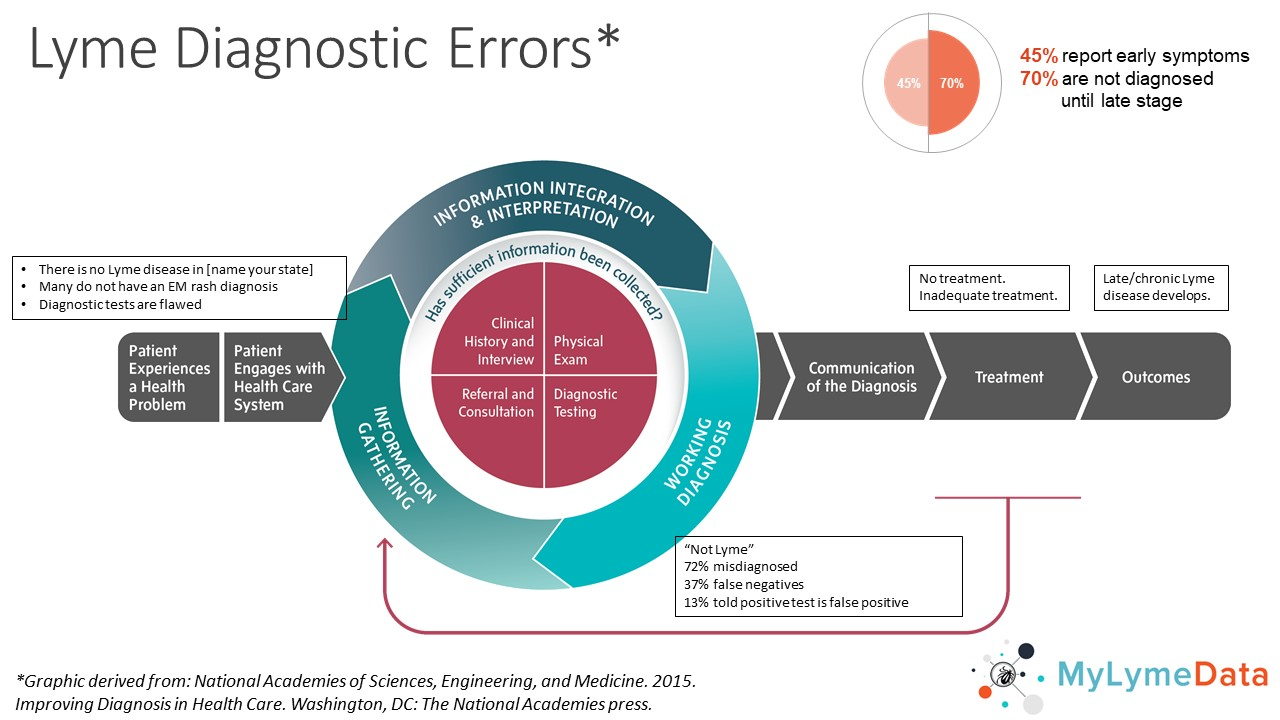
A large part of SIDM’s focus is on identifying and preventing diagnostic errors, using a diagram first developed by the Institute of Medicine (now the National Academy of Medicine) in its highly acclaimed report “Improving Diagnosis in Care.”

This report identifies different points along the path to diagnosis where things can go wrong and diagnosis can be delayed or missed.

We have modified the graphic from the report that illustrate points of diagnostic error to reflect the diagnostic issues we encounter in Lyme disease.

Lyme Diagnostic Errors

Click here to learn more about the Society to Improve Diagnosis in Medicine.

____________________

**Comment**

Lots of great info here.

This presentation was whittled down to just Lyme or Borrelia; however, most of us out here have a plethora of infections, which research hasn’t touched with a ten-foot pole.  In fact, it’s only been recently even mentioned:  https://madisonarealymesupportgroup.com/2018/10/30/study-shows-lyme-msids-patients-infected-with-many-pathogens-and-explains-why-we-are-so-sick/

For the first time, Garg et al. show a 85% probability for multiple infections including not only tick-borne pathogens but also opportunistic microbes such as EBV and other viruses.  83% of all commercial tests focus only on Lyme (borrelia), despite the fact we are infected with more than one microbe. The review also states it takes 11 different visits to 11 different doctors, utilizing 11 different tests to be properly diagnosed. https://www.news-medical.net/news/20181101/Tick-borne-disease-is-multiple-microbial-in-nature.aspx?  Presence of long-term IgM and IgG antibodies have been reported in LD patients that were tested by the CDC two-tier system. In 2001, Kalish and colleagues reported anti-Borrelia IgM or IgG persistence in patients that suffered from LD 10–20 years ago63. Similarly, Hilton and co-workers recorded persistent anti-Borrelia IgM response in 97% of late LD patients that were considered cured following an antibiotic treatment64.

The study not only broaches the polymicrobial issue, but the persistence issue of borrelia, which also hasn’t been dealt with properly.

Since testing misses half of all Lyme cases, and they aren’t even considering other pathogens, and the persistence factor, we are in a horrible mess.

They state that only 10-20% of patients are “chronically/persistently” infected.  I believe these percentages to be far too low.  This group is all I deal with.  This issue also desperately needs to be studied.


http://www.greenmedinfo.com/blog/medical-cannabis-superior-opioids-chronic-pain-study-finds?

Medical Cannabis Superior To Opioids for Chronic Pain, Study Finds

“© [Nov 4, 2018] GreenMedInfo LLC. This work is reproduced and distributed with the permission of GreenMedInfo LLC. Want to learn more from GreenMedInfo? Sign up for the newsletter here http://www.greenmedinfo.com/greenmed/newsletter.”

Sufferers of chronic pain have been faced with a perilous decision—risk a crippling addiction to opioids or find a way to live with the pain. A new clinical study has focused on medical cannabis as an alternative to opioids, and the results may be a turning point towards a safe, plant-based option for easing pain

A new study published in the European Journal of Internal Medicine represents hope for millions of sufferers of chronic pain. Researchers at the Cannabis Clinical Research Institute at Soroka University Medical Center, and Ben-Gurion University of the Negev (BGU), found that medical cannabis can significantly reduce chronic pain without adverse effects, particularly among adults aged 65 and older. Use of cannabis, aka medical marijuana, was found to be both safe and effective for elderly patients experiencing pain because of another medical condition, such as cancer, multiple sclerosis, Parkinson’s disease, Crohn’s disease, ulcerative colitis, and post-traumatic stress disorder.

One of the head researchers in this study, Prof. Victor Novack, M.D., is a professor of medicine in the BGU Faculty of Health Sciences (FOHS), as well as BGU’s Chair in Internal Medicine. He also heads the Soroka Cannabis Clinical Research Institute. According to Prof. Novack, M.D.:

“Older patients represent a large and growing population of medical cannabis users, [yet] few studies have addressed how it affects this particular group, which also suffers from dementia, frequent falls, mobility problems, and hearing and visual impairments.”[1]

The study surveyed 2,736 patients aged 65 years and older, at the inception of medical cannabis treatment, and throughout the 33-month study period. Surveys indicated the most common reasons for using cannabis were pain (66.6%) and cancer (60.8%). Methods of ingestion included cannabis-infused oils and smoking or vaporizing the herb. After six months of cannabis therapy, researchers provided a follow-up questionnaire which sought to determine any changes to pain intensity and quality of life, as well as any adverse events that were experienced. 901 of the original respondents replied.

After 6-months of medical marijuana treatment (all statistics are +/-):

  • 94% reported an improved overall condition, and a 50% reduction in pain
  • 60% reported improved quality of life, from “bad” or “very bad” to “good” or “very good”
  • 70% reported moderate to significant improvement in their condition
  • 20% of respondents stopped using opioids or reduced their dose

Notably, the most common side effects reported were mild: dizziness (9.7%) and dry mouth (7.1%), a far cry from the high-percentage of opioid-related deaths that are linked to chronic pain.[2] BGU researchers believe that utilizing cannabis may decrease the use of other prescription medications, including opioids, and encourage further research into this plant-based alternative, especially as it relates to an aging population.

Chronic pain is a problem that affects an estimated 100 million Americans.[3] It is also one of the most significant public health problems in the United States, with an estimated cost to society of $560-$635 billion annually, an amount equal to about $2,000 for every person living in the U.S.[4] Meanwhile, the nation’s growing opioid epidemic sees 1 of every 550 chronic opioid users dying within three years of their first opioid prescription.[5] While natural alternatives to deadly opiates are rarely offered by medical doctors, medical marijuana may be the drug that bridges this senseless gap. Research is beginning to mount that shows more promise than the medical establishment can long ignore.

Neuropathy is a type of chronic pain that presents as tingling and numbness in the hands and feet, often due to nerve damage from complications of cancer or diabetes, among other causes. A 2017 meta-analysis of prior studies on neuropathy found that cannabis, particularly selected isolates called cannabinoids, can provide analgesic benefit in patients with chronic neuropathy. Cannabis can also be used as an adjunct to other pain therapies, potentially lowering the amount of dangerous synthetic medication that is required to relieve pain. A recent study on the Opioid-Sparing Effect of Cannabinoids found that when cannabinoids were administered with opioids, specifically morphine, nearly four times less morphine was needed to achieve the same analgesic effect. This presents further evidence for cannabis as a means of reducing cases of opiate dependency and death.

While the politics of cannabis are exceedingly complex, the truth of this miraculous plant is becoming increasingly obvious: it heals the human body. The fact that it does so without the need for a black-box warning of Serious Adverse Events ensures that cannabis is the future of medicine. While clinical studies in the United States have been impeded due to cannabis’s classification as a Schedule One Controlled Substance (meaning the substance has no medicinal value), other countries have taken the lead. A UK study seeking to reduce chronic pain in advanced cancer patients not fully relieved from use of opioids, found that a cannabis extract composed of THC (Tetrahydrocannabinol) and CBD (Cannabidiol), two of the active constituents in cannabis, reduced pain by more than 30% from baseline when compared with placebo, with no serious adverse effects.

Beyond the realm of chronic pain, cannabis has been shown to positively support individuals dealing with post-traumatic stress. It has demonstrated effectiveness at calming the often-debilitating side effects of inflammatory bowel disease, aka Crohn’s disease. Isolates from the cannabis plant have shown promise at treating “incurable” diseases such as Grave’s disease and brain cancer, and work better than traditional medications for Alzheimer’s disease. With so much evidence of profound medicinal value, legislation based on old systems of control will not long hold back the tide. There are simply too many health benefits to be obtained from the cannabis plant.

For additiona research on the medical benefits of cannabis, visit the GreenMedInfo database on the subject.


Resources

[1] https://www.sciencedaily.com/releases/2018/02/180213111508.htm

[2] Service Use Preceding Opioid-Related Fatality. Olfson, Wall, Wang, Crystal, Blanco. Am J Psychiatry. 2017 Nov 28:appiajp201717070808. doi: 10.1176/appi.ajp.2017.17070808.

[3] Institute of Medicine Report from the Committee on Advancing Pain Research, Care, and Education: Relieving Pain in America, A Blueprint for Transforming Prevention, Care, Education and Research. The National Academies Press, 2011. http://books.nap.edu/openbook.php?record_id=13172&page=1.

[4] IOM (Institute of Medicine) 2011. Relieving Pain in America: A Blueprint for Transforming Prevention, Care, Education and Research, Washington, DC; The National Academies Press.

[5] Gabapentin, opioids, and the risk of opioid-related death: A population-based nested case-control study. Gomes, Juurlink, Antoniou, Mamdani, Paterson, van den Brink. PLoS Med. 2017 Oct 3;14(10):e1002396. doi: 10.1371/journal.pmed.1002396. eCollection 2017 Oct.


https://www.ncbi.nlm.nih.gov/m/pubmed/30389325/

Acrodermatitis chronica atrophicans in children: Report on two cases and review of the literature.

Maraspin V, et al. Ticks Tick Borne Dis. 2019.

Abstract

Acrodermatitis chronica atrophicans is a late manifestation of European Lyme borreliosis and is characterized by high levels of borrelial IgG antibodies, slowly expanding skin redness usually beginning on distal parts of extremities, and corresponding histologic findings. It very rarely develops in children. The main prerequisite for the diagnosis is clinical suspicion. In the present article we report on two children with acrodermatitis chronica atrophicans and on the findings of a PubMed literature search on acrodermatitis chronica atrophicans in childhood, published in the past three decades.

_________________

**Comment**

Acrodermatitis chronica atrophicans (ACA) is a fancy way of saying long-term persistence of Borrelia infection in the skin.  

Not a lot is known about this condition but what is known is that lack of adequate or appropriate treatment of early Lyme leads to the condition.  Borrelia’s ability to change antigens thereby messing up the immune response doesn’t help matters either.

As to the “3 stages of Lyme,” folks can jump from stage to stage with no particular rhyme or reason:  https://globallymealliance.org/about-lyme/diagnosis/stages/

One little girl within 4-6 hours after tick bite couldn’t walk or talk:  https://madisonarealymesupportgroup.com/2016/12/07/igenex-presentation/

Please see https://emedicine.medscape.com/article/1051695-overview for a slide-show of pictures.  Swelling and a bluish red coloring of the skin are fairly classic symptoms along with numbness, burning, tingling, muscle weakness, and Babinski sign (a reflex movement of the big toe upward instead of downward when the plantar aspect of the foot is stroked, a manoeuvre used to test injury to, or diseases of, the upper motor neurons).

The Medscape article also points out that other genospecies of borrelia have been known to cause ACA. They also point out ACA is often under diagnosed.

Please read this before taking the author’s advice about treatment length:  https://madisonarealymesupportgroup.com/2016/02/13/lyme-disease-treatment/.  Then don’t forget the possible involvement of coinfections:  https://madisonarealymesupportgroup.com/2018/10/30/study-shows-lyme-msids-patients-infected-with-many-pathogens-and-explains-why-we-are-so-sick/  For the first time, Garg et al. show a 85% probability for multiple infections including not only tick-borne pathogens but also opportunistic microbes such as EBV and other viruses.

I’m glad articles like these are coming out.  In order for researchers and mainstream medicine to believe something it has to be published.  But just because something hasn’t been published doesn’t mean it doesn’t exist.  

https://www.change.org/p/the-us-senate-calling-for-a-congressional-investigation-of-the-cdc-idsa-and-aldf/u/23622076?

Dr. Paul Mead, Acting Branch Chief

Carl Tuttle
Hudson, NH, United States

NOV 16, 2018 —
Today’s letter to Dr. Paul Mead of the CDC with Cc: to the TBD Working Group.
—— Original Message ———-
From: Carl Tuttle <runagain@comcast.net>
To: pfm0@cdc.gov, tickbornedisease@hhs.gov
Date: November 16, 2018 at 11:00 AM
Subject: Re: Direct Diagnostic Tests for Lyme Disease Published: 11 October 2018
Nov 16, 2018

Division of Vector-Borne Diseases
Centers for Disease Control and Prevention
3156 Rampart Rd
Fort Collins, Colorado CO 80521
Attn: Paul Mead, MD, MPH Acting Branch Chief
pfm0@cdc.gov

Dear Dr. Mead,
You recently coauthored the following paper in Clinical Infectious Diseases:
Direct Diagnostic Tests for Lyme Disease
Clinical Infectious Diseases, ciy614, https://doi.org/10.1093/cid/ciy614
Published: 11 October 2018

Excerpt:

“… serologic tests cannot distinguish active infection, past infection, or reinfection. Reliable direct-detection methods for active B. burgdorferi infection have been lacking in the past but are needed and appear achievable.”

You are aware that Dr. Neil Spector’s serologic tests were repeatedly negative missing his Lyme disease which led to the destruction of his heart requiring a transplant.[i] And I’m sure you have seen the lawsuit in the Supreme Court of Pennsylvania regarding a misdiagnosis of Multiple Sclerosis due to four negative serology results for Lyme disease. [ii]

These are just two examples of how faulty/misleading antibody tests can alter a person’s life; proof that we are dealing with a very serious life-altering/life-threatening infection here when left untreated.

I want to point out that Post Treatment Lyme Disease Syndrome (PTLDS) and untreated Lyme disease of months, years or decades are two entirely separate disease states with the latter being entirely ignored for over three decades. (Wormser’s racketeering scheme to downplay the severity of Lyme disease)

Could you please answer the following six questions?

  1. What is the CDC’s plan to fast track direct detection laboratory methods for the early detection of Lyme disease i.e.; DNA/Sanger Sequencing, NIST which has been “shown to detect the disease near the time of infection” but has been put on the shelf or PHELIX Phage based PCR?
  2. Just two days ago the CDC announced a “record number” of tickborne diseases:
    Record Number of Tickborne Diseases Reported in U.S. in 2017 November 14, 2018
    https://www.cdc.gov/media/releases/2018/s1114-record-number-tickborne-diseases.html   Excerpt:
    These 2017 data capture only a fraction of the number of people with tickborne illnesses. Under-reporting of all tickborne diseases is common, so the number of people actually infected is much higher. [End of excerpt]
    With over 300,000 new cases of Lyme disease per year, Lyme now has an infection rate six times the AIDS epidemic and twice as prevalent as breast cancer. At what point in time will the U.S. Centers for Disease Control escalate Lyme disease to Highest Alert? (With funding equivalent to the level of threat to public health)
  3. When will the CDC officially recognize chronic relapsing seronegative Lyme disease?
    Seronegative Chronic Relapsing Neuroborreliosis.
    https://www.ncbi.nlm.nih.gov/pubmed/7796837
    A PubMed search for persistent Borrilia infection will uncover hundreds of papers.
  4. When will the CDC disassociate themselves with the seven defendants in the RICO lawsuit who have had a thirty year bias against persistent infection? (No research funding to anyone with a bias against chronic Lyme disease)
  5. What is the plan to fast track research to determine how Lyme disables it victim so we know what we’re dealing with here and how to treat it? In other words, stop focusing on the acute stage of disease after early treatment as listed on page 133 in the Final EIS Assignments of 2017 https://www.cdc.gov/eis/downloads/position-description-book-2017.pdf
    Excerpt: “Analyze existing data from a prospective cohort of 1,000 Lyme disease patients to determine the frequency and identify risk factors for post-treatment Lyme disease syndrome (PTLDS).”
  6. When will the CDC publicly state that Lyme disease is capable of death and severe disability as reported by the patient community for the past three decades?

Dr. Mead, I would like to call attention to your perspective on plague published last year in the New England Journal of Medicine as one of your comments struck a chord with me:
Plague in Madagascar — A Tragic Opportunity for Improving Public Health
https://www.nejm.org/doi/10.1056/NEJMp1713881
Paul S. Mead, M.D., M.P.H.

Excerpt:

“Recent reports suggest that the outbreak is subsiding. This is encouraging news, but the epidemic will leave in its wake several important questions — first and foremost: How big was it really? Without diminishing the suffering of individual patients and their loved ones, it’s important to recognize that plague’s gruesome reputation can cloud short-term understanding of an outbreak.4” [End of excerpt]

How ironic is that statement!

“Without diminishing the suffering of individual patients and their loved ones”

Public outcry over the severity of Lyme has been ignored for decades by the CDC so this is a slap in the face to the horribly sick and disabled Lyme disease patient.

A response to these six questions is requested and please hit “Reply All” as I have carbon copied our legislators here in New Hampshire who have recognized Lyme disease as an “insidious disease.”

Sincerely,
-Carl Tuttle
Lyme endemic Hudson, NH
References:

[i] Neil Spector “Gone in a Heartbeat”
https://www.bayarealyme.org/blog/story/neil-spector/

[ii] [J-13-2018] IN THE SUPREME COURT OF PENNSYLVANIA MIDDLE DISTRICT http://www.pacourts.us/assets/opinions/Supreme/out/Majority%20Opinion%20%20ReversedVacatedRemanded%20%2010373940443079867.pdf?cb=1