60449793_638521926618213_7129666163994263552_n

Join the “Ask Dr. Rawls” Live Q&A Marathon!

As part of the month-long Live Learn Lyme campaign in honor of Lyme Awareness Month, Dr. Bill Rawls is donating 3 hours of his time to answer all your questions about Lyme disease during a LIVE Facebook and YouTube broadcast.

To join the conversation, simply follow us on our RawlsMD Facebook page or subscribe to the RawlsMD YouTube channel.

Then, tune in to our Facebook or YouTube page for the Live Video Stream on Wednesday, May 15th between 11am and 2pm EDT, and submit your questions in the livecast comments section. 

Don’t forget to either save this email or add the event to your calendar:


https://www.wdtv.com/content/news/Tick-population-soaring-as-local-vets-treat–509346101.html  News Video here

Tick population soaring as local vets see Lyme Disease cases in dogs quadruple

FAIRMONT, W.Va. (WDTV) — The CDC says there is an accelerating trend of tickborne diseases in the U.S. as we begin National Lyme Disease Awareness Month.

Scott Moore is a Veterinarian at the Fairmont Veterinary Hospital. He’s one of the hundreds of vets in West Virginia and the Northeast that are treating more and more dogs for Lyme Disease every year.

“In the last five years, we’ve seen a dramatic rise in Lyme Disease cases,” Moore said.

According to data from the nonprofit Pets and Parasites, about 1 out of every 20 dogs tested for the disease in West Virginia were positive in 2014. Last year, it was 1 of 10.

Medical professionals aren’t quite sure what is causing the increase, which is progressively worse further up the East Coast. But Moore is seeing some trends.

“We’re seeing a lot more ticks that carry the Lyme disease in our area opposed to the common wood tick,” Moore said.

The CDC also warns that the U.S. isn’t fully prepared to control the threat of increasing tick populations.

“Local and state health departments and vector control organizations face increasing demands to respond to ticks and tickborne diseases,” a 2018 CDC report said. “Proven and publicly accepted methods are needed to better prevent tick bites and to control ticks and tickborne diseases.”

Lyme Disease isn’t contagious. But it can be deadly if not treated early.

“Sometimes the dogs won’t be able to move well. In some cases, it can progress to kidney failure,” Moore said. “When Lyme Disease hits the kidney, it’s almost 100 percent fatal.”

He recommends getting good flea and tick prevention for dogs or investing in a flea and tick collar.

The CDC suggests checking yourself for ticks and showering within two hours of coming inside including from your own backyard.

“We need to be careful,” Moore said. “Check yourself, check your dogs, use the preventions that are available. Lyme vaccines are available and good flea and tick preventions are available.”

https://capcvet.org/articles/despite-the-availability-of-preventative-measures-the-risk-of-vector-borne-disease-remains-high./
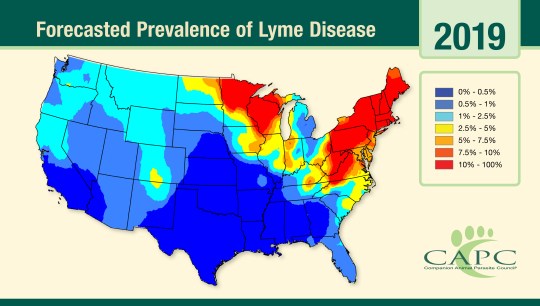
20190402-CAPC-Forecast-Maps-Display-Lyme.jpg

The tick vector of Borrelia burgdorferi, an agent of Lyme disease in dogs, is expanding its range from the northeastern and mid-Atlantic states, the upper Midwestern states, and throughout Canada. These ticks are bringing their associated pathogens along for the ride. These include Anaplasma phagocytophilum, Babesia spp., Borrelia miyamotoi, Ehrlichia muris eauclarensis, and possibly Bartonella spp. among others.

  • The seroprevalence of B. burgdorferi is predicted to be higher in three areas this year. Most notably throughout the Appalachian region. Veterinarians in eastern Pennsylvania, West Virginia, western Virginia and North Carolina, and eastern Ohio and Kentucky should reinforce their recommendations on the use of tick preventatives and may consider vaccination for high-risk patients.
  • Second, a hotspot of higher than average seroprevalence is expected to be seen in northwestern Minnesota.
  • Third, although small, areas in Indiana are expected to see higher than average seroprevalence. This is not a historically endemic state, so veterinarians should educate themselves and their clients about the risks of tick-borne disease.
  • The Atlantic coast, New England states, central Wisconsin, and southeastern Minnesota are all expected to see lower than average seroprevalence in 2019.

Preventing exposure to ticks is the best way to prevent infection with tick-borne pathogens. The areas highlighted above expected to see lower than average seroprevalence are endemic for Borrelia burgdorferi and risk for exposure is high!

Ehrlichiosis and Anaplasmosis

View the Ehrlichia spp. and Anaplasma spp. forecast and learn more about the CAPC guidelines for prevention and treatment of ehrlichiosis and anaplasmosis.

2019 Anaplasma spp. forecast

2019 Ehrlichia spp. forecast

Year-round protection, annual testing

The best way to protect your patients is to advise owners of the importance of year-round prevention, even during the winter months. You can use the CAPC Parasite Prevalence Maps to support your recommendation by underscoring the risks in your area and in regions of the country your clients may travel with their pets. It is also critical to emphasize the importance of compliance and using products according to label. The use of CAPC Parasite Prevalence maps and Forecast maps are a validated tool for increasing client willingness to engage in parasite prevention. Sign up for local alerts today by visiting the CAPC Parasite Prevalence Maps and selecting “Get Updates”.

Veterinary professionals and pet owners who want to monitor the activity in their county throughout the year, can also access 30-Day Parasite Forecast Maps at www.petdiseasealerts.org. These maps, developed exclusively by CAPC, provide a local forecast for every county in the continental United States on a monthly basis.

The Science behind the Forecasts

Vector-borne disease is dynamic and ever changing, driven by multiple factors that affect the development of arthropod vectors and the pathogens they carry. Leading parasitologists work in collaboration with a team of statisticians to identify regions of the country that may experience higher parasite incidence in the months ahead. Numerous factors are analyzed, including the number of positive tests and the influence of weather patterns, vegetation indices, and human population density. Using this multi-disciplinary approach, we are leveraging everyone’s expertise to focus on a single common interest: forecasting the risk of exposure to vector-borne pathogens. While these forecasts predict the potential risk of a dog testing positive, they do not necessarily reflect the occurrence of clinical disease.

To learn more about the science behind the maps, full access to our manuscripts describing the methodology and fidelity of our forecasts can be found here.

We are committed to publishing our scientific studies in open-access journals so they are freely available to researchers, veterinarians, and the general public. For those interested in learning more about the science of these forecasts or to see additional graphics, we encourage you to view them here:

Heartworm:

Bowman DD, Liu Y, McMahan CS, Nordone SK, Yabsley MJ, Lund RB. Forecasting United States heartworm Dirofilaria immitisprevalence in dogs. Parasit Vectors. 2016 Oct 10;9(1):540. https://parasitesandvectors.biomedcentral.com/articles/10.1186/s13071-016-1804-y

Wang D, Bowman DD, Brown HE, Harrington LC, Kaufman PE, McKay T, Nelson CT, Sharp JL, Lund R. Factors influencing U.S. canine heartworm (Dirofilaria immitis) prevalence. Parasit Vectors. 2014 Jun 6;7:264 https://parasitesandvectors.biomedcentral.com/articles/10.1186/1756-3305-7-264

Brown HE, Harrington LC, Kaufman PE, McKay T, Bowman DD, Nelson CT, Wang D, Lund R. Key factors influencing canine heartworm, Dirofilaria immitis, in the United States. Parasit Vectors. 2012 Oct 30;5:245. https://parasitesandvectors.biomedcentral.com/articles/10.1186/1756-3305-5-245

Tick-borne pathogens:

Stich RW, Blagburn BL, Bowman DD, Carpenter C, Cortinas MR, Ewing SA, Foley D, Foley JE, Gaff H, Hickling GJ, Lash RR, Little SE, Lund C, Lund R, Mather TN, Needham GR, Nicholson WL, Sharp J, Varela-Stokes A, Wang D. Quantitative factors proposed to influence the prevalence of canine tick-borne disease agents in the United States. Parasit Vectors. 2014 Sep 4;7:417. https://parasitesandvectors.biomedcentral.com/articles/10.1186/1756-3305-7-417

Watson SC, Liu Y, Lund RB, Gettings JR, Nordone SK, McMahan CS, Yabsley MJ. A Bayesian spatio-temporal model for forecasting the prevalence of antibodies to Borrelia burgdorferi, causative agent of Lyme disease, in domestic dogs within the contiguous United States. PLoS One. 2017 May 4;12(5):e0174428. https://journals.plos.org/plosone/article?id=10.1371/journal.pone.0174428

Liu Y, Lund RB, Nordone SK, Yabsley MJ, McMahan CS. A Bayesian spatio-temporal model for forecasting the prevalence of antibodies to Ehrlichiaspecies in domestic dogs within the contiguous United States. Parasit Vectors. 2017 Mar 9;10(1):138. https://parasitesandvectors.biomedcentral.com/articles/10.1186/s13071-017-2068-x

McMahan CS, Wang D, Beall MJ, Bowman DD, Little SE, Pithua PO, Sharp JL, Stich RW, Yabsley MJ, Lund RB. Factors associated with Anaplasmaspp. seroprevalence among dogs in the United States. Parasit Vectors. 2016 Mar 22;9:169. https://parasitesandvectors.biomedcentral.com/articles/10.1186/s13071-016-1431-7

Liu Y, Watson SC, Gettings JR, Lund RB, Nordone SK, Yabsley MJ, McMahan CS. A Bayesian spatio-temporal model for forecasting Anaplasmaspecies seroprevalence in domestic dogs within the contiguous United States. PLoS One. 2017 Jul 24;12(7):e0182028. https://journals.plos.org/plosone/article?id=10.1371/journal.pone.0182028

________________________

**Comment**

We shall see if Wisconsin truly has lower seroprevalence.  I’m not buying it.


https://www.change.org/p/the-us-senate-calling-for-a-congressional-investigation-of-the-cdc-idsa-and-aldf/u/24550940?

Lyme Advocates Rally in DC Over Government Mishandling of Lyme Disease

MAY 14, 2019 — 

FOR IMMEDIATE RELEASE

Contact: Mirenda Campirano
Phone: 956-778-1130
Email: thelymearmy@gmail.com

WASHINGTON, D.C. (May 13, 2019) — Lyme Disease patients with their families and friends from across the United States and Canada are converging on Capitol Hill in to convince elected officials to hold a formal investigation into the government’s mishandling of tick-borne diseases.

The group is gathering outside the Hart Senate Office Building on Friday, May 17, 2019. Three independent Lyme disease groups are banding together to lead the call.

Representatives of The Lyme Army centered in Texas, The Lyme Center of Martha’s Vineyard in Massachusetts and The Lyme Disease Foundation from Connecticut have scheduled appointments with elected officials to demand a comprehensive congressional investigation into the mishandling of this insidious disease by Health and Human Services and their divisions of the Centers for Disease Control (CDC), as well as the National Institutes of Health.

​The day will culminate at Union Square with a candlelight vigil at 6 p.m. to commemorate those who have lost their lives to this horrific disease. A list of names of those who have died of and with tick-borne diseases will be read. A march to Health and Human Services (HHS) will follow.

​Award-winning film producer, director, and cinematographer Andy Abrahams Wilson and another documentary crew will be there to film the day’s events.

Lyme and tick-borne diseases are not recognized by the CDC or the mainstream medical community because most Lyme patients do not meet the CDC’s current case definition, despite clinical symptoms and serologic evidence.

“Fraudulent testing criteria and an inordinately narrow case definition both promulgated by the CDC and Infectious Disease Society of America (IDSA), have led to the denial of this debilitating, incurable disease; thus, patients are left with little to no access to health care, inaccurate test results, no valid treatments, no insurance coverage, no disability insurance, and little funding for proper research,” said Mirenda Campirano, a registered nurse and advocate for those who suffer from Lyme. “We are passing these infectious diseases to our children. I know, because I gave it, along with several other tick-borne infections, to my son in utero.”

With the CDC now reporting 390,000 cases of Lyme annually, the implications of this statistic are devastating.  In addition to the revised testing standards that are too narrowly defined, many Lyme strains do not test positive on the traditional ELISA or Western blot tests. This leaves millions of people infected with Lyme disease excluded.

Lyme and tick-borne diseases are not recognized as a legitimate disease and there is insufficient funding for proper research – research to elaborate more accurate criteria for laboratory testing as well as research to determine how best to treat this devastating illness.

The decision to delegitimize Lyme and tick-borne diseases have left patients’ lives in ruins as they lose their ability to work, their homes and their savings, become isolated from their family and friends, and ignored or by the mainstream medical community. Moreover, although the CDC is a United States based organization, its reach is global. Many countries that lack the resources the United States enjoys in the field of disease control look to the US for guidance. The CDC, HHS and IDSA are supposed to be the United States’ health protection agencies. They are supposed to save lives and protect people from health threats. Part of the CDC’s mission is to provide consultation and assistance to other nations to help assist in approving their disease prevention and control. Sadly, in the case of Lyme and tick-borne diseases, these agencies are withholding the truth of Lyme disease and failing citizens of the United States as well as the world at large.

ABOUT THE GROUPS:

The Lyme Army, led by Mirenda Campirano, RN BSN, is a grass roots activist group made up of individuals from across the globe fighting for truth and justice so that Lyme Disease patients can get the help they rightfully deserve. Her son contracted Lyme in utero, while she was infected. Campirano is actively working with Texas legislators to help provide pass legislation that will provide patients and doctors with more accurate Lyme testing and insurance coverage. She is also the founder of the Lyme Disease/Tick Borne Illness Group of the Rio Grande Valley, TX.

The Lyme Disease Foundation, Inc. is the first Lyme disease nonprofit in the world. It was co-founded in 1988, by a healthcare lawyer Karen Vanderhoof-Forschner, JD, LLM, BS, MBA, CPCU, CLU and a team of Lyme researchers and business people, to find the scientific truth about Lyme disease, in the hopes of saving her dying son’s life. Her son Jamie was born in 1985 and at birth had contracted Lyme in utero. He was multihandicapped from the disease. He died in 1991 during a relapse when his brain crushed itself. On autopsy the doctors found the Lyme bacterium in his optic nerve. More IV therapy was not better treatment because he died while infected. Jamie was unique because he had damage to the back of his eyes that proved he had damage from a congenital spirochetal infection.

Dr. Enid Haller is the Executive Director of The Lyme Center of Martha’s Vineyard, a free walk-in information service for Lyme and tick-borne diseases. Both Vanderhoof-Forschner and Haller are former member of the Tick-Borne Disease Working Group Subcommittee for Access to Care Services and Support to Patients. These three organizations called on their members and supporters to be present in the nation’s capital on May 17, 2019 to their members and supporters to be present in the nation’s capital on May 17, 2019 to walk the halls of Congress to demand a congressional investigation of the mishandling of Lyme and tick-borne diseases.

Visit The Lyme Army Facebook page, the Lyme Disease Foundation Facebook page, or The Lyme Center at Martha’s Vineyard.

______________________

**Comment**

While I won’t be there, I’m with you in Spirit!

https://folks.pillpack.com/how-my-daughters-taught-me-to-open-up-about-my-mental-health/

How My Daughters Taught Me To Open Up About My Mental Health

It took my daughter’s own battle with depression to recognize that for years, I’d been ashamed of my own mental health.

This post is part of a collaboration with Inspire, a healthcare social network with more than one million patients and caregivers.


While walking out from a recent screening of a documentary about teenagers living with anxiety, I realized something.

I turned to my youngest daughter.

“I have lived with anxiety as long as I can remember,” I told her.

“I know,” she replied, and smiled kindly at me.

I never told anyone before about the paralyzing anxiety I experienced starting in 7th grade. I would blush till I felt my head would explode my pulse would pump in my throat like a hammer. I feared to be called on. One bully would taunt me, “Why does this happen to you?” My only exit then was going to the bathroom and hide.

“I have lived with anxiety as long as I can remember,” I told her.

Despite my intermittent anxiety, though, I built a great life. I married an amazing man, and together, we had two of the most caring, wonderful girls I’ve ever known.

But then seven years ago, when she was nine, my oldest was admitted to an inpatient psychiatric hospital and diagnosed with severe depression. My world stopped. Standing in an elevator with other parents leaving that hospital unit, I realized I was just inducted into the club of parents with children who live with a mental illness.

Yet even as we helped our oldest through her own treatment journey, it wasn’t until I had that post-movie exchange about anxiety that I realized that my daughter’s mental health issues were closely linked to my own.

I realized then that the stigma I felt about my own anxiety issues had prevented me from talking to my own children about them. I was a nurse, a mother, and a person living with anxiety, but I had never told them that mental health issues were was normal to struggle with. In fact, my husband and I both come from families with long lineages of mental illness, but it was never discussed… and so, in turn, we had not talked about it with our daughters.

I was a nurse, a mother, and a person living with anxiety, but I had never told them that mental health issues were was normal to struggle with.

When my daughter was diagnosed with depression seven years ago, my instinct when family members had told me to hide the truth was to fight as a family in the open. I wasn’t going to make my daughter think I was ashamed of her.

But now, as I considered the rhetorical mirror my youngest daughter had had held up to me, I realized I needed to do more than just advocate for their mental health. I needed to live openly with my own anxiety issues as well. We pass so many things on in our genes to our children. I did not want to pass shame on to them by example.

So now, I’m trying to live life the way I want my daughters to live it: by accepting my own mental health challenges, and listening to them when they arise. So I try to sleep more, eat healthier, and unplug when I feel overwhelmed. And when I feel the old me, the anxious me, rising up? I take her to the yoga room at my gym, and give her a hug. Because she is me, and I need to accept and love myself if my daughters are going to do so as well.

We pass so many things on in our genes to our children. I did not want to pass shame on to them by example.

Anxiety is part of who I am: not knowing and not understanding what was happening to me was like walking with a small rock in my shoe and not able to take it out .Its extremely uncomfortable but you keep walking.

My daughters are now thriving teenagers. Both have mental health issues, but they are under control, because we helped them find the right tools early on. If only I had done the same for myself, but it’s never too late to stop ignoring your issues and practice some self-compassion.

It’s easy to say, “Remember to do some self-care.” It’s harder to implement. The notion to always care for your children before yourself is something that I have always done. It’s hard to reprioritize, but by relearning to care for my own mental health, I now think I’m in a better place to be the mother my two strong, brave daughters truly deserve. A mother who embraces not just their mental health, but her own.

_____________________

**Comment**

Lyme/MSIDS can cause all manner of mental issues.  Please share this information with others because you can feel so completely isolated.  There were many, many days throughout treatment where I seriously wondered if I was losing my mind.  Normal.  Very normal when treating this beast.  Forgive yourself and treat the sickie kindly.

I highly recommend becoming a part of a support group so you can quickly learn you aren’t alone.  There are many out here in Lyme-land who also feel isolated and question their sanity.  When you have doctor after doctor telling you that “it’s all in your head,” you begin to believe them.  They are, after all, “experts,” right?

Wrong.
They are human beings afraid of losing their livelihoods, who are often uneducated about this beast.

At this point, my best advice is skip mainstream medicine.  It WILL NOT help you.  It will only take your money, abuse you, and cause you infinite grief.

Get to a trained ILADS doctor.  If you don’t know where to find these folks, contact your local Lyme support group.  They are boots on the ground folks who are up on this information.

For more:  https://madisonarealymesupportgroup.com/2015/10/18/psychiatric-lymemsids/

https://madisonarealymesupportgroup.com/2019/03/24/cat-scratch-disease-caused-teens-schizophrenia-like-symptoms-report-says/

https://madisonarealymesupportgroup.com/2019/04/07/missing-links-connect-the-dots-between-lyme-mental-health/

https://madisonarealymesupportgroup.com/2019/04/11/lyme-disease-neurological-changes-in-children/

https://madisonarealymesupportgroup.com/2019/03/26/lyme-its-known-involvement-in-mental-health/

https://madisonarealymesupportgroup.com/2019/02/16/lyme-is-all-in-your-head-a-wake-up-call-to-mental-health-professionals/

https://madisonarealymesupportgroup.com/2017/06/20/suicide-lyme-and-associated-diseases/