Archive for the ‘Uncategorized’ Category

Systemic Review of Cerebrovascular Manifestations of LD

http://journal.frontiersin.org/article/10.3389/fneur.2017.00146/full

Frontiers in Neurology,  20 April 2017

Cerebrovascular Manifestations of Lyme Neuroborreliosis—A Systematic Review of Published Cases

imageAdam Garkowski1*, imageJoanna Zajkowska2, imageAgata Zajkowska3, imageAlina Kułakowska3,imageOlga Zajkowska4, imageBożena Kubas5, imageDorota Jurgilewicz5, imageMarcin Hładuński5 andimageUrszula Łebkowska1
  • 1Department of Radiology, Medical University of Białystok, Białystok, Poland
  • 2Department of Infectious Diseases and Neuroinfections, Medical University of Białystok, Białystok, Poland
  • 3Department of Neurology, Medical University of Białystok, Białystok, Poland
  • 4Faculty of Applied Informatics and Mathematics, Warsaw University of Life Sciences SGGW, Warsaw, Poland
  • 5Independent Department, Laboratory of Molecular Imaging, Medical University of Białystok, Białystok, Poland

Background: Lyme neuroborreliosis (LNB) is a disease caused by spirochete Borrelia burgdorferi, involving the nervous system. It usually manifests as lymphocytic meningoradiculitis, but in rare cases, it can also lead to cerebrovascular complications. We aimed to perform a systematic review of all reported cases of LNB complicated by central nervous system vasculitis and stroke or transient ischemic attack (TIA).

Materials and methods: We conducted a systematic review of literature between May 1987 and December 2016 with patients who presented with cerebrovascular course of LNB.

Results: This study included 88 patients with a median age of 46 years. The median interval from onset of symptoms suggesting Lyme disease to first symptoms of cerebrovascular manifestations of LNB was 3.5 months. The most common cerebrovascular manifestation of LNB was ischemic stroke (76.1%), followed by TIA –transient ischemic attack (11.4%). The posterior circulation was affected alone in 37.8% of patients, the anterior circulation in 24.4% of patients, and in 37.8% of cases, posterior and anterior circulations were affected simultaneously. The most common affected vessels were middle cerebral artery—in 19 cases, basilar artery—in 17 cases, and anterior cerebral artery—in 16 cases. A good response to antibiotic treatment was achieved in the vast number of patients (75.3%). The overall mortality rate was 4.7%.

Conclusion: Cerebral vasculitis and stroke due to LNB should be considered, especially in patients who live in or have come from areas with high prevalence of tick-borne diseases, as well as in those without cardiovascular risk factors, but with stroke-like symptoms of unknown cause.

Supplementary Material
The Supplementary Material for this article can be found online at http://journal.frontiersin.org/article/10.3389/fneur.2017.00146/full#supplementary-material.  **This data shows year of publication, signs and symptoms, CSF protein level, Radiological/histopathological features, treatment, and outcome (complete or incomplete).  (Treatments included:  penicillin, steroids, ceftriaxone, doxycycline, amoxicillin, azithromycin, probenecid, cyclophosphamide, cefotaxime, and ampicillin) 

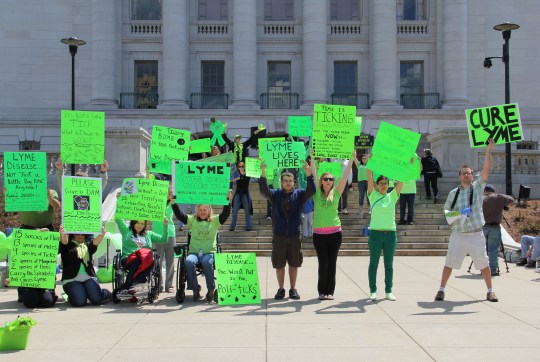
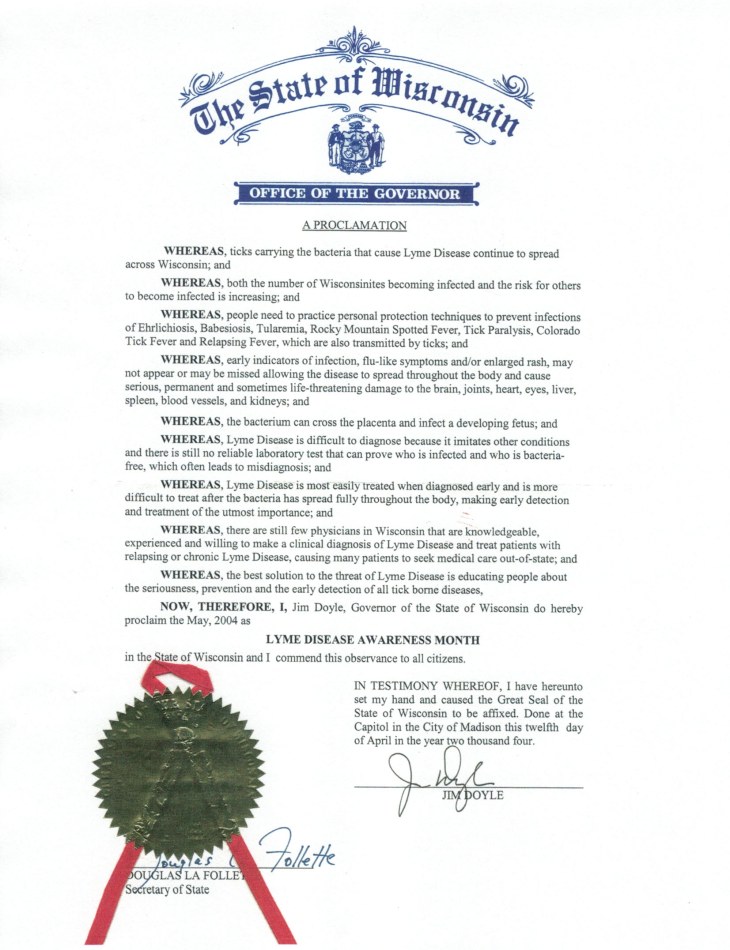
May is Lyme Awareness Month in Wisconsin since 2004

In Wisconsin the Legislature passes the proclamation every year at the state level.  Hopefully the 2017 Assembly Joint Resolution 41 will pass tomorrow.  I will post it as soon as it does.  But here is the 2004 proclamation:


LYME Certificate

What the Media Don’t Tell You About Lyme Disease (But Should)

http://www.huffingtonpost.com/entry/5900678fe4b06feec8ac91f3  by David Michael Conner 4/26/17

Great article.   Please go to link as there are graphics you’ll want to see.

Thank you David for speaking out for those who can’t.


Klinghardt Workshop in May

http://files.constantcontact.com/5a4b6d10101/e160daa9-7ff7-45e8-80c9-840460224315.pdf

Klinghardt Lyme Solutions

Lyme Disease-Mold Illness-Autism-Parasites-Healthy Home – Self Help Strategies for Brain Health -Heavy Metal Detox

Dietrich Klinghardt MD PhD

May 5-7, 2017
Bastyr University, Kenmore WA

  • Friday Evening Patient Assessment Demonstrations
  • Autonomic Response Testing Protocols Pre-seminar Workshop
  • Detox Strategies and Demos – Healing with Light & Infrared – Hidden Infections
  • Many Unique Exhibitors with Self Help Tools
  • Guest Lecturers

Magda Havas PHD

How Electrosmog Affects the Lyme Patients

Dr. Amy Derksen

Immune Dysregulation and Inflammatory Response Helpers “How to Avert A crisis”

Dr. Paul Anderson


Cancer and Lyme Therapy

Dr. Karima Hirani

LDI Therapy

Autonomic Response Testing Pre-Seminar

Andreanna Rainville RN, LMP

Klinghardt Academy Brain Solutions Conference

Registration: info@klinghardtacademy.com 908-899-1650

Date and Times: May 5-7, 2017

Friday 9am – 12

Friday 1 – 5:30 pm Friday 5:30-6:30 Friday 7 -9 pm Sat 9-6pm

Sun 9-1 pm

Pre-Seminar Workshop: Autonomic Response Protocols

Lyme Seminar with Dr. Klinghardt and guests
Dinner Buffet at Bastyr University ( included )
Evening Assessment Demonstrations by Dr. KLinghardt Lyme Seminar Lecturers and Dr. Klinghardt

Dr. Klinghardt

Pricing: $795.00 full conference including all evening lectures $150.00 for ART pre-seminar

$50.00 for Fri. evening Lyme lecture only
DVD Pre Order for attendee price: $350.00 non-attendees $550.00

Venue:
Bastyr University 14500 Juanita Dr. NE Kenmore, WA 98028 908-647-9224

Overnight Accommodations
On Bastyr Campus 5th Floor Guest rooms: $37.50 per night

Contact Bastyr Conference Services 425-602-3075 · confer@bastyr.edu
Marriott Courtyard – Kirkland Room Block Rate: $129.00 per night Thurs-Sunday

Address: 11215 NE 124th St, Kirkland, WA 98034 Phone: (425) 602-3200

Hilton Garden Inn – Bothel

Address: 22600 Bothell Everett Hwy, Bothell, WA 98021 Phone: (425) 486-0400

Transportation From Airport: Uber, Taxi or recommended to Rent a Car
(40 min ride from Seattle Int Airport to Bastyr University)

Registration: info@klinghardtacademy.com 908-899-1650

Announcing TRED – “Tick Research to Eliminate Diseases: Scientist Coalition”

April 11, 2017 Announcement – For Distribution

Announcing the formation of a consortium of scientists titled, “Tick Research to Eliminate Diseases: Scientist Coalition (TRED).” TRED is a group of scientists, who joined together for synergy in promoting the need to address the ticks, the primary vector, as an answer to the environmental piece of this puzzle of Lyme and Tick-Borne Diseases.

TRED GOALS

1. Educate policy makers about the seriousness of tick-borne disease, and demonstrate the necessity and efficiency of addressing this serious problem at the source, the ticks.

2. Increase tick-borne disease research funding which specifically addresses the reduction of the tick population and/or blocking the ability of ticks to transmit all TBDs at federal, state and county levels.

3. Develop, test and implement research technologies to reduce incidence of tick-borne disease by reducing the risk of exposure to ticks and pathogens.

4. Coordinated implementation of these TBD prevention measures by federal, state, local governments and the public.

5. Representation by a Scientist in the field of Tick Research to the Federal Workgroup as described in Section 2062 of the 21st Century Cures Act.

Tick Research to Eliminate Diseases: Scientist Coalition (TRED) Membership List

Apperson, Charles S., PhD
Dept. of Entomology and Plant Pathology
N. C. State University

Barbour, Alan G., MD
Author: Lyme Disease: Why It’s Spreading, How It Makes You Sick, and What to Do about It
Professor of Medicine, Microbiology & Molecular Genetics, and Ecology & Evolutionary Biology
University of California Irvine

Barthold, Stephen W., DVM, PhD
Distinguished Professor, Emeritus
Department of Pathology, Microbiology and Immunology
School of Veterinary Medicine
University of California at Davis

Benach, Jorge, PhD
Distinguished Toll Professor of Molecular Genetics & Microbiology and Pathology
Department of Molecular Genetics and Microbiology
Stony Brook University

Breitschwerdt, Ed DVM, DACVIM
Professor, Internal Medicine
Adjunct Professor of Medicine, Duke University Medical Center
North Carolina State University
Lab: Vector Borne Disease Diagnostics
Director, NCSU Biosafety Level III Laboratory
PI for the Intracellular Pathogens Research Laboratory, Center for Comparative Medicine
https://cvm.ncsu.edu/directory/breitschwerdt-ed/
http://www.cancer.duke.edu/comparativeoncology/people/ed-breitschwerdt

Kevin M. Esvelt, Ph.D.
Leader, Sculpting Evolution Group
Assistant Professor, MIT Media Lab
Massachusetts Institute of Technology
www.sculptingevolution.org

Fallon, Brian A., M.D.
Professor of Clinical Psychiatry
Columbia University College of Physicians and Surgeons
Director of the Lyme and Tick-borne Diseases Research Center
Columbia University Medical Center

Sarah A. Hamer, MS PhD DVM Dipl ACVPM
Assistant Professor
Associate Wildlife Biologist®
Department of Veterinary Integrative Biosciences and
Interdisciplinary Program in Ecology and Evolutionary Biology
Texas A&M University
http://vetmed.tamu.edu/vibs/directorydetail?userid=11671
http://vetmed.tamu.edu/faculty/hamer-lab

Hodzic, Emir DVM, MSci, PhD
Real-time PCR Research and Diagnostics Core Facility
School of Veterinary Medicine
Department of Medicine and Epidemiology
University of California, Davis

HU, Linden, MD
Professor of Molecular Biology & Microbiology
Tufts University
Sackler School of Graduate Biomedical Sciences
http://sackler.tufts.edu/Faculty-and-Research/Faculty-Profiles/Linden-Hu-Profile

Esteve-Gassent, Maria
Assistant Professor
Veterinary Pathobiology
College of Veterinary Medicine and Biomedical Sciences
Texas A&M University
https://vetmed.tamu.edu/labs/lyme-lab

Holly Gaff, PhD
Associate Professor
Graduate Program Director, PhD in Ecological Sciences
Department of Biological Sciences
Old Dominion University
http://www.odu.edu/~hgaff
Honorary Associate Professor
Mathematics, Statistics and Computer Science
University of KwaZulu-Natal
South Africa

Lane, Robert, PhD
Professor Emeritus of Medical Entomology
Department of Environmental Science,
Policy and Management
University of California, Berkeley, CA 94720

Luft, Ben, MD
Professor of Medicine
SUNY Stony Brook, NY

Maggi, Ricardo, PhD
Intracellualr Pathogens Research Lab,
College of Veterinary Medicine
Raleigh, NC 2760

Mather, Tom N., PhD
Professor & Director URI Center for Vector-Borne Disease
University of Rhode Island
http://www.tickencounter.org/
http://tickencounter.org/news/stuff_you_should_know_tick_image

Nieto, Nathan C, PhD
http://nau.edu/CEFNS/NatSci/Biology/Faculty-Staff/Faculty-Pages/Nathan-C-Nieto/
Assistant Professor of Microbiology
Northern Arizona University
Department of Biological Sciences
College of Engineering, Forestry, and Natural Sciences

Ostfeld, Richard S. PhD
Author: Lyme Disease: The Ecology of a Complex System, and Infectious Disease Ecology: Effects of Ecosystems on Disease and of Disease on Ecosystem
Disease Ecologist, PhD U of CA, Berkeley
Cary Institute Ecosystem Studies’
http://www.caryinstitute.org/science-program/our-scientists/dr-richard-s-ostfeld

Roe, R. Michael, PhD
William Neal Reynolds Distinguished Professor
Department of Entomology
North Carolina State University
http://www.nature.com/articles/ncomms10507

Sonenshine, Dan, PhD
Author: “The Biology of Ticks” Vol 1 & 2
Professor Emeritus at Old Dominion
Department of Biological Sciences
Old Dominion University
http://www.nature.com/articles/ncomms10507

Kirby C. Stafford III, Ph.D.
Chief Scientist, State Entomologist
Department of Entomology
Center for Vector Biology and Zoonotic Diseases
NE Regional Center for Excellence in Vector Borne Diseases
The Connecticut Agricultural Experiment Station
Website: www.ct.gov/caes

Telford, Sam, PhD
Professor, Vector-Borne Infections, Public Health
Department of Infectious Disease and Global Health
Tufts University
Cummings School of Veterinary Medicine at Tufts University
http://vetprofiles.tufts.edu/faculty/sam-r-telford-i

Thangamani,Saravanan, M.Sc., Ph.D
Associate Professor,
Director, Insectary Services Core, Galveston National Laboratory,
Director, ACL-3 Laboratory,
Member, Institute for Human Infections and Immunity,
Member, Center for Biodefense and Emerging Infectious Diseases,
Department of Pathology,
University of Texas Medical Branch (UTMB),
Web: https://www.utmb.edu/pathology/faculty/bios/thangamani.asp

Jean Tsao, PhD
Department of Fisheries & Wildlife
Michigan State University East Lansing, MI
https://www.researchgate.net/profile/Jean_Tsao2

Wikel, Stephen, PhD
Professor emeritus
Frank H Netter MD, School of Medicine
previous
Senior Associate Dean for Scholarship, Professor and Chairman, Department of Medical Sciences St. Vincent’s Medical Center Endowed Chair Frank H. Netter, M.D., School of Medicine at Quinnipiac University
and
Professor of Pathology, Center for Biodefense and Emerging Infectious Diseases
University of Texas Medical Branch
https://www.vectorbase.org/organisms/ixodes-scapularis/wikel
http://www.keystonesymposia.org/index.cfm?e=Web.Meeting.Flyer&MeetingID=1349
http://www.nature.com/articles/ncomms10507

Jill Auerbach
Tick Research to Eliminate Diseases: Scientist Coalition, Coordinator
NYS Senator Serino’s Advisiory Board on Lyme and TBD, Co-chair
Hudson Valley Lyme Disease Association, Chairperson
Dutchess County Legislative Tick Task Force, Member
Stop Ticks On People (S.T.O.P.), Board Member
NYS Coalition on Lyme and Tick-borne Disease, Member
Public Integrated Pest Management Work Group, Member