The great take-away from the following article is that if there is NO CODE, there is NO RECOGNITION OF DISEASE.
http://dermagicexpress.blogspot.com/2018/04/the-lyme-disease-dementia-code-icd-11.html By Dr. Jose Lapenta
THE LYME DISEASE AND THE DEMENTIA CODE ICD-11

Hello friends of the network, in this new edition of the DERMAGIC EXPRESS I will continue with the “saga” on the subject of LYME DISEASE, in this case THE ICD-11 DEMENTIA CODE, that I imagine you are wondering what it means, and now I will always explain it to you.
ICD stands for INTERNATIONAL CLASSIFICATION OF DISEASES which was implemented by the World Health Organization (WHO), and is used by this entity to classify diseases according to their signs, symptoms, abnormal findings, complaints, social circumstances and external causes of a certain disease. This system is published by WHO and is used worldwide for morbidity and mortality statistics.
The number that follows, in this case the No 11 means the year in which the revision is made, in this case ICD 11 codes, means INTERNATIONAL CLASSIFICATION OF DISEASES for the year 2108, that is to say the present year.
The ICD 10 was the previous one, made between 1983 and 1993 with updates and there we found the CODES OF LYME DISEASE REVISION YEAR 2016 by the WHO under the number A69.2, link: http://apps.who.int/classifications /icd10/browse/2016/en#/A69.2
Where few entities are recognized in relation to this disease, including:
- LYME DISEASE or ERYTYEMA MIGRANS: A69.2
- BASAL, CEREBRAL AND SPINAL MENINGITIS due to lyme disease: A69.2 and G01
- CHRONIC, ACUTE AND SUBACUTE ARTHRITIS: lyme disease: A69.2 and M01.2
- PERIPHERAL POLINEUROPATHY due to lyme disease: A69.2 and G63.0

This is the only thing found on that page of the ICD-10 year 2016. And below I will show you the update that took place on October 1 of the year 2017
LYME disease as I have said in many opportunities and with a “MOUNTAIN” of BIBLIOGRAPHICS REFERENCES and which published under the name of: UNDERSTANDING LYME DISEASE, CLASSIFICATION AND CODES, in the DERMAGIC EXPRESS web site, was also published in the online magazine INVESTIGATIVE DERMATOLOGY AND VENEREOLOGY RESEARCH on January 12, 2018, link: https://www.ommegaonline.org/article-details/UNDERSTANDING-THE-LYME-DISEASE-CLASSIFICATION-AND-CODES/1769
In this CLASSIFICATION AND CODES the majority of CONDITIONS, VARIANTS, and DIFFERENT CLINICAL MANIFESTATIONS of LYME DISEASE are mentioned, many of which HAVE NOT BEEN RECOGNIZED OR INCLUDED OR CODIFIED nowadays, and must be included by THE WORLD ORGANIZATION OF HEALTH(WHO) in the REVISION No 11, for this year 2018, for that reason as I mention it is called ICD-11, in a few words an update of the CODES, which will be applied GLOBALLY. I hope you have understood what I mean.
If there is no CODE (recognition) for the clinical entity, read DEMENTIA due to LYME disease, for example. There will be no recognition of it, it will not be taken into account within the possible causes of dementia, there will be no treatment guidelines available for this pathology GLOBALLY and cases will increase. Now do you get it?
Then you will be asking why I chose DEMENTIA as a clinical manifestation of the LATE OR TERTIARY STAGE OF LYME DISEASE, of which I bring you more EVIDENCE, that this is true.
To begin the subject, remember that the BORRELIA is a SPIROCHETE, like the SYPHILIS, which has the same STAGES in its CLINICAL manifestations: LATENT, CONGENITAL, PRIMARY, SECONDARY AND TERTIARY OR LATE.
THE SYPHILIS, produced by the causal agent TREPONEMA PALLIDUM (ESPIROCHETE), is an ancestral disease, whose descriptions date from the HOLY BIBLE, chapter of the GENESIS, discovered by Fritz Schaudin and Erlich Hoffmann in the year 1905, in the year 1910 the German German Paul Erlich discovered the Salvarsan an arsenic derivative as the first treatment for this disease and won the Nobel prize for It. In 1928 appeared the “immortal” PENICILIIN discovered by ALEXANDER FLEMING and put into practice in the 40’s against this plague. Today, other antibiotics are used, such as Doxycycline, Clindamycin, Tetracyclines, and Ceftriaxone.
The LYME DISEASE or ERYTHEMA MIGRANS is also probably of ancestral origin because in the HOLY BIBLE also in the book EXODUS, the TICKS are mentioned as plague, which in the case of this disease is the transmitting VECTOR. Also described since ancient times and known in the town of LYME, Connecticut as JUVENILE LYME ARTHRITIS, and first described in 1764 by the Reverend John Walker on the island of Jura (Island of deer). It was in the year 1981-1982 that the scientist Willy Burgdorfer discovers the causal agent, this being the FEARED ESPIROCHETE BORRELIA BURGDORFERI (in honor of its discoverer).
Why am I telling you this story? because between these two diseases there are GREAT SIMILARITIES, and some DIFFERENCES.
SIMILARITIES AND DIFFERENCES BETWEEN SYPHILIS AND LYME:
========================================================================
- Both causative agents are ESPIROCHETES: TREPONEMA PALLIDUM (SYPHILIS), BORRELIA BURGDORFERI (ERYTHEMA MIGRANS OR LYME DISEASE)
- Both have the same stages: CONGENITAL, LATENT, PRIMARY, SECONDARY, TERTIARY OR LATE. (NEUROSYPHILIS, NEUROBORRELIOSIS)
- SYPHILIS is transmitted by sexual contact, SEMINAL fluid and blood transfusions. LYME DISEASE IS ALSO ASSOCIATED WITH SEXUAL TRANSMISSION and FLUIDS in recent studies, a fact that some scientists deny but there is EVIDENT PROOF that this event is true.
- Both ESPIROCHETES have been detected by simple optical microscopy: SYPHILIS (dark field), BORRELIA BURGDORFERI (blue staining), and both have been found in skin lesions: SYPHILIS (SYPHILITIC CHANCRE), BORRELIA (LYMPHOCYTOMA by BORRELIA).
- The causal agent of SYPHILIS is only one: THE TREPONEMA PALLIDUM, in the case of LYME DISEASE there are more than 50 species described, and more than 25 species for RECURRENT FEVER by Borrelia, having been shown susceptibility to some antibiotics according to the GEOGRAPHICAL SPECIES AND DISTRIBUTION, which complicates further the treatment of the latter.
- Both diseases when administered an EFFECTIVE TREATMENT can present patients the reaction of JARISCH-HERXHEIMER, produced by the death of the ESPIROCHETES and the release into the bloodstream of their toxins, being the main symptoms: fever, chills, hypotension, headache, tachycardia, reddening of the skin, pruritus (itching) and muscle pain. It is usually not fatal and not all patients manifest it.
- Both diseases respond to the same antibiotics: in SYPHILIS, even after years, TREPONEMA PALLIDUM remains sensitive to BENZYLPENICILLIN. In the case of BORRELIA BURGDORFERI there is resistance to PENICILLIN and many of the antibiotics, perhaps most of the discoveries that can eliminate it. This is one of the points of conflict today with LYME DISEASE, resistance to antibiotic therapy even in the long term with subsequent multi organ involvement due to the survival of THE BORRELIA and its subsequent colonization of many organs inlcuded the BRAIN, and produce neurological manifestations, including DEMENTIA. The SYPHILIS can also reach the BRAIN in the late stage when it is not treated, producing DEMENTIA among its manifestations.
- Both SPIROCHETES: TREPONEMA PALLIDUM (SYPHILIS) and BORRELIA BURGDORFERI (LYME-ERYTHEMA MIGRANS DISEASE) have been detected in the CEREBROSPINAL FLUID and in the BRAIN.
- Both diseases are of WORLD DISTRIBUTION, the LYME disease that was believed to exist only in NORTH AMERICA, EUROPE, ASIA AND AFRICA, has also been described in THE SOUTHERN HEMISPHERE.
- Both diseases in their LATE STAGE: NEUROSYPHILIS AND NEUROBORRELIOSIS have produced brain illness: DEMENTIA and mimic ALZHEIMER DISEASE in other cases.
- Both ESPIROCHETES are detected by SEROLOGICAL TESTS, in the case of SYPHILIS, the known VDRL and FTA-ABS with more than 95% effectiveness, in the case of LYME, the situation is more difficult: the CDC (Center for Disease Control and Prevention) only two TESTs have been approved for this disease: IEA (enzyme immunoassay), but rarely IFA (indirect immunofluorescence), and if these are negative: WESTERN BLOT (IgG and IgM). The percentage of EFFECTIVENESS of these is highly questioned today because in many cases the result is NEGATIVE in both, and if the patient does not have money to perform a more effective PARTICULAR examination, he/she WILL NOT HAVE TREATMENT, the disease will progress over the years to multi organic condition included DEMENTIA.
Now I am going to place the manifestations of the LATE STAGE OF THE SYPHILIS, called NEUROSYPHILIS, so you can see that they are practically the same as the NEUROBORRELIOSIS:
These effects occur in a period ranging from 5 to 20 years after the patient has been infected, and they do not receive treatment.
In the case of LYME DISEASE, the period is the same, and two aspects are included: the ABSENCE of treatment, or INEFFECTIVE treatment even for years. Unlike SYPHILIS, borrelia becomes resistant for YEARS and then colonizes the brain, causing practically the same effects of NEUROSYPHILIS, nowadays called NEUROBORRELIOSIS, and within these is DEMENTIA.
SYMPTOMS OF LATE SYPHILIS OR NEUROSYPHILIS:
========================================================================
1.) Abnormal reflexes
2.) Muscle atrophy
3.) Muscle contractions
4.) Abnormal gait
5.) Blindness
6.) Confusion, disorientation
7.) Sudden personality changes
8.) Changes in mental stability
9.) Dementia
10.) Depression
11.) Headache
12.) Fecal and urinary incontinence
13.) Irritability
14.) Memory problems
15.) Mood disturbances
16.) Numbness in the toes, feet, or legs
17.) Muscle weakness
18.) Poor concentration
19.) Psychosis[5]
20.) Seizures
21.) Neck stiffness
22.)Tremors
23.) Visual disturbances: ARGYLL ROBERTON PUPILS
24.) ALZHEIMER DISEASE LIKE (MIMIC)
NEUROSYPHILIS can also be presented ASYMPOMATIC, MENINGOVASCULAR, GENERAL PARESIA OR TABES DORSALIS.
Except for a few, most of these manifestations of NEUROSYPHILIS, also produced by NEUROBORRELIOSIS.
To not make it so long the ICD (INTERNATIONAL CLASSIFICATION OF DISEASES) was born in the years 1890 with the purpose of grouping and classifying the causes of death by the different diseases in the world. Later in 1983, the French doctor Jacques Bertillon, introduced the Classification of Causes of Death of Bertillon in a congress of the International Statistical Institute in Chicago.
In 1900 the first international conference was held to review the International Classification of Causes of Death, with reviews that take place every ten years. By then, the classification included an alphabetical index and a tabular list.
In 1948 the World Health Organization assumed the revisions and the ICD term was adopted officially when the first sixth (6) revisions had been made, and I propose the revision seventh ICD-7 that was carried out in Paris in February of 1955, where the SYPHLIS APPEARS IN THE LIST UNDER THE FOLLOWING CODES: (NEUROSYPHILIS DOES NOT APPEAR OR DEMENTIA BY SYPHILIS, Appear the term “Insane”)
========================================================================
ICD-7 PARIS FEBRUARY 1955 CODES FOR THE SYPHILIS
========================================================================
(020-029) Syphilis and its sequelae
020 Congenital syphilis
021 Early syphilis
022 Aneurysm of aorta
023 Other cardiovascular syphilis
024 Tabes dorsalis
025 General paralysis of insane
026 Other syphilis of central nervous system
027 Other forms of late syphilis
028 Latent syphilis
029 Syphilis, unqualified
====================================================================
10 years later the World Health Organization met in Geneva in July 1965 for the eighth ICD-8 revision of the classification and codes. APPEARS THE SYPHILIS, AND THE AFFECTION OF THE CENTRAL NERVOUS SYSTEM, BUT NOT THE CODE DEMENTIA BY SYPHILIS, neither the JUVENILE ARTHRITIS OF LYME, nor the CODE LYME, because said disease as such, its causal agent as I said a thousand times was discovered in 1981 by Willy Burgdorfer, and Lyme Juvenile Arthritis was first described in 1975.
========================================================================
ICD-8 WORLD HEALTH ORGANIZATION in Geneva, July 6 to 12, 1965 ========================================================================
(090-099) Syphilis and other venereal diseases
090 Congenital syphilis
091 Early syphilis, symptomatic
092 Early syphilis, latent
093 Cardiovascular syphilis
094 Syphilis of central nervous system
095 Other forms of late syphilis, with symptoms
096 Late syphilis, latent
097 Other syphilis and not specified
==================================================================
The ninth revision of the ICD-9 CODES was made 10 years later in Geneva from September 30 to October 5, year 1975, and for the first time the term LYME appears under the code 088.81 WITH THE NAME OF LYME DISEASE OR ERYTHEMA CHRONICUM MIGRANS.
The JUVENILE PARALYTIC DEMENTIA CODE and NEUROSYPHILIS appears for the first time in the list due to SYPHILIS under code 0.90.40
==================================================================
ICD-9 YEAR 1975 GENEVA SEPTEMBER 30 TO OCTOBER 5 1975 LYME AND SYPHILIS CODES
==================================================================
088.81 Lyme disease
Erythema chronicum migrans
==================================================================
090.40 Juvenile neurosyphilis, unspecified
Congenital neurosyphilis
Juvenile paralytic dementia
Youth:
general paresis
tabes
taboparesis
094.8 Other specified neurosyphilis
=====================================================================
The World Health Organization did not wait 10 years for the next revision and in 1983 began the tenth revision ICD-10, and took more time to complete it: year 1989-1993 with periodic updates between which highlight years 2010 and 2016 and 2017, Planning the 11th ICD-11 revision for the current year 2018. In this list, DEMENTIA BY SYPHILIS APPEARS with code A52.1+ for PARALYTIC DEMENTIA and A50.4 for JUVENILE PARALYTIC DEMENTIA due to SYPHILIS and all the clinical manifestations reported for this disease appear in the list.
The opposite occurred with the LYME DISEASE, which was already codified in the ICD-9 and that for 1993 and beyond 2016 almost ALL of its CLINICAL manifestations were already DESCRIBED as it is published in THE LYME CODES mentioned above. For the Update of 2016 and 2017 ICD- CODES the term LYME appears in the list in this way:
==================================================================
ICD-10 years 1983-1993 WITH UPDATES 2010-2016 for LYME DISEASE
==================================================================
Lyme disease or erythema migrans: A69.2
Basal, cerebral ans spinal meninitis due to lyme disease: A69.2 and G01
Chronic, acute and subacute arthritis: lyme disease: A69.2 and M01.2
Peripheral Polineuropathy due to lyme disease: A69.2 and G63.0
==================================================================
ICD-10 OCTOBER 1, YEAR 2017 LYME DISEASE CODES UPDATE
==================================================================
Source: http://www.icd10data.com/search?s=lyme
Lyme disease: Code A69.2
Relapsing fevers: Code A68
Lyme disease (A69.2-); recurrent fever
Arthritis due to Lyme disease: Code A69.23
– Lyme arthritis
Meningitis due to Lyme disease: Code A69.21
– Meningitis in lyme disease
Other conditions associated with Lyme disease: Code A69.29:
– Lyme myopericarditis; Myopericarditis due to lyme disease; Myopericarditis due to Lyme disease
Other neurologic disorders in Lyme disease: Code A69.22:
– Cranial neuritis due to lyme disease; Lyme cranial neuritis; Lyme meningoencephalitis; Lyme polyneuropathy; Meningoencephalitis due to lyme disease; Polyneuropathy due to lyme disease; Cranial neuritis; Meningoencephalitis; Polyneuropathy
Lyme disease, unspecified: Code A69.20:
– Acute lyme disease; Erythema chronica migrans; Erythema chronicum migrans (skin condition); Lyme disease.
Arthropathy in Lyme disease: Code A69.23
Immunity to lyme disease by positive serology; Immunity to lyme disease, positive serology: Code: R76.8
History of lyme disease: Code Z86.19
==================================================================
As you may notice some of the “many of the clinical manifestations” recognized and published by the scientific society worldwide were INCLUDED in the ICD-10 and its updates, but also many others have not been included, among them the DEMENTIA by LYME DISEASE, SEXUAL TRANSMISSION, and CONGENITAL LYME (TRANSLPLACENTAL TRANSMISSION) taking into account that for the 80’s, 90’s and 2,000’s, there was already scientific evidence of these facts including the BRAIN affectation with neurological manifestations (DEMENTIA) and illness similar to ALZHEIMER’S.
It is for this year 2018 when the World Health Organization (WHO) publishes a “Beta Draft” where the DEMENTIA TERMS due to LYME DISEASE and NEUROBORRELIOSIS, CONGENITAL LYME BORRELIOSIS, LYME CARDITIS and others are finally included. (See photo) link: https://icd.who.int/dev11/f/en#http%3a%2f%2fid.who.int%2ficd%2fentity%2f218492135
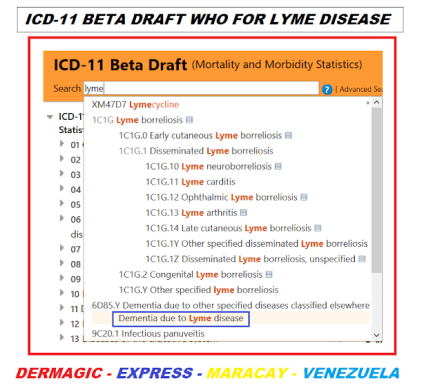
The growing worldwide increase in cases of LYME DISEASE, and its clinical manifestations that have led patients to even “wheelchairs” has awakened in society a “fight” for the TOTAL CLASSIFICATION AND CODES of this disease that will be included in this year’s list.
The simple question here is the following: why is SYPHILIS and its DEMENTIA CODE and the entire spectrum of the disease included in the list but LYME DISEASE does not? For the year 2017 when I repeat there is a “MOUNTAIN like the EVEREST” of scientific publications worldwide, on DEMENTIA, SEXUAL TRANSMISSION, CONGENITAL LYME, AND ASSOCIATION WITH ALZHEIMER’S DISEASE, AND OTHERS MORE ??? And nowadays, the year 2018 is when these CODES come to appear in a “beta draft”?
Almost more than 20 years have passed since these affectations were described scientifically due to LYME: CARDITIS, NEUROBORRELIOSIS, DEMENTIA, CONGENITAL DISEASE, TRANSPLACENTAL and SEXUAL TRANSMISSION and many more.
According to some experts in the field do not want to recognize these CODES because the treatments are long-term and INSURANCE COMPANIES do not want to know anything about this, because the costs of treatment would increase their expenses, so that the word “LYME” has been become a kind of generalized fear, there are even cases of persecuted doctors and removed their licenses for this cause.
Other scientists affirm: SYPHILIS with 3 doses of BENZYLPENICILIN or known antibiotics for 21-28 days heal the patient, and a simple VDRL or FTA-ABS (serological tests) make the diagnosis. In the case of LYME, the situation is more complicated due to RESISTANCE to antibiotics and the ability of BORRELIA to evade DIAGNOSTIC tests. But the CDC says that the two tests I mentioned are enough. Nothing could be more wrong!
Do you want my opinion? As always I will give it to you: Regardless of the causes, the fights between IDSA and ILADS, and CDC, The World Health Organization (WHO) MUST END AND THEY MUST RECOGNIZE THESE CODES, because they can no longer “cover the sun with a finger” – the evidence is too big.
CONCLUSIONS:
=============
“Beta draft” means NOT APPROVED by the WHO, I repeat NOT STILL APPROVED !
The term DEMENTIA by Lyme finally appeared in the “beta draft” of the ICD-11
The term CONGENITA LYME finally appeared in the “beta draft” of the ICD-11
The term NEUROBORRELIOSIS finally appeared in the “beta draft” of the ICD-11
The term SEXUAL TRANSMISSION due to Lyme does not exist in the previous ICDs or in the “beta draft” of the ICD-11
There I leave you more BIBLIOGRAPHIC REFERENCES that prove SCIENTIFICALLY that the BORRELIA BURGDORFERI ESPIROCHETE (LYME) as well as the ESPIROCHETE TREPONEMA PALLIDUM (SIFILIS), can colonize the BRAIN in its LATE STAGE and produce DEMENTIA in those affected and that must be included in the ICD -11 of the year 2.018, as well as many others.We can not wish for more, let this be true and fullfilled.
I am in the SOUTHERN HEMISPHERE, but I am part of the Ad Hoc committee of the ICD-11 as an expert reviewer. End of story.
Greetings to all
Dr. José Lapenta Dermatologist
Dr. José Lapenta Md. (Coworker)
==================================================================
BIBLIOGRAPHICAL REFERENCES
==================================================================
1.) Meningovascular form of neuroborreliosis: similarities between neuropathological findings in a case of Lyme disease and those occurring in tertiary neurosyphilis. Acta Neuropathol. 1990;80(5):568-72. [PUBMED]. Miklossy J1, Kuntzer T, Bogousslavsky J, Regli F, Janzer RC.
2.) Chronic or late lyme neuroborreliosis: analysis of evidence compared to chronic or late neurosyphilis. Open Neurol J. 2012;6:146-57. doi: 10.2174/1874205X01206010146. Epub 2012 Dec 28. [PUBMED]. Miklossy J1.
3.) [Autopsy case of meningovascular neurosyphilis associated with Fischer’s plaques].Brain Nerve. 2007 Jul;59(7):797-803. [Article in Japanese] [PUBMED] Obi K1, Tsuchiya K, Anno M, Ohta S, Nakamura R, Akiyama H.
4.) Biology and neuropathology of dementia in syphilis and Lyme disease. Handb Clin Neurol. 2008;89:825-44. doi: 10.1016/S0072-9752(07)01272-9. [PUBMED] Miklossy J1.
5.) [Neuroborreliosis with extensive cerebral vasculitis and multiple cerebral infarcts]. Nervenarzt. 1999 Feb;70(2):167-71. [PUBMED] [Article in German.] Schmitt AB1, Küker W, Nacimiento W.
6.) Lyme neuroborreliosis and dementia. J Alzheimers Dis. 2014;41(4):1087-93. doi: 10.3233/JAD-130446. [PUBMED]. Blanc F1, Philippi N1, Cretin B1, Kleitz C2, Berly L2, Jung B1, Kremer S3, Namer IJ4, Sellal F5, Jaulhac B6, de Seze J7.
7.) Rapidly progressive frontal-type dementia associated with Lyme disease.J Neuropsychiatry Clin Neurosci. 1995 Summer;7(3):345-7. [PUBMED]. Waniek C1, Prohovnik I, Kaufman MA, Dwork AJ.
8.) Psychiatric manifestations of Lyme borreliosis. J Clin Psychiatry. 1993 Jul;54(7):263-8. [PUBMED].Fallon BA1, Nields JA, Parsons B, Liebowitz MR, Klein DF.
9.) [Mental disorders in the course of lyme borreliosis and tick borne encephalitis].
[Article in Polish] Przegl Epidemiol. 2002;56 Suppl 1:37-50. [PUBMED]. Juchnowicz D1, Rudnik I, Czernikiewicz A, Zajkowska J, Pancewicz SA.
10.) [Polymorphic mental disorders in the course of Lyme borreliosis–case study].
[Article in Polish] Psychiatr Pol. 2009 May-Jun;43(3):353-61 [PUBMED]. Helon B1, Tłuczek TW, Buczyjan A, Adamczyk-Helon A, Wojnarowicz M, Mikuła R, Ciciński P, Bojarska J.
11.) [Mental disorders in Lyme disease]. Pol Merkur Lekarski. 2001 Nov;11(65):460-2.
[Article in Polish] [PUBMED]. Rudnik-Szałaj I1, Popławska R, Zajkowska J, Szulc A, Pancewicz SA, Gudel I.
12.) [Lyme borreliosis in neurology and psychiatry]. Fortschr Med. 1990 Apr 10;108(10):191-3, 197. [Article in German] [PUBMED]. Kohler J1.
13.) Lyme neuroborreliosis. Ann Neurol. 1995 Jun;37(6):691-702. Ann Neurol. 1995 Jun;37(6):691-702. [PUBMED]. Garcia-Monco JC1, Benach JL.
14.) [Clinical manifestations of neuroborreliosis in the Volga region]. Ter Arkh. 2010;82(11):68-70. [Article in Russian] [PUBMED]. Nafeev AA, Klimova LV.
15.) Avellis syndrome due to borreliosis. Eur J Neurol. 2007 Jan;14(1):112-4. [PUBMED].Habek M1, Mubrin Z, Brinar VV.
16.) Neuroborreliosis-associated cerebral vasculitis: long-term outcome and health-related quality of life. J Neurol. 2013 Jun;260(6):1569-75. doi: 10.1007/s00415-013-6831-4. Epub 2013 Jan 18. [PUBMED]. Back T1, Grünig S, Winter Y, Bodechtel U, Guthke K, Khati D, von Kummer R.
17.) Lyme-associated parkinsonism: a neuropathologic case study and review of the literature. Arch Pathol Lab Med. 2003;127(9):1204-6. [PubMed] Cassarino DS, Quezado MM, Ghatak NR, Duray PH.
18.) Historic evidence to support a causal relationship between spirochetal infections and Alzheimer’s disease. Front Aging Neurosci. 2015 Apr 16;7:46. doi: 10.3389/fnagi.2015.00046. eCollection 2015. [PUBMED]. Miklossy J1.
19.) Alzheimer’s disease – a neurospirochetosis. Analysis of the evidence following Koch’s and Hill’s criteria. J Neuroinflammation. 2011 Aug 4;8:90. doi: 10.1186/1742-2094-8-90. [PUBMED]Miklossy J1.
20.) Dementia associated with infectious diseases. Int Psychogeriatr. 2005;17 Suppl 1:S65-77.
[PUBMED]. Almeida OP1, Lautenschlager NT.
21.) Borrelia in the brains of patients dying with dementia. JAMA. 1986 Oct 24-31;256(16):2195-6. [PUBMED]. MacDonald AB.
22.) Beta-amyloid deposition and Alzheimer’s type changes induced by Borrelia spirochetes. Neurobiol Aging. 2006 Feb;27(2):228-36. [PUBMED] Miklossy J1, Kis A, Radenovic A, Miller L, Forro L, Martins R, Reiss K, Darbinian N, Darekar P, Mihaly L, Khalili K.
23.) Unraveling Diagnostic Uncertainty Surrounding Lyme Disease in Children with Neuropsychiatric Illness. Child Adolesc Psychiatr Clin N Am. 2018 Jan;27(1):27-36. doi: 10.1016/j.chc.2017.08.010. Epub 2017 Oct 21. [PUBMED] . Koster MP1, Garro A2.
24.) Lyme disease and pediatric autoimmune neuropsychiatric disorders associated with streptococcal infections (PANDAS): an overview. 2012;5:163-74. doi: 10.2147/IJGM.S24212. Epub 2012 Feb 22. [PUBMED] . Rhee H1, Cameron DJ.
25.) Paediatric autoimmune neuropsychiatric disorders associated with streptococcal infection (PANDAS). Int J Neuropsychopharmacol. 2001 Jun;4(2):191-8. [PUBMED]. Leonard HL1, Swedo SE.
26.) Post-Lyme syndrome and chronic fatigue syndrome. Neuropsychiatric similarities and differences. Arch Neurol. 1997 Nov;54(11):1372-6. [PUBMED]. Gaudino EA1, Coyle PK, Krupp LB.
27.) Psychological states and neuropsychological performances in chronic Lyme disease. Appl Neuropsychol. 1999;6(1):19-26. [PUBMED]. Elkins LE1, Pollina DA, Scheffer SR, Krupp LB.
28.) Lyme disease in a patient with chronic lymphocytic leukemia mimics leukemic meningeosis. Onkologie. 2007 Nov;30(11):564-6. Epub 2007 Oct 16. [PUBMED]. Schweighofer CD1, Fätkenheuer G, Staib P, Hallek M, Reiser M.
29.) Dramatic response to a 3-week course of ceftriaxone in late neuroborreliosis mimicking atypical dementia and normal pressure hydrocephalus. J Neurol Sci. 2016 Jul 15;366:146-148. doi: 10.1016/j.jns.2016.05.002. Epub 2016 May 4. [PUBMED]. Topakian R1, Artemian H2, Metschitzer B3, Lugmayr H4, Kühr T5, Pischinger B6.
30.) Transient worsening of optic neuropathy as a sequela of the Jarisch-Herxheimer reaction in the treatment of Lyme disease. J Neuroophthalmol. 1994 Jun;14(2):77-80. [PUBMED] Strominger MB1, Slamovits TL, Herskovitz S, Lipton RB.
31.) Delayed onset of the Jarisch-Herxheimer reaction in doxycycline-treated disease: a case report and review of its histopathology and implications for pathogenesis. Am J Dermatopathol. 2015 Jun;37(6):e68-74. doi: 10.1097/DAD.0000000000000093. [PUBMED] Kadam P1, Gregory NA, Zelger B, Carlson JA.
32.) Lyme disease complicated by the Jarisch-Herxheimer reaction. J Emerg Med. 1998 May-Jun;16(3):437-8.[PUBMED] Maloy AL1, Black RD, Segurola RJ Jr.
33.) Serological Evidence of Borrelia Burgdorferi Infection in Mexican Patients with Facial Palsy. Rev Invest Clin. 2017 Nov-Dec;69(6):344-348. doi: 10.24875/RIC.17002344. [PUBMED] Gordillo-Pérez G1, García-Juárez I1, Solórzano-Santos F2, Corrales-Zúñiga L3, Muñoz-Hernández O2, Torres-López J1.
34.) A simple method for the detection of live Borrelia spirochaetes in human blood using classical microscopy techniques. Morten Motzfeldt Laane, Ivar Mysterud. Published 2013. Semantic Sholar. Source: https://www.semanticscholar.org/paper/A-simple-method-for-the-detection-of-live-Borrelia-Laane-Mysterud/4f6251e40f196b094905d84e87b8b6fe8d1d1636
35.) Lyme disease: cause of a treatable peripheral neuropathy. Neurology. 1987;37(11):1700-6. [PubMed] Halperin JJ, Little BW, Coyle PK, Dattwyler RJ.
36.) Retrobulbar optic neuritis: a complication of Lyme disease? J Neurol Neurosurg Psychiatry. 2007;78(12): 1409–1410. doi: 10.1136/jnnp.2006.113761. [PubMed Central] Krim E, Guehl D, Burbaud P, and LaguenyA.
37.) Unusual manifestations of nervous system Borrelia burgdorferi infection. Arch Neurol. 1987;44(7):781-3. [PubMed] Midgard R, Hofstad H.
38.) Optic neuropathy in children with Lyme disease. Pediatrics. 200;108(2):477-81. [PubMed] Rothermel H, Hedges TR 3rd, Steere AC.
39.) Optic nerve involvement in Lyme disease. Curr Opin Ophthalmol. 2012;23(6):485-90. doi:10.1097/ICU.0b013e328358b1eb. (Pubmed) Träisk F, Lindquist L.
40.) Lyme disease –induced polyradiculopathy mimicking amyotrophic lateral sclerosis. Inter J of Neuroscience. 2014;124(11):859–862. doi:10.3109/00207454.2013.879582. [PubMed] Burakgazi AZ.
41.) Late Diagnosis of Early Disseminated Lyme Disease: Perplexing Symptoms in a Gardener, J Am Board Fam Med May-June 2008 vol. 21 no. 3 234-236 [PubMed] doi: 10.3122/jabfm.2008.03.070196 Brooke E. Salzman, MD, Amber Stonehouse, MD and James Studdiford, MD
42.) Borrelia arthritis and chronic myositis accompanied by typical chronic dermatitis. JBR-BTR. 2008;91(3):88-9. [PubMed] Brtkova J, Jirickova P, Kapla J, Dedic K, Pliskova L.
43.) Tick inoculation in an eyelid region: report on five cases with one complication of the orbital myositis associated with Lyme borreliosis. Klin Oczna. 2006;108(4-6):220-4. [PubMed] Holak H, Holak N, Huzarska M, Holak S.
44.) [Ocular manifestations of Lyme borreliosis in northwest Croatia]. Lijec Vjesn. 2004;126(5-6):124-8. [Article in Croatian] [PubMed] Golubic D, Vinkovic T, Turk D, Hranilovic J, Slugan I.
45.) Ocular Lyme borreliosis. Am J Ophthalmol. 1989;15;108(6):651-7. [PubMed] Winward KE, Smith JL, Culbertson WW, Paris-Hamelin A.
46.) Early disseminated Lyme disease: Lyme meningitis. Am J Med. 1995 Apr 24;98(4A):30S-37S; discussion 37S-43S. [PubMed] Pachner AR.
47.) Neurologic manifestations in children with Lyme disease. Pediatrics. 1995;96:1053-1056. [PubMed] Bingham PM, Galetta SL, Athreya B, Sladky J.
48.) Lyme disease: cause of a treatable peripheral neuropathy. Neurology. 1987;37(11):1700-6. [PubMed] Halperin JJ, Little BW, Coyle PK, Dattwyler RJ.
49.) Neuroborreliosis-associated cerebral vasculitis: long-term outcome and health-related quality of life. J Neurol. 2013 Jun;260(6):1569-75. doi: 10.1007/s00415-013-6831-4. [PubMed] Back T1, Grünig S, Winter Y, Bodechtel U, Guthke K, Khati D, von Kummer R.
50.) Cerebral vasculitis as the only manifestation of Borrelia burgdorferi infection in a 17-year-old patient with basal ganglia infarction. Eur Neurol. 2003;50:109–12. [PubMed] Heinrich A, Khaw AV, Ahrens N, Kirsch M, Dressel A.
51.) Borrelia rhombencephalomyelopathy. Arch Neurol. 1991;48:832–6. [PubMed] Kuntzer T, Bogousslavsky J, Miklossy J, Steck AJ, Janzer R, Regli F.
52.) Large cerebral vessel occlusive disease in Lyme neuroborreliosis. Neuropediatrics. 2002;33:37–40. [PubMed] Klingebiel R, Benndorf G, Schmitt M, von Moers A, Lehmann R.
53.) Systemic, secondary and infectious causes for cerebral vasculitis: clinical experience with 16 new European cases. Rheumatology International. 2009;30(11):1471-1476. doi:10.1007/s00296-009-1172-4. [PubMed] Kraemer M, Berlit P.
54.) Basal meningovasculitis and occlusion of the basilar artery in two cases of Borrelia burgdorferi infection. Neurology. 1988;38:1317–9. [PubMed] Veenendaal-Hilbers JA, Perquin WV, Hoogland PH, Doornbos L.
55.) Lyme-associated parkinsonism: a neuropathologic case study and review of the literature. Arch Pathol Lab Med. 2003;127(9):1204-6. [PubMed] Cassarino DS, Quezado MM, Ghatak NR, Duray PH.
56.) Genetics Underlying Atypical Parkinsonism and Related Neurodegenerative Disorders. Jellinger KA, ed. International Journal of Molecular Sciences. 2015;16(10):24629-24655. doi:10.3390/ijms161024629 [PubMed] Scholz SW, Bras J.
57.) Neuroborreliosis Presenting as Acute Disseminated Encephalomyelitis. Pediatric Emergency Care. 2012;28(12):1374-1376. doi:10.1097/pec.0b013e318276c51d. [PubMed] Rocha R, Lisboa L, Neves J, García López M, Santos E, Ribeiro A.
58.) [Chronic neuroborreliosis with gait ataxia and cognitive disorders]. [in German]. Praxis (Bern 1994). 1997;86(20):867-9. [PubMed] Pennekamp A, Jaques M.
59.) Central nervous system manifestations of Lyme disease. Arch Neurol. 1989;46:790–5. [PubMed] Pachner AR, Duray P, Steere AC.
60.) [Meningoencephalomyelitis caused by Borrelia burgdorferi: a case without epidemiologic history or chronic migratory erythema]. [in Spanish]. Med Clin (Barc). 1989;93:218–20. [PubMed] Ponz E, Graus F, Alvarez R, Sarmiento X, Vidal J, Grau JM.
61.) Alzheimers disease: A novel hypothesis integrating spirochetes, biofilm, and the immune system. Journal of Neuroinfectious Diseases. 2016;07(01). doi:10.4172/2314-7326.1000200.[https://www.researchgate.net/publication/294089000_Alzheimer’s_Disease_A_Novel_Hypothesis_Integrating_Spirochetes_Biofilm_and_the_Immune_System]Allen HB, Morales D.
62.) [Mental disorders in the course of lyme borreliosis and tick borne encephalitis] [in Polish]. Przeglad epidemiologiczny. 2002;56:37–50. [PubMed] Juchnowicz D, Rudnik I, Czernikiewicz A, Zajkowska J, Pancewicz SA.
63.) ) Multiple neurologic manifestations of Borrelia burgdorferi infection. Rev Neurol. 1988;144:765–75. [PubMed] Dupuis MJ.
64.) Concurrent neocortical borreliosis and Alzheimer’s disease. Human Pathology. 1987;18(7):759-761. doi:10.1016/s0046-8177(87)80252-6. [PubMed] MacDonald A, Miranda J.
65.) The underdiagnosis of neuropsychiatric lyme disease in children and adults. Psychiatric Clinics of North America. 1998;21(3):693-703. doi:10.1016/s0193-953x(05)70032-0. [PubMed] Fallon B, Kochevar J, Gaito A, Nields J.
66.) Distinguishing Lyme from septic knee monoarthritis in Lyme disease-endemic areas. Pediatrics. 2013;131(3):e695-701. doi:10.1542/peds.2012-2531. [PubMed] Deanehan JK, Kimia AA, Tan Tanny SP, et al.
67.) Temporomandibular joint involvement caused by Borrelia Burgdorferi. J Cranio-Maxillo-fac Surg Off Publ Eur Assoc Cranio-Maxillo-fac Surg. 2007;35(8):397-400. doi:10.1016/j.jcms.2007.06.003. [PubMed] Lesnicar G, Zerdoner D.
68.) Diagnosis and clinical characteristics of ocular Lyme borreliosis. Am J Ophthalmol. 1995;119(2):127-135. [PubMed] Karma A, Seppälä I, Mikkilä H, Kaakkola S, Viljanen M, Tarkkanen A.
69.) [Ocular manifestations of Lyme borreliosis in northwest Croatia]. [in Croatian]. Lijec Vjesn. 2004;126(5-6):124-128. [PubMed] Golubic D, Vinkovic T, Turk D, Hranilovic J, Slugan I.
70.) Borrelia burgdorferi in a newborn despite oral penicillin for Lyme borreliosis during pregnancy. The Pediatric Infectious Disease Journal. 1988;7(4):286–288. doi:10.1097/00006454-198804000-00010. [PubMed] Weber K1, Bratzke HJ, Neubert U, Wilske B, Duray PH.
71.) Coronary aneurysm in Lyme disease: Treatment by covered stent. International Journal of Cardiology. 2008;128(2):e72–e73. doi:10.1016/j.ijcard.2007.04.163. [PubMed] Cuisset T, Hamilos M, Vanderheyden M.
72.) Coronary artery aneurysm in two patients with long-standing Lyme borreliosis. The Lancet. 1994;344(8932):1300-1301. doi:10.1016/s0140-6736(94)90789-7. [PubMed] Gasser R, Watzinger N, Eber B et al.
73.) Presence of Borrelia burgdorferi sensu lato antibodies in the serum of patients with abdominal aortic aneurysms. Eur J Clin Microbiol Infect Dis. 2012 May;31(5):781-9. doi: 10.1007/s10096-011-1375-y. Epub 2011 Aug 13. [PubMed] Hinterseher I1, Gäbel G, Corvinus F, Lück C, Saeger HD, Bergert H, Tromp G, Kuivaniemi H.
74.) Peroperative cardiogenic shock suggesting acute coronary syndrome as initial manifestation of Lyme carditis. J Clin Anesth. 2016 Dec;35:430-433. doi: 10.1016/j.jclinane.2016.08.005. Epub 2016 Oct 18. [PubMed] Clinckaert C, Bidgoli S, Verbeet T, Attou R, Gottignies P, Massaut J, Reper P.
75.) [Complete atrioventricular block as the first clinical manifestation of a tick bite (Lyme disease)] [in Italian]. Giornale italiano di cardiologia (2006). 2011;12(3):214–6. [PubMed] Bacino L, Gazzarata M, Siri G, Cordone S, Bellotti P.
76.) Peroperative cardiogenic shock suggesting acute coronary syndrome as initial manifestation of Lyme carditis. Journal of Clinical Anesthesia. 2016;35:430–433. doi:10.1016/j.jclinane.2016.08.005. [PubMed] Clinckaert C, Bidgoli S, Verbeet T, et al.
77.) [The Lyme carditis as a rare differential diagnosis to an anterior myocardial infarction] [in German]. Zeitschrift für Kardiologie. 2002;91(12):1053–1060. doi:10.1007/s00392-002-0873-4. [PubMed] Dernedde S, Piper C, Kühl U, et al.
78.) [Reversible complete heart block by re-infection with Borrelia burgdorferi with negative IgM-antibodies] [in German]. Deutsche medizinische Wochenschrift (1946). 2008;134:23–6. [PubMed]Guenther F, Bode C, Faber T.
79.) Lyme carditis: restitutio ad integrum documented by cardiac magnetic resonance imaging. Cardiology in Review. 2004;12(4):185-187. doi:10.1097/01.crd.0000123841.02777.5d. [PubMed] Karadag B, Spieker L, Schwitter J et al.
80.) Manifestations of Lyme carditis. International Journal of Cardiology. 2017;232:24-32. doi:10.1016/j.ijcard.2016.12.169. [PubMed] Kostic T, Momcilovic S, Perišic Z et al.
81.) Understandig the Lyme disease Classification and codes. Investigative Dermatology and Venereology Research. Review. Publish Date : 2018-01-12. dr. Jose Lapenta. Dr. Jose Lapenta.https://doi.org/10.15436/2381-0858.18.1769. Source:
https://www.ommegaonline.org/article-details/UNDERSTANDING-THE-LYME-DISEASE-CLASSIFICATION-AND-CODES/1769
82.) History of the development of the ICD.doc source: http://www.who.int/classifications/icd/en/HistoryOfICD.pdf
83.) International Classification of Diseases, Revision 8 (1965) Source:
http://www.wolfbane.com/icd/icd8.htm
84.) Online ICD9/ICD9CM codes. Source: http://icd9.chrisendres.com/
85.) ICD-10 Version 2.016. Source:
http://apps.who.int/classifications/icd10/browse/2016/en#/IX
86.) 2018 New ICD-10-CM Codes. Source:
http://www.icd10data.com/ICD10CM/Codes/Changes/New_Codes
87.) Information from World Health Organization (WHO): List of Official ICD-10 Updates. For the ICD-11 revision: The ICD 11th Revision is due by 2017 (Archived, Feb. 2014); ICD Revision Timelines and ICD-11 Beta Draft (online beta-version of ICD-11). Source:
https://icd.who.int/dev11/l-m/en
88.) Wikipedia.org: International Statistical Classification of Diseases and Related Health Problems. Source: https://en.wikipedia.org/wiki/International_Statistical_Classification_of_Diseases_and_Related_Health_Problems
89.) LYME DISEASE TRANSPLACENTAL TRANSMISSION AND FETAL DAMAGE. Dr Jose Lapenta. February 25,2.018. Source:
http://dermagicexpress.blogspot.com/2018/02/lyme-disease-transplacental.html
90.) LYME DISEASE, SEXUAL TRANSMISSION AND ARRIVAL TO THE SOUTHERN HEMISPHERE. Dr. Jose Lapenta. February 5,2.018. Source:
http://dermagicexpress.blogspot.com/2018/02/lyme-disease-sexual-transmission-and.html
91.) LYME, LEPROSY AND SYPHILIS, THE MISSING LINKS. Dr. Jose Lapenta. January 22, 2.018. Source:
http://dermagicexpress.blogspot.com/2018/01/lyme-leprosy-and-syphilis-missing-link.html
92.) UNDERSTANDIG THE LYME DISEASE, CLASSIFICATION AND CODES II. Dr. Jose Lapenta. December 28, 2.017. Source:
http://dermagicexpress.blogspot.com/2017/12/understandig-lyme-disease-codes-and.html
93.) THE LYME DISEASE, DEMENTIA AND ALZHEIMER. Dr. Jose Lapenta. May 7, 2017. Source:
http://dermagicexpress.blogspot.com/2017/05/the-lyme-disease-approach-to-effective.html
94.) Centers for Disease Control and Prevention. Two step Laboratoring Process. Source:
https://www.cdc.gov/lyme/diagnosistesting/labtest/twostep/index.html
95.) Madison Area Lyme Support Group. Source:
https://madisonarealymesupportgroup.com/
96.) International Classification of Diseases, Revision 7 (1955) Source:
http://www.wolfbane.com/icd/icd7.htm