Archive for the ‘Treatment’ Category

Innovative Pain Treatment Strategies Podcast

https://livingwithlyme.us/episode-101-innovative-pain-treatment-strategies/

Cindy Kennedy, FNP, is joined by nurse practitioner Jackie Orent-Nathan to have a frank conversation surrounding her approach to working with patients who deal with chronic pain. Jackie has found great success in educating her patients about the physiology of pain and why current medical therapies are not the answer.Jackie specializes in pain management at a large primary care practice. Understanding offers a way out of the despair of persistent pain. Jackie facilitates a program that combines pain education with yoga to empower pain sufferers to take back control of their lives as they reduce their fear of movement.

Join our Facebook group: https://www.facebook.com/Livingwithlyme.us

Check out Pursue Wellness: https://pursuewellness.us/

SHOW NOTES

What are modern thoughts about pain?
What is the association with the brain?
Jackie’s pain treatment strategies.
How does the Mind-Body approach work with handling pain?
Other co-factors when dealing with pain.

_________________

For more:  https://madisonarealymesupportgroup.com/2020/01/09/10-ways-to-ease-pain-in-patients-with-chronic-lyme/  Please see comment section for more ideas

https://madisonarealymesupportgroup.com/2020/01/02/acetyl-l-carnitine-for-neuropathy-pain-relief/

https://madisonarealymesupportgroup.com/2019/11/10/new-research-shows-spinal-stimulation-may-work-better-than-medication-for-long-term-pain-reduction/

https://madisonarealymesupportgroup.com/2019/04/18/ketamine-reduces-depression-related-behaviors-in-mice-limits-bb-in-vivo-relieves-chronic-pain/

https://madisonarealymesupportgroup.com/2017/09/14/iv-ketamine-in-ptls/

5 Things to Know About Chronic Inflammatory Demyelinating Polyneuropathy (The 6th Thing is Lyme Can Cause It)

https://www.medscape.com/viewarticle/918480?

5 Things to Know About Chronic Inflammatory Demyelinating Polyneuropathy

By Ariel Harsinay

September 20, 2019

Chronic inflammatory demyelinating polyneuropathy (CIDP) may be a rare disease, but it is one of the most common forms of neuropathy and the most common form of chronic autoimmune neuropathy. Roughly 30,000 Americans are currently diagnosed with CIDP. Unlike many other neuropathies, CIDP is treatable, but its similarities with other nerve disorders often make it extremely difficult to diagnose. Here are five things to know about CIDP.

1. CIDP is an autoimmune disorder that attacks the peripheral nervous system.

CIDP is an autoimmune, neurologic condition in which the myelin sheath surrounding the axons of neurons is attacked by the immune system, causing demyelination. Myelin normally serves as axonal insulation, allowing neurons to rapidly transmit action potentials and communicate with neighboring neurons. The demyelination seen in CIDP impairs this process, resulting in motor impairment, numbness, difficulty walking, and general weakness and fatigue.

The immune response causing CIDP involves the activation of T cells as well as the expression of cytokines, tumor necrosis factor, interferons, and interleukins. Immunoglobulin and complement are also implicated in CIDP pathogenesis.

2. CIDP presentation can vary considerably.

Fifty to sixty percent of CIDP cases are so-called “typical,” presenting with symmetric symptoms of both proximal and distal limbs in which motor impairment is more prominent than sensory symptoms. A diagnosis requires that a patient’s symptoms have progressed gradually for at least 8 weeks, although some patients present with either acute or relapsing-remitting forms of the disease. While CIDP symptoms can usually be managed throughout life, long-term disability is not uncommon.

Some 20%-30% of CIDP cases are idiopathic, although it is frequently seen in conjunction with a variety of other illnesses, including HIV, diabetes, lupus, hepatitis, lymphatic cancer, and restless legs syndrome. It also may present as a comorbidity of infection or as a side effect of various cancer and HIV drugs.

CIDP can affect anyone but is most commonly diagnosed in individuals in their 50s and 60s and is twice as common in men. The global yearly incidence of the disorder is 1.5-3.6 million, with around 30,000 people affected in the United States at any given time. In patients with type 2 diabetes the incidence rises to over 26%.

3. A variety of tests can confirm a CIDP diagnosis.

Nerve conduction studies and electromyography are diagnostic standards in CIDP they; can reveal the demyelination and resulting slowed neuromuscular transmission characteristic of disease. Nerve biopsy can also be helpful, providing pathologic evidence of nerve damage and inflammation.

Often physicians will also order a lumbar puncture in suspected CIDP cases, looking for elevated spinal fluid protein without elevated white cells. In atypical cases, in which electrophysiologic tests may be inconclusive, MRI can help confirm a diagnosis. Blood tests may also be used to detect common comorbidities such as diabetes and lupus.

__________________

**Comment**

And, Dr. Cameron has written how one woman with CIDP actually had Lyme disease:  https://danielcameronmd.com/chronic-inflammatory-demyelinating-polyneuropathy-cidp-case-resolved-antibiotics/

Excerpt:

Lyme disease has been ruled out in other conditions based on negative serologic tests only to seroconvert to positive serologies on follow-up. [1,2] This was demonstrated in the case of a 41-year-old woman with chronic inflammatory demyelinating polyneuropathy (CIDP), according to Perronne from the Infectious Diseases Unit, University Hospital Raymond Poincaré, APHP, Versailles Saint Quentin University, Garches, France.

The woman, who was then treated successfully with 6 weeks of doxycycline and hydroxychloroquine, showed “a dramatic clinical improvement” with a complete disappearance of neurologic signs, according to Perronne.

The authors advised against automatically ruling out Lyme disease based on negative serologic tests.

The woman presented with asthenia (loss of strength), weakness, and diffuse paresthesias (abnormal skin sensations). All of which are hallmark Lyme symptoms.

For more on CIDP:  https://30g7el1b4b1n28kgpr414nuu-wpengine.netdna-ssl.com/wp-content/uploads/2012/01/CIDP.pdf

A word of warning, however.  The pdf mentions the success of corticosteroids, but Lyme literate doctors have discovered this to be counter productive unless antimicrobials are used concurrently as catabolic steroids depress the immune system allowing the infection(s) to proliferate.  

Regarding treatment for CIDP, the pdf states that “up to eighty percent of CIDP patients respond to one or more therapies that modulate the immune system. Treatments shown to work in clinical trials include prescribing corticosteroids, blood plasma exchange or plasmapheresis, and intravenous immunoglobulin or IVIG. All three treatments are highly effective and lead to improved strength and function in CIDP patients. Each treatment has its advantages and disadvantages that should be discussed with the physician.”

If you’ve been diagnosed with CIDP but suspect tick borne illness, please share this with your medical practitioner.  Also, point out the initial seronegativity on Lyme tests by patients with CIDP who were found to seroconvert later.  

Is Prolonged Treatment For Lyme Disease The New Norm?

https://danielcameronmd.com/is-prolonged-treatment-for-lyme-disease-the-new-norm/

IS PROLONGED TREATMENT FOR LYME DISEASE THE NEW NORM?

The Infectious Diseases Society of America (IDSA) guidelines recommend a 3- to 4-week course of antibiotics for the treatment of Lyme disease. But a new study by the Centers for Disease Control and Prevention (CDC) indicates that nearly 2 out of every 3 patients with Lyme disease are treated longer than 4 weeks.

According to an annual, cross-sectional, nationwide survey,

  • 20.3% were treated for 5 to 8 weeks, while
  • 35.6% were treated for more than 8 weeks.
The CDC authors were surprised at the number of Lyme disease (LD) cases being treated with prolonged therapy.

“A surprisingly large proportion of respondents reported receiving more than 8 weeks of antibiotic treatment for LD,” writes Hook in the journal Ticks and Tick-borne Diseases.

Prolonged therapy for Lyme disease is not new. “Many respondents reporting receiving prolonged therapy is concordant with other reports of providers’ non-adherence to or unfamiliarity with LD treatment guidelines,” writes Hook.

The CDC authors were not able to address the rationale for extended treatment without having access to the attending physician or patient charts. Instead, they cited the familiar dogma regarding Lyme disease treatment.

  • “There is no scientific evidence of clinical benefit from antibiotic treatment longer than current guidelines recommend.”
  • “In patients with persistent symptoms and a history of LD, several controlled trials showed no benefit in prolonged antibiotic therapy.”

The authors postulate that prolonged therapy for Lyme disease could be stopped with education.

“Our results indicate that providers in LD endemic areas may benefit from education regarding the duration of therapy needed, especially in light of the risk of antibiotic-related complications and development of resistance.”

Editor’s note: I find that most doctors are well aware of the IDSA and CDC opposition to more than a 4-week course of antibiotics. The evidence behind the IDSA and CDC recommendations is flawed. I am an author of the International Lyme and Associated Diseases Society (ILADS) guidelines, which recommend prolonged therapy for Lyme disease if needed.

References:
  1. Hook SA, Nelson CA, Mead PS. U.S. public’s experience with ticks and tick-borne diseases: Results from national HealthStyles surveys. Ticks Tick Borne Dis. 2015 Jun;6(4):483-8.

__________________

**Comment**

All I can say is “THANK GOD FOR ILADS!”

To understand the shady biased back story on why we are in the straits we are in:  https://madisonarealymesupportgroup.com/2019/02/22/why-mainstream-lyme-msids-research-remains-in-the-dark-ages/

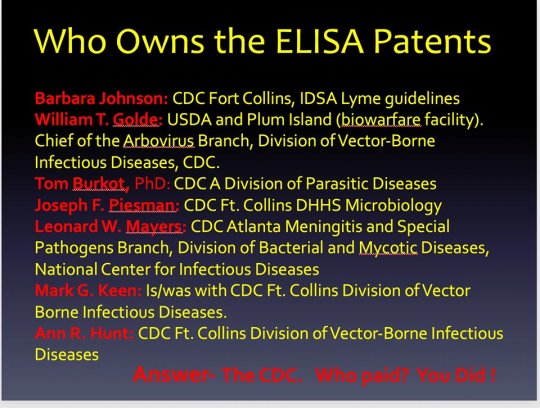
Also worth noting are the severe conflicts of interest within the CDC, the very people making treatment guidelines:

64357008_10217935576008450_2638357839671721984_n

ConflictReport  Go to part III

I just posted this excellent article on the backstory of the Lymerix vaccine which also uncovers shady dealings, dishonesty, and conflicts of interest:  https://madisonarealymesupportgroup.com/2020/02/10/the-bitter-feud-over-lymerix/


Severe Babesia Infection Leads to Exchange Transfusion

https://danielcameronmd.com/severe-babesia-infection-exchange-transfusion/

SEVERE BABESIA INFECTION LEADS TO EXCHANGE TRANSFUSION

Babesia infection, transfusion

Babesiosis is a parasitic disease transmitted primarily through the bite of an infected tick but it can also be spread through tainted blood transfusions or less frequently via organ transplantation or perinatally. The severity of Babesia can range from asymptomatic to life-threatening. In immunocompromised patients or in those who have contracted the disease through blood transfusions, a Babesia infection has a fatality rate of about 20%. [1,2]

Although the majority of Babesia cases are treated with antimicrobial agents, patients with severe cases may require an exchange transfusion (ET). In their article, “Repeat exchange transfusion for treatment of severe babesiosis,” Radcliffe and colleagues describe the case of a 73-year-old woman with an extreme case of a Babesia infection, who was immunocompromised. [3]

The woman ultimately required 2 exchange transfusions, along with prolonged anti-parasitic therapy to successfully treat the Babesia microti infection.

Approximately 1 month after camping in New Hampshire, the woman developed malaise, headaches, weakness, anorexia, and nausea, which lasted for 4 days. She did not recall having a tick bite.

The patient had a history of splenectomy, an autoimmune disorder, and immunosuppression therapy. “Her medical history was significant for longstanding rheumatoid arthritis treated with weekly etanercept and prior splenectomy for immune-mediated thrombocytopenia,” writes Radcliffe.

A blood smear revealed a parasitic burden of 43% and anemia with hemoglobin 9.2 mg/dL. “She was started on azithromycin and clindamycin and transferred to our hospital,” writes Radcliffe.

Case report: Severe Babesia in a 73-year-old woman resolves after 2 exchange transfusions. CLICK TO TWEETThe woman was admitted to the intensive care unit for hypotension. She initially needed fluids and vasopressors, as well as supplemental oxygen for a pulse oximetry of 88%.

Her treatment for the Babesia infection was changed to include: IV clindamycin, oral quinine sulfate, and oral doxycycline, as empiric treatment for possible co-infection with Lyme disease and/or anaplasmosis.

And on day 1, she received a red blood cell exchange transfusion of 12 units. This dropped the parasite load to 7.6%.

However, “despite a post-exchange drop in parasitemia to 7.6%, it rebounded to 11.4% on hospital day 5 accompanied by new onset high fevers and hypoxia,” explains Radcliffe.

On day 5, she received her second exchange transfer, which lowered parasitemia to 2.2%.

“She improved after a second exchange transfusion and ultimately resolved her infection after 12 weeks of anti-babesial antibiotics,” writes Radcliffe.

She underwent extended treatment for the Babesia infection, in part due to a parasitemia at day 9 of 1.7% and <1% at day 19.

“Antibiotics were discontinued as follows: atovaquone/proguanil at 61 days post-discharge, doxycycline at 72 days post-discharge, and azithromycin at 86 days post-discharge,” writes Radcliffe.

There are only 6 other cases in the literature documenting exchange transfusions in patients with Babesia. Unfortunately, one of those patients died.

“Our present case is instructive,” the authors explain, “because two ETs were necessary for cure despite a marked lowering of parasitemia after the first ET (81.5% reduction) and an extended anti-parasitic regimen…”

The authors conclude: “These cases highlight the need to remain vigilant when managing babesiosis in highly immunocompromised patients.”

Editor’s note: This patient’s case should serve as a reminder of the risk Babesia poses for immunocompromised patients with autoimmune disorders such as rheumatoid arthritis.

References:
  1. Krause PJ. Human babesiosis. Int J Parasitol 2019;49(2):165–74.
  2. Krause PJ, Gewurz BE, Hill D, Marty FM, Vannier E, Foppa IM, et al. Persistent and
    relapsing babesiosis in immunocompromised patients. Clin Infect Dis 2008;46(3):370–6.
  3. Radcliffe C, Krause PJ, Grant M. Repeat exchange transfusion for treatment of severe babesiosis. Transfus Apher Sci. 2019 Sep 5. pii: S1473-0502(19)30189-2.

_____________________

**Comment**

According to Dr. Horowitz, Babesia is one of the most tenacious coinfections he treats and he recommends treating for 9 months to a year.  In my experience, with a lengthy, overlapping treatment using numerous antimicrobials, you can cure Babesia.  For treatment options:  https://madisonarealymesupportgroup.com/2016/01/16/babesia-treatment/  I include the treatment that was effective for us.

Authorities state that patients are more likely to get Babesia or Bartonella if they are immunocompromised.  What they aren’t considering is that having Lyme or other tick-borne illnesses CAUSES patients to be immunocompromised and sets them up to be targets for other pathogens that are either transmitted directly from a tick bite OR reactivates a latent infection that the immune system was able to keep in check until a trigger suppresses the immune system causing it to fail, allowing a activation of a latent infection.  Their heads are in the sand.

Dr. Rajadas: Disulfiram for Lyme Interviews

December 2019

Dr Jayakumar Rajadas First Interview with Disulfiram for Lyme Support Group

Dr. Rajadas Disulfiram for Lyme 2nd Interview Dec. 2019

Part 1 Introduction: https://youtu.be/Y0Ud42LRZp0

Part 2 Acetaldehyde: https://youtu.be/0XccN9U_2nk

Part 3 Delivery and Side Effects: https://youtu.be/YzsSUC2Pz38

Part 4 Dosages and Other Conditions: https://youtu.be/QSw861IMwwQ

Part 5 Research and Funding: https://youtu.be/16zHx8XK5fk

Link to the support group: https://www.facebook.com/groups/dsf4l…

__________________

**Comment**

Again – please understand the risks:  https://madisonarealymesupportgroup.com/2019/10/15/disulfiram-psychosis-update/

For a great read on disulfiram:  https://madisonarealymesupportgroup.com/2019/11/19/if-disulfiram-is-the-cure-for-lyme-disease-should-it-be-prescribed-to-all-lyme-disease-patients/