Please click on link above to watch a short video. This PSA from Lia Gaertner & Shanti the dog show questing ticks in the middle of the sidewalk, demonstrating the need to be diligent with tick checks as well as spraying clothes/shoes with permethrin when out doors.
Ticks are being found in wide-open spaces now. No need to go deep in the woods or shrubby areas to find them.
TOUCHED BY LYME: Is Lyme disease a bioweapons experiment gone bad?
By Dorothy Kupcha Leland
The mainstream “origin story” of Lyme disease in the United States goes like this: In the 1970s, a mysterious ailment afflicted a group of people in and around Lyme, Connecticut. Eventually, scientists determined it was caused by a spirochete transmitted by the bite of an Ixodes tick. A short course of antibiotics would resolve the issue. Mystery solved. Problem fixed.
Since then, that’s basically the script followed by health officials, researchers who receive government funding to study Lyme disease, and the medical establishment.
“the chasm between what researchers say about Lyme disease and what the chronically ill patients say they are experiencing has remained an open wound for decades.”
And Newby knows what she’s talking about.
In 2002, while vacationing on Martha’s Vineyard in Massachusetts, she and her husband Paul were bitten by unseen ticks.
“These tick bites would rob us of our good health,” Newby writes, “and send me on an investigation into an almost unimaginable possibility: that we were collateral damage in a biological weapons race that had started during the Cold War.”
Upon their return to California, Newby and her husband got horribly sick. A succession of medical experts couldn’t pinpoint the problem and eventually dismissed them as patients.
This happened despite the fact that Newby had a positive Lyme test, which her doctors rejected as a “false” positive.
In time, she found her way to a physician who was familiar with tick-borne illnesses. This doctor diagnosed her with Lyme disease and babesiosis, both prevalent in ticks on Martha’s Vineyard. And Newby began years of treatment that slowly brought her back to health.
Under Our Skin
During her recovery, Newby started working with film director Andy Abrahams Wilson, of Open Eye Pictures. They jointly researched what became the award-winning Lyme documentary “Under Our Skin,” delving into the history of the Lyme disease controversy.
(For readers not familiar with the issue, here it is in a nutshell: Hundreds of thousands of people get sick every year in the US with Lyme and other tick-borne illnesses. But for complex reasons, patients have a devil of a time getting properly diagnosed and treated.
Newby’s case was typical. She saw 10 doctors before stepping out of the medical mainstream and paying out of pocket for a physician who could recognize what she had and knew how to treat it. A point of contention in the controversy is whether the illness can persist after the patient receives a short course of antibiotics. Government/medical establishment folks say no. The patient experience says yes.)
In the course of filming “Under Our Skin,” Newby and Wilson struggled to find a government expert on Lyme disease willing to be interviewed on camera. The CDC, the NIH, and others all declined.
“The politics of the disease were too charged,” she writes, “and the government researchers seemed to want to steer clear of the controversy.”
Then they met retired NIH researcher Willy Burgdorfer, the discoverer of the Lyme spirochete—Borrelia burgdorferi—for whom it is named. In contrast to others they had sought out, Burgdorfer seemed eager to talk.
“Willy told us that the US government knows that Lyme disease can become chronic and that patients can relapse years after an initial infection,” Newby writes. “And that the disease is particularly damaging to the neurological systems of children.”
“A shameful affair”
Furthermore, Burgdorfer criticized the dozen or so researchers who have gotten most of the government funding for Lyme disease.
“The controversy in Lyme disease research is a shameful affair,” he said on camera. He stated that the work should instead be done by scientists “who don’t know beforehand the results of their research.”
Then, Newby writes: “As soon as we turned off the camera and began packing up our gear, Willy told us with a smile, ‘I didn’t tell you everything.’ But try as we might, we couldn’t get him to say more.”
“Under Our Skin” was released in 2008. Now, fast-forward to the present day and Newby’s new book “Bitten: The Secret History of Lyme Disease and Biological Weapons.”
In it, she describes her years’ long effort to understand who Burgdorfer was and to get to the bottom of what he hinted at that day.
Fascinated by ticks
Burgdorfer grew up in Basel, Switzerland, and became fascinated with ticks while a PhD student at the Swiss Tropical Institute.
At the end of his training, in 1951, he took a position at the US government’s Rocky Mountain Laboratory in Montana. It held the most extensive collection of ticks in the country.
At first, it appeared that the job involved figuring out how to protect people and animals from tick-borne diseases. However, Burgdorfer was apparently soon disabused of that notion.
During that Cold War era, the US government was heavily involved in bioweapons research. Scientists sought ways to turn infectious microbes—such as anthrax, plague, brucella, and tularemia—into potent military tools that could disable a huge population. (Perhaps the Russians?)
Newby writes about a particular meeting Burgdorfer attended in Canada:
“After hearing from a roomful of entomological warfare experts…he now most certainly knew that he was no longer protecting humans from tiny eight-legged beasts. He was instead turning those beasts into lethal weapons.”
Burgdorfer spent time at Fort Detrick, Maryland, where one of the buildings was nicknamed the “Anthrax Hotel.” Another structure housed the “Eight Ball,” a massive cloud chamber used for testing airborne bioweapons on animals and human volunteers.
He brainstormed with entomologist James Oliver, who was working on a program to drop weaponized ticks out of airplanes. He traveled to England and Czechoslovakia, to meet with scientists doing similar work.
Burgdorfer also experimented with ways to infect ticks with more than one pathogen at a time.
Documentation
Newby meticulously documents all this with massive archival research, discussions with many people knowledgeable about bioweapons research in the US, and another interview with Burgdorfer himself in 2013.
By then, advanced Parkinson’s disease was stealing his ability to speak clearly, and his health was failing. (In fact, he would die the following year.)
In this final interview, Burgdorfer confirmed that he had been working on tick-borne bioweapons research. And insinuated there had been an accidental release of some sort.
At this point in the book, the reader is itching to know: will he give specifics? Was the outbreak of sickness in and around Lyme, Connecticut, in the 70s connected to bioweapons research? Was there an accidental release of pathogens? Or a deliberate one?
Newby writes:
“It was frustrating that he still wouldn’t disclose key details on the who, what, and where of the alleged bioweapons accident. He offered me more pieces of the puzzle, but for unknown reasons, he was holding back on the whole story.”
Even more puzzle pieces would emerge in the months before his death. It turns out Burgdorfer had a trove of Lyme-related research notes that he had never relinquished to government archivists. He instead wanted them preserved for posterity in a university library. (They are now available online at Utah Valley University.) More complexities would surface after Burgdorfer’s death, when his widow provided additional materials for the academic archive.
The Swiss Agent
Newby went through these records with a fine-tooth comb. Most intriguing were Burgdorfer’s references to something he dubbed the “Swiss Agent.” Was this another pathogen? Could it be what makes Lyme disease so virulent? Why was it never mentioned in any of Burgdorfer’s journal articles? Why wouldn’t he talk about it?
The author does a stellar job of sifting through a huge collection of clues. But some answers remain tantalizingly out of reach.
“If the outbreak was caused by a US accident, we need it exposed,” she writes. “If it was a hostile act by a foreign actor, then it shows how woefully unprepared we are for future attacks.”
The Lyme community cares passionately about the true origin story of this burgeoning epidemic. Indeed, the microbe has been around for eons. Lyme spirochetes have been found in ticks that were encased in amber15 million years ago. Lyme DNA is in the bones of “The Iceman,” who lay frozen in the Alps for over 5000 years.
But did something happen in the last half of the 20th Century to ramp up this pathogen’s virulence? And/or, to make it spread more easily? Newby’s book certainly suggests that.
Burgdorfer died in 2014, leaving behind significant “dots” without connecting them all. The aforementioned James Oliver died in 2018, two years after giving amagazine interview about his bioweapons research at Fort Detrick. (He said one of his goals had been to figure out ways to distribute ticks to targeted geographic areas.) But like Burgdorfer, he stopped short of providing specifics.
Were these two men seeking to clear their consciences for the roles they played in bioweapons research? Their generation of scientists is dying off. Is anyone left who might offer clarity? Are there any still-classified documents that hold the secrets?
Repairing the “open wound”
Newby’s book raises important questions that deserve answers. Chief among them: precisely what was done to weaponize Lyme disease—and why won’t the government come clean about it?
Lyme and other tick-borne pathogens are spreading throughout the world. In the US alone, the number of people suffering from Lyme disease is projected to hit 2 million in 2020.
Yet, for the last 40+ years, our government’s effort to solve the Lyme disease crisis has been lethargic at best. While the medical establishment minimizes their plight, patients have largely been left on their own to figure out (and pay for) Lyme-related medical care. Meanwhile, few research dollars have been devoted to finding more effective treatments.
“Bitten: The Secret History of Lyme Disease and Biological Weapons” is a wake-up call. It’s time to stop business as usual and prioritize the Lyme disease epidemic.
Helping those who currently suffer and protecting coming generations both depend on it.
What also depends on it: the ability to heal the “open wound” of how Lyme disease has been treated, untreated, and mistreated, for far too long.
FAIRMONT, W.Va. (WDTV) — The CDC says there is an accelerating trend of tickborne diseases in the U.S. as we begin National Lyme Disease Awareness Month.
Scott Moore is a Veterinarian at the Fairmont Veterinary Hospital. He’s one of the hundreds of vets in West Virginia and the Northeast that are treating more and more dogs for Lyme Disease every year.
“In the last five years, we’ve seen a dramatic rise in Lyme Disease cases,” Moore said.
According to data from the nonprofit Pets and Parasites, about 1 out of every 20 dogs tested for the disease in West Virginia were positive in 2014. Last year, it was 1 of 10.
Medical professionals aren’t quite sure what is causing the increase, which is progressively worse further up the East Coast. But Moore is seeing some trends.
“We’re seeing a lot more ticks that carry the Lyme disease in our area opposed to the common wood tick,” Moore said.
The CDC also warns that the U.S. isn’t fully prepared to control the threat of increasing tick populations.
“Local and state health departments and vector control organizations face increasing demands to respond to ticks and tickborne diseases,” a 2018 CDC report said. “Proven and publicly accepted methods are needed to better prevent tick bites and to control ticks and tickborne diseases.”
Lyme Disease isn’t contagious. But it can be deadly if not treated early.
“Sometimes the dogs won’t be able to move well. In some cases, it can progress to kidney failure,” Moore said. “When Lyme Disease hits the kidney, it’s almost 100 percent fatal.”
He recommends getting good flea and tick prevention for dogs or investing in a flea and tick collar.
The CDC suggests checking yourself for ticks and showering within two hours of coming inside including from your own backyard.
“We need to be careful,” Moore said. “Check yourself, check your dogs, use the preventions that are available. Lyme vaccines are available and good flea and tick preventions are available.”
___________________
**Comment**
That “common” wood tick, also known as the American Dog tick, transmits numerous pathogens including:
tularemia
Rocky Mountain Spotted Fever
tick paralysis (fully engorged female)
So, the wood tick is far from safe.
If Lyme is increasing in dogs, expect the same for humans.
If the CDC states we are unprepared, things are dire indeed. They are the last to know anything.
The tick vector of Borrelia burgdorferi, an agent of Lyme disease in dogs, is expanding its range from the northeastern and mid-Atlantic states, the upper Midwestern states, and throughout Canada. These ticks are bringing their associated pathogens along for the ride. These include Anaplasma phagocytophilum, Babesia spp., Borrelia miyamotoi, Ehrlichia muris eauclarensis, and possibly Bartonella spp. among others.
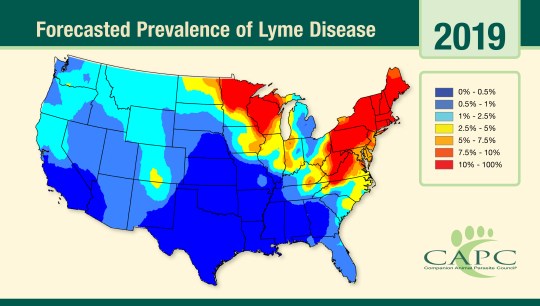
The seroprevalence of B. burgdorferi is predicted to be higher in three areas this year. Most notably throughout the Appalachian region. Veterinarians in eastern Pennsylvania, West Virginia, western Virginia and North Carolina, and eastern Ohio and Kentucky should reinforce their recommendations on the use of tick preventatives and may consider vaccination for high-risk patients.
Second, a hotspot of higher than average seroprevalence is expected to be seen in northwestern Minnesota.
Third, although small, areas in Indiana are expected to see higher than average seroprevalence. This is not a historically endemic state, so veterinarians should educate themselves and their clients about the risks of tick-borne disease.
The Atlantic coast, New England states, central Wisconsin, and southeastern Minnesota are all expected to see lower than average seroprevalence in 2019.
Preventing exposure to ticks is the best way to prevent infection with tick-borne pathogens. The areas highlighted above expected to see lower than average seroprevalence are endemic for Borrelia burgdorferi and risk for exposure is high!
The best way to protect your patients is to advise owners of the importance of year-round prevention, even during the winter months. You can use the CAPC Parasite Prevalence Maps to support your recommendation by underscoring the risks in your area and in regions of the country your clients may travel with their pets. It is also critical to emphasize the importance of compliance and using products according to label. The use of CAPC Parasite Prevalence maps and Forecast maps are a validated tool for increasing client willingness to engage in parasite prevention. Sign up for local alerts today by visiting the CAPC Parasite Prevalence Maps and selecting “Get Updates”.
Veterinary professionals and pet owners who want to monitor the activity in their county throughout the year, can also access 30-Day Parasite Forecast Maps at www.petdiseasealerts.org. These maps, developed exclusively by CAPC, provide a local forecast for every county in the continental United States on a monthly basis.
The Science behind the Forecasts
Vector-borne disease is dynamic and ever changing, driven by multiple factors that affect the development of arthropod vectors and the pathogens they carry. Leading parasitologists work in collaboration with a team of statisticians to identify regions of the country that may experience higher parasite incidence in the months ahead. Numerous factors are analyzed, including the number of positive tests and the influence of weather patterns, vegetation indices, and human population density. Using this multi-disciplinary approach, we are leveraging everyone’s expertise to focus on a single common interest: forecasting the risk of exposure to vector-borne pathogens. While these forecasts predict the potential risk of a dog testing positive, they do not necessarily reflect the occurrence of clinical disease.
To learn more about the science behind the maps, full access to our manuscripts describing the methodology and fidelity of our forecasts can be found here.
We are committed to publishing our scientific studies in open-access journals so they are freely available to researchers, veterinarians, and the general public. For those interested in learning more about the science of these forecasts or to see additional graphics, we encourage you to view them here:
Stich RW, Blagburn BL, Bowman DD, Carpenter C, Cortinas MR, Ewing SA, Foley D, Foley JE, Gaff H, Hickling GJ, Lash RR, Little SE, Lund C, Lund R, Mather TN, Needham GR, Nicholson WL, Sharp J, Varela-Stokes A, Wang D. Quantitative factors proposed to influence the prevalence of canine tick-borne disease agents in the United States. Parasit Vectors. 2014 Sep 4;7:417. https://parasitesandvectors.biomedcentral.com/articles/10.1186/1756-3305-7-417
Watson SC, Liu Y, Lund RB, Gettings JR, Nordone SK, McMahan CS, Yabsley MJ. A Bayesian spatio-temporal model for forecasting the prevalence of antibodies to Borrelia burgdorferi, causative agent of Lyme disease, in domestic dogs within the contiguous United States. PLoS One. 2017 May 4;12(5):e0174428. https://journals.plos.org/plosone/article?id=10.1371/journal.pone.0174428
Liu Y, Lund RB, Nordone SK, Yabsley MJ, McMahan CS. A Bayesian spatio-temporal model for forecasting the prevalence of antibodies to Ehrlichiaspecies in domestic dogs within the contiguous United States. Parasit Vectors. 2017 Mar 9;10(1):138. https://parasitesandvectors.biomedcentral.com/articles/10.1186/s13071-017-2068-x
Liu Y, Watson SC, Gettings JR, Lund RB, Nordone SK, Yabsley MJ, McMahan CS. A Bayesian spatio-temporal model for forecasting Anaplasmaspecies seroprevalence in domestic dogs within the contiguous United States. PLoS One. 2017 Jul 24;12(7):e0182028. https://journals.plos.org/plosone/article?id=10.1371/journal.pone.0182028
________________________
**Comment**
We shall see if Wisconsin truly has lower seroprevalence. I’m not buying it.
Lyme disease is a bacterial infection that can be transmitted by ticks
It mimics a number of disorders such as arthritis, multiple sclerosis (MS), chronic fatigue syndrome, amyotrophic lateral sclerosis (ALS) and Alzheimer’s disease. Infected individuals also can appear to be completely healthy even though they are experiencing severe symptoms
Up to 300,000 people may contract Lyme disease each year in the U.S.
Lyme disease remains one of the most serious and controversial epidemics today.
Approximately 30,000 cases of Lyme disease are reported to the Centers for Disease Control and Prevention (CDC) every year. However, data from the standard national surveillance show that around 300,000 people are diagnosed with Lyme disease each year in the U.S.,1 indicating the disease is considerably underreported. But what exactly is Lyme disease and how can you contract it?
An Overview on Lyme Disease
Lyme disease is a bacterial infection that can be transmitted by ticks.2Some studies suggest that the bacteria that cause it can also be spread by other insects like fleas, mosquitoes and mites.3 Lyme disease is called “the great imitator” because it mimics a number of disorders such as arthritis, multiple sclerosis (MS), chronic fatigue syndrome, amyotrophic lateral sclerosis (ALS) and Alzheimer’s disease.4,5
It’s also called “the invisible illness,” as infected individuals can appear to be completely healthy even though they are experiencing severe symptoms.6
Lyme disease usually starts with a red, round rash that resemble a bull’s-eye. It then progresses with symptoms such as fatigue, fever, headaches and joint and muscle pain. It can then progress to muscle spasms, loss of motor coordination, intermittent paralysis, meningitis and even heart problems.7 The disease typically causes vague, dispersed pain, which is the reason it is often misdiagnosed as fibromyalgia even by experienced doctors.8
The best strategy against Lyme disease is to avoid being bitten by ticks and other insects. The CDC recommends checking your whole body carefully after going to a tick-infested area and taking a shower immediately after being outdoors, to wash off and easily find ticks or tick bites.9
Controversies Surrounding Chronic Lyme Disease
Many physicians now acknowledge that Lyme disease is real, but there is still controversy about whether it can become a chronic condition.10 Members of the Infectious Disease Society of America (IDSA) do not believe in chronic Lyme and generally will not treat a patient longer than the usual duration of treatment, which is four to six weeks.
On the other hand, members of the International Lyme and Associated Diseases Society (ILADS) believe that Lyme disease can persist and are willing to treat patients for a longer duration.11
According to a study funded by the National Institutes of Health, long-term antibiotic treatment is not beneficial for individuals with ongoing symptoms of Lyme disease, as it does not result in a positive prognosis and only increases the risks for complications such as biliary disease.12,13 It can also significantly decrease the beneficial bacteria in the gut and impair your natural immune function. To help manage this condition without complications, opt for safer holistic methods.
These Pages Will Help You Better Understand Lyme Disease
Take immediate action if you suspect that you, someone you know or your pet is infected with Lyme disease. Read these pages to learn more about Lyme disease, including its causes, stages, symptoms and treatment options. Learning crucial information about this potentially debilitating condition is an important step to helping lower your risk.
According to the CDC 42,743 people contracted Lyme in 2017; however, they estimate it’s 10 times that number, so the estimated number of NEW cases was close to 428,000. Since these numbers are already two years old and it’s only increased, it’s even higher than that.
Let’s break down the studies that supposedly show “long-term antibiotic treatment is not beneficial for individuals with ongoing symptoms of Lyme disease.”
The first clinical trial, which included two studies conducted at multiple research sites, had patients treated with 30 days of an intravenous antibiotic followed by 60 days of treatment with an oral antibiotic.
Another study, published in 2003, patients were treated with 28 days of intravenous antibiotic compared with placebo.
A subsequent study supported by NINDS gave patients that had at least three weeks of prior intravenous antibiotics, either 10 weeks of intravenous ceftriaxone or intravenous placebo.
A reappraisal of several of these studies concluded that IV antibiotics may provide benefit to PTLDS fatigue, but in light of significant adverse events they were not recommended and improved methods of treatment were needed.
I do not call a month or two of IV antibiotics “long term”treatment. Regarding the severe reactions by a few on IV antibiotics, many patients do not require IV’s at all, lessening the adverse events substantially. Everyone knows IV antibiotics come with risk but that is a risk patient and doctor should weigh against the severity of the case. To determine that IV antibiotics across the board are not worth the risk is like stating that due to severe reactions, cancer treatment should be discontinued for everyone at all times. Go here to read of a Milwaukee, WI doctor and IDSA founder who used 6-8 grams of IV antibiotics on many of his patients with success: https://madisonarealymesupportgroup.com/2017/07/09/idsa-founder-used-potent-iv-antibiotics-for-chronic-lyme/
BTW: long-term antibiotics have been used for acne, rheumatic fever, cystic fibrosis, and other diseases. Lyme/MSIDS can maim and kill you.
In vitro work has shown only certain drugs work against various forms of Lyme: https://www.dovepress.com/evaluation-of-in-vitro-antibiotic-susceptibility-of-different-morpholo-peer-reviewed-article-IDRMetronidazole led to reduction of spirochetal structures by ~90% and round body forms by ~80%. Tigecycline and tinidazole treatment reduced both spirochetal and round body forms by ~80%–90%.In terms of qualitative effects, only tinidazole reduced viable organisms by ~90%. Following treatment with the other antibiotics, viable organisms were detected in 70%–85% of the biofilm-like colonies.
Studies used to supposedly show that long-term antibiotics don’t work are rigged from the get-go to reveal a pre-determined outcome.
I can tell you right now, my husband and I very well might not be on planet earth if it weren’t for judiciously used long-term oral antibiotics. I’m talking YEARS of treatment, not a month’s worth. If you watched “Under Our Skin,” the ranger stated,
“Who would have thought my greatest improvement came after 3 years of treatment.“
This has been our experience with many other patients saying the exact same thing.
In talking to Dr. Hoffman, RIP, and probably one of the most experienced practitioners in the state of Wisconsin, he told me that when he initially started treating people for this in the 70’s, before it even had a name, cases resolved within a couple of months to a year. Now, cases are taking 3 and more years for resolution. WHY? Good question. He, Dr. Burrascano, and Dr. Horowitz have all stated that coinfections weren’t as much of an issue decades ago, but that now the added effect of Lyme with numerous coinfections are making cases much more severe. http://www.lymepa.org/c07%20Lyme%20disease%20and%20Babesiosis%20coinfection.pdf
The CDC/NIH/IDSA won’t even consider pleomorphism of borrelia or coinfections involvement. Again, WHY?
Perhaps that question needs to be resolved first before anyone claims the science is settled on treatment.
Trust me – nobody out here in Lyme-land enjoys taking antibiotics. We take them because they improve our lives dramatically or even can make us completely well. Antimicrobial treatment is imperative but only one prong of successful treatment. I understand the need for antibiotic stewardship but people are dying from Lyme/MSIDS.For more:https://madisonarealymesupportgroup.com/2016/02/13/lyme-disease-treatment/
This plague is far, far worse than they are admitting. Don’t kid yourself. This is about money & power. Insurance companies don’t want to pay so authorities have constructed a paradigm making that possible.




 Madison Area Lyme Support Group