Archive for the ‘Rocky Mountain Spotted Fever’ Category

Ticks From U.S. Cats: Patterns of Infestation & Infection With Pathogens

https://www.sciencedirect.com/science/article/pii/S0304401718301596?via%3Dihub

Ticks from cats in the United States: patterns of infestation and infection with pathogens

Under a Creative Commons license
open access

Highlights

Tick infestations were documented on 332 cats from 18 states in the United States.

Adult and immature stages of IxodesAmblyomma, and Dermacentor were recovered.

Molecular assays documented infection with at least one pathogen in 17.1% of ticks.

One in 5 cats with ticks spent ≤30% time outdoors; 10 were reportedly indoor only.

Results show cats at risk of tick infestation and exposure to tick-borne pathogens.

Abstract

Ticks are an important but under recognized parasitic threat to cats in many areas of the United States. To characterize the species and stages of ticks most commonly recovered from cats and determine the prevalence of disease agents in the ticks, we conducted a survey of ticks removed from cats at veterinary practices in 18 states from April 2016 – June 2017.

A total of 796 ticks were submitted from 332 cats from 41 different veterinary practices. A single tick was submitted from the majority of cats, with a mean infestation intensity of 2.4 (range 1–46). The most common tick was Ixodes scapularis, accounting for 422/796 (53.0%) ticks submitted, followed by Amblyomma americanum (224/796; 28.1%) and Dermacentor variabilis (131/796; 16.5%); a few I. pacificusI. banksiD. occidentalisA. maculatumRhipicephalus sanguineus, and Otobius megnini were also submitted.

A majority of ticks were adults (593/796; 74.5%); females predominated in all adult tick submissions including I. scapularis (277/327; 84.7% female), A. americanum(66/128; 51.6% female), and D. variabilis (75/126; 59.5% female). Immature ticks included 186 nymphs and 17 larvae and were primarily I. scapularis and A. americanum.

Adult I. scapularis were most reported to be attached to the dorsal head and neck; A. americanum to the abdomen and perianal region; and D. variabilis to the back and ear. Ticks were collected in every month; the largest number of submissions were in May and June (42.5% of ticks) and October and November (35.9% of ticks). Adults of I. scapularis were most commonly submitted October through DecemberA. americanum March through June, and D. variabilis May through July.

Cats with ticks were predominantly male (58.8%) and altered (76.2%), and most reportedly spent >30% of time outdoors, although 64/294 (21.8%) for which lifestyle estimates were provided were reported to live primarily (≤30% of time outside; n = 54) or entirely (100%; n = 10) indoors.

Assay of ticks removed from cats revealed I. scapularis were infected with Borrelia burgdorferi (25.7%) and Anaplasma phagocytophilum(4.4%); A. americanum were infected with Ehrlichia chaffeensis (1.3%); and D. variabilis were infected with spotted fever group Rickettsia spp. (3.1%). No ticks in this study tested positive for Cytauxzoon felis.

Pet cats, including those that live primarily indoors, are at risk of tick infestation, potentially exposed to tick-borne disease agents, and would benefit from routine tick control.

_______________

**Comment**

Some interesting points:

  1. Ticks were found on cats year-round
  2. The majority of ticks were ADULTS
  3. This study points out we need to essentially throw out the idea you can only get a tick bite in the spring and fall.  It also points out that adult ticks are to be taken just as seriously as nymphs.
  4. According to the study, molecular assays were used and the following pathogens found.  It says nothing of Bartonella, which is unfortunate.  We really need to determine why so many humans are infected with it.

Table 4. Pathogens detected in adult ticks recovered from cats.

Tick Pathogen % positive (No. positive/No. tested)
Ixodes scapularis Anaplasma phagocytophilum 4.4% (12/272)
Borrelia burgdorferi 25.7% (70/272)
Amblyomma americanum Cytauxzoon felis 0% (0/121)
Ehrlichia chaffeensis 1.7% (2/121)
Ehrlichia ewingii 0% (0/121)
Dermacentor variabilis Cytauxzoon felis 0% (0/123)
Rickettsia spp. 3.1% (4/123)

Tick & Mosquito-borne Diseases: Trends in the U.S.

https://www.gideononline.com/2018/05/04/tick-and-mosquito-borne-diseases-trends-in-the-united-states/

May 4th 2018

TICK AND MOSQUITO-BORNE DISEASES: TRENDS IN THE UNITED STATES

The following data are abstracted from Gideon and the Gideon e-book series. [1] Charts were created using an interactive tool driven by over 30,000 base graphs in the program. [2]

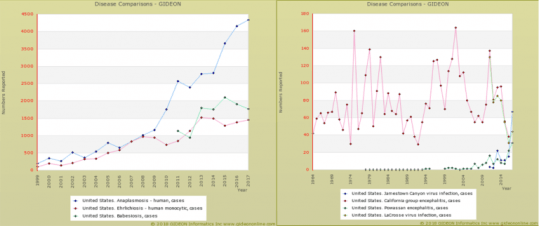
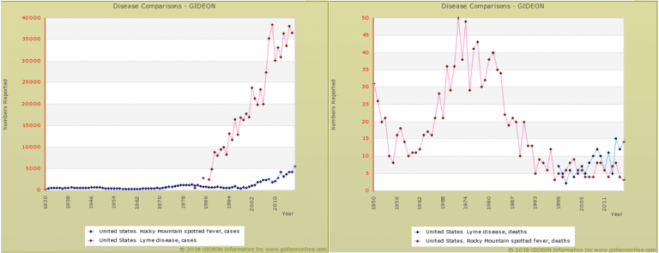
Chart 1 contrasts trends for reported incidence of Lyme disease and Rocky Mountain spotted fever (RMSF). Note that while rates of Lyme disease in 2016 are 15-fold those reported in 1987, those of RMSF increased by a factor of seven. The number of fatal cases for both diseases have remained similar in recent years (i.e., the relative case-fatality rate of Lyme disease has decreased)

LymeSF-768x295

Chart 2 summarizes incidence data for a variety of tick-borne and mosquito-borne infections. Note that rates of Ehrlichiosis, Anaplasmosis, Babesiosis, Jamestown Canyon virus infection and Powassan encephalitis have increased since the year 2000. The incidence of LaCrosse encephalitis has decreased, while that of California encephalitis is largely unchanged.

MiscArbo-768x322

Charts 3 and 4 demonstrate that incidence and reported deaths for Western equine encephalitis, Eastern equine encephalitis, St. Louis encephalitis and West Nile fever have changed little in recent years.

Enceph-768x296

References:

Berger S. Infectious Diseases of the United States, 2018. 1,254 pages, 510 graphs, 16,672 references. Gideon e-books, https://www.gideononline.com/ebooks/country/infectious-diseases-of-the-united-states/
Gideon e-Gideon multi-graph tool, https://www.gideononline.com/cases/multi-graphs/

In Tick Management, Species Matters

https://entomologytoday.org/2018/05/03/tick-management-species-matters-blacklegged-lone-star-american-dog-ticks/https://entomologytoday.org/2018/05/03/tick-management-species-matters-blacklegged-lone-star-american-dog-ticks/

In Tick Management, Species Matters

three tick species
No single tick-management method works perfectly, and one factor plays a key role in how well any particular tick-management method might work: Which tick species is it best suited for? A new guide in the Journal of Integrated Pest Management reviews research on tick management tools and their effectiveness on three tick species (shown here, left to right): the blacklegged tick (Ixodes scapularis), the lone star tick (Amblyomma americanum), and the American dog tick (Dermacentor variabilis). (Image credits, L to R: Lennart Tange/Flickr, CC BY 2.0; Dr. Amanda Loftis, Dr. William Nicholson, Dr. Will Reeves, Dr. Chris Paddock, CDC Public Health Image Library; James Gathany, CDC Public Health Image Library)

In any part of the United States where ticks are present, awareness and personal protection are the first steps to avoiding tick bites and the potential disease pathogens they transmit: Using repellent and conducting frequent tick checks, especially after venturing into wooded or brushy areas, will help in avoiding ticks of all varieties.

But, for managing ticks more broadly, such as in yards and park spaces or at the community or regional level, the problem gets more complicated. No single method works perfectly, and one simple factor plays a key role in how well any particular tick-management method might work: Which tick species is it best suited for?

As part of a new special collection on Integrated Tick Management in the open-access Journal of Integrated Pest Management, Alexis White and Holly Gaff, Ph.D., of Old Dominion University have written a guide to tick control technologies that delineates their varying levels of effectiveness against the three dominant disease-carrying tick species in the eastern half of the United States: the blacklegged tick (Ixodes scapularis), the lone star tick (Amblyomma americanum), and the American dog tick (Dermacentor variabilis).

To the casual observer, a tick is a tick, but entomologists and public health professionals know different tick species behave in different ways.

“Most of the host-targeted methods … are tailored more toward one or two specific species of ticks because of tick-host preferences,” says White. “For example, lone star ticks are not known to feed on rodents, so bait boxes and tick tubes would not be an effective control measure for this species.

Host-targeted methods aim to reduce the tick population by recruiting the animals that ticks feed on to the effort. For instance, bait boxes attract rodents and bring them into contact with acaricide (a tick-targeted pesticide), while tick tubes provide acaricide-laden nesting material for rodents. Both are tailored well to blacklegged ticks and American dog ticks, which commonly feed on rodents.

Lone star ticks, meanwhile, commonly feed on larger animals such as deer. A device known as the “4-poster” works similar to the rodent bait box, attracting deer with food placed in the center of four posts with rollers laden with acaricide that the deer rub against while feeding.

White and Gaff examined existing research on these tick-management methods as well as several others: habitat modification, controlled burns, broadcast acaricides, deer removal, deer fences, and even a semi-autonomous robot known as “TickBot” that lures ticks toward acaricide as it patrols a prescribed path.

“Based on current literature, broadcast acaricides consistently reduce human and domestic animal tick encounters at least for a short period of time,” says Gaff. “However, these chemicals are known to be harmful to other invertebrates in the environment and cannot be applied in all areas because of legal restrictions.”

For the typical homeowner in tick-prone regions, though, White says a few methods offer the best combo of practicality and effectiveness across species. “Our recommendation is for homeowners with property adjacent to woods to maintain regular mowing and leaf litter removal throughout the yard and also install a mulch barrier between the edge of their yard and the forest to serve as a reminder of the tick dangers along that edge,” she says.

In the course of their review of existing research, they noted that, due to its role as the primary vector of the bacterium that causes Lyme disease, the blacklegged tick has been the subject of far more research than other species. However, as the U.S. Centers for Disease Control and Prevention notes in a new report released Tuesday, both the volume and variety of tick-borne diseases is on the rise, with afflictions such as anaplasmosis/ehrlichiosis, babesiosis, Powassan virus, spotted fever rickettsiosis, and tularemia added to the list alongside Lyme disease.

Gaff says more research is needed, and integrated tick management (ITM) efforts must aim to employ a variety of practices to reduce the threat of tick-borne diseases.

“ITM needs to focus on creating areas with reduced tick populations rather than eliminating all ticks from the environment. Ticks do serve a purpose in the ecosystem, but we do not have to be their next blood meal,” she says.

________________

**Comment**

Being involved with Integrated Pest Management (IPM) I’ve heard recent discussions about this “mulch barrier” actually drawing ticks similarly to leaf litter.  The mulch retains moisture, which ticks like.  Unfortunately, ticks have been found right in play grounds that use mulch as the flooring. Due to this, I would not advise using mulch as a plan for controlling ticks.


Tick, Mosquito, and Flea Diseases More Than Tripled Since 2004

https://www.washingtonpost.com/news/to-your-health/wp/2018/05/01/diseases-spread-by-ticks-mosquitoes-and-fleas-more-than-tripled-in-the-u-s/?

Diseases spread by ticks, mosquitoes and fleas more than tripled in the U.S. since 2004

By Lena H. Sun, May 1, 2018

GIQEI6K2ZY5H3BCXBPVK77U4AM

Clockwise from top left: The deer tick, which transmits Lyme disease; the American dog tick, which transmits Rocky Mountain spotted fever and tularemia; the Culex pipiens mosquito, which transmits West Nile virus; and the Aedes aegypti mosquito, which transmits Zika, dengue and chikungunya. (Centers for Disease Control and Prevention)

The warmer weather of spring and summer means the start of tick and mosquito season and the diseases they transmit, including Lyme disease, Rocky Mountain spotted fever, West Nile and Zika.

A new report from the Centers for Disease Control and Prevention has found that illnesses from mosquito, tick and flea bites more than tripled in the United States from 2004 to 2016.

The report, released Tuesday, shows that the number of reported cases of these diseases jumped from 27,388 cases in 2004 to more than 96,000 cases in 2016. The data includes illnesses reported in U.S. states and territories. During that period, more than 640,000 cases of these diseases were reported to the CDC.

Officials say the actual number of people who have become sick is much higher, in part because many infections are not reported or recognized. Some patients may experience mild symptoms and not seek medical attention, and not all diseases were reported for the full 13-year analysis period or from all states and territories. The data “substantially underestimate disease occurrence,” the report said.

For example, recent data from clinical and laboratory diagnoses estimate that Lyme disease infects about 300,000 Americans every year, which is eight to 10 times the number reported in the CDC analysis. In 2016, the number of Lyme disease incidents reported for the United States was 36,429.

As a group, these diseases in the United States are notable for their wide geographical distribution and resistance to control. Only one of the diseases, yellow fever, has a vaccine approved by the Food and Drug Administration.

The increase in disease cases caused by the bite of an infected mosquito, tick or flea in the United States is the result of many factors. Mosquitoes and ticks and the germs they spread are increasing in number and moving into new areas. West Nile virus, for example, was introduced to New York City in 1999 and then spread across the country. As a result of these increases, more people are at risk for infection. Overseas travel and commerce are also increasingly common, and someone infected with a mosquito-borne virus such as Zika in one country can unknowingly transport it home.

Climate change, which experts say can exacerbate many public health threats, also plays an important role, allowing mosquitoes and ticks to thrive in warmer temperatures, said Lyle Petersen, director of the CDC’s Division of Vector-Borne Diseases, which produced the report. Warmer temperatures tend to make mosquitoes get infected faster and also more infectious, he said in an interview. “The amount of virus in the mosquito increases, and when it bites you, more virus gets into you and the chances of you getting infected and becoming sick goes up,” said Petersen, who has gotten sick from West Nile virus.

For ticks, the higher temperatures have allowed them to spread into new areas, allowing them to live farther north, and that puts more people at risk, he said. What’s more, he said, “when the tick season is longer, people are exposed over longer periods.”

But other factors also play a role. The number of Lyme disease cases has increased rapidly because the population of deer — and deer ticks — has skyrocketed. “In New England 100 years ago, there were hardly any trees because they were all cut down for farmland, and the deer had been hunted to extinction,” he said. “All those forests have grown back, the deer population exploded, and the tick populations have also exploded, bringing more disease.”

Most of the pathogens are transmitted to humans from animals, such as rodents or birds, “making them difficult or impossible to eliminate,” the report said.

“The presence of vectors with proven or possible capacity to transmit a wide range of pathogens leaves the United States susceptible to outbreaks of exotic vector-borne diseases,” the report said.

Tick-borne diseases account for more than 75 percent of the reports and occur throughout the continental United States, but they are predominantly in the eastern part of the country and in areas along the Pacific Coast. Diseases spread by mosquitoes, such as dengue fever, chikungunya and Zika, were almost exclusively transmitted in Puerto Rico, American Samoa and the U.S. Virgin Islands. West Nile virus, also spread by mosquitoes, is widespread across the continental United States, where it is the major mosquito-borne disease.

During the time covered in the study, nine new germs spread by the bites from infected mosquitoes and ticks were discovered or introduced in the United States, the report said.

“The pace of emergence of new or obscure vector-borne pathogens through introduction or belated recognition appears to be increasing,” the report said.

They include two previously unknown life-threatening tick-borne viruses — Heartland and Bourbon — that were reported from the Midwest, and the chikungunya and Zika viruses transmitted by mosquitoes that were introduced to Puerto Rico in 2014 and 2015. In the United States, there were also travel-related Zika cases and limited local spread of dengue and Zika viruses in Florida and Texas. The total number of reported Zika cases in the U.S. states and territories in 2016 was 41,680, accounting for the upsurge in disease cases from all vectors for that year.

The responsibility for detecting and responding to diseases spread by vectors such as mosquitoes and ticks is almost all funded locally and operated by local and state health departments. But their resources have been greatly reduced over the years. More than 80 percent of 1,083 local mosquito control organizations in a recent national survey reported some basic deficiencies.

But on a more basic level, Petersen said, more innovative ways are needed to control ticks and mosquitoes. When the first local spread of Zika in the continental United States was reported in Florida in 2016, authorities discovered that the Aedes aegypti mosquitoes that spread the virus there were “resistant to the most common pesticides that we have,” Petersen said.

In some ways, the Zika outbreak allowed state and local authorities to increase their capacity to fight these threats. But much more needs to be done, he said. “This is a long-term problem that’s going to getting worse, and it requires a sustained response over time.”

CDC 2  (Go here for CDC graph)

Lena H. Sun is a national reporter for The Washington Post covering health with a special focus on public health and infectious disease. A longtime reporter at The Post, she has covered the Metro transit system, immigration, education and was the Beijing bureau chief from 1990 to 1994. Follow @bylenasun

______________

**Comment**

Again, climate change does not affect ticks and Lyme/MSIDS as they are ecoadaptive and can essentially survive just about anywhere:  https://madisonarealymesupportgroup.com/2017/08/14/canadian-tick-expert-climate-change-is-not-behind-lyme-disease/

“Ticks are marvellous eco-adaptors. They will be the last species on the planet. Do you see how silly this theory of climate change is as a way to rationalize what’s happening. It’s all a red herring to divert your attention,” he explains.

https://madisonarealymesupportgroup.com/2018/05/01/cdc-says-tick-mosquito-infections-spreading-rapidly/

But the author, Dr. Lyle R. Petersen, the agency’s director of vector-borne diseases, repeatedly declined to connect the increase to the politically fraught issue of climate change, and the report does not mention either climate change or global warming.
Many other factors are at work, he emphasized, while noting that “the numbers on some of these diseases have gone to astronomical levels.”

Fire – Good News for Tick Reduction

Fire & Ticks: The Impacts of Long-term Prescribed Fire on Tick Populations & Tick-borne Disease Risk

Approx. 1 hour

Published on Mar 29, 2018

This webinar by Dr. Liz Gleim, Assistant Professor of Biology & Environmental Studies from Hollins University explores the impacts of long-term prescribed fire on ticks & tick-borne disease risk and what appears to be some promising results linking fire & reducing disease risk.

Webinar found on the NAFSE website, www.firesciencenorthatlantic.org.

https://madisonarealymesupportgroup.com/wp-content/uploads/2018/04/4101b-gleim_tick26fire_webinar_final.pdf

(slide show in link)

The research conducted in southwest Georgia concerned four tick species (slide 2):

  • Lone Star Tick – known for causing Human Monocytic Ehrlichiosis (HME), Ehrlichiosis ewingii (STARI)
  • Gulf Coast Tick – known for causing Rickettsiosis
  • American Dog Tick – known for causing Rocky Mountain Spotted Fever (RMSF)
  • Black Legged Tick – known for causing Lyme Disease (LD), Human granulocytic anaplasmosis (HGA), and Babesiosis

Prior research (slide 5) have shown a discrepancy regarding whether or not controlled fire reduces tick abundance over time.  Gleim found that these prior studies did not take into account “real-world” management practices such as they were conducted in small areas and consisted of single-burns.

Gleim’s study consisted of 21 Total sites in 4 different categories (slide 7):

  1. 8 burned sites surrounded by burned areas
  2. 5 burned sites surrounded by unburned areas
  3. 5 unburned sites surrounded by unburned areas
  4. 3 control unburned sites surrounded by unburned areas

The study went for 2 years in which they did monthly tick surveys, took weather data, and did vegetative and host surveys (slide 8).  In the two years they collected over 47,000 ticks.

Tick abundance was in the following order (slide 10):

  1. Lone Star Tick
  2. Black Legged Tick
  3. Gulf Coast Tick
  4. American Dog Tick

Regarding fire on tick populations, they found the burned areas “flatlined” the tick populations whereas the control sites had typical tick abundance (slide 11) .  

Greater than 95% leaf litter = 2X more ticks (slide 12)

High tree density = 6X more ticks

Regarding black legged ticks:

Burning reduced the black legged tick population by 78%

High tree density = 17X more ticks

Recent precipitation = 2X more ticks

Gleim was concerned about the effects of red imported fire ants (RIFA) on the ticks (slide 14 & 15)

Ticks:  Evidence has shown that Imported fire ants reduce populations of certain tick species by preying on engorged female ticks filled with blood and eggs or small hatching ticks. Non-engorged ticks freeze in place and “play possum” when examined by a foraging ant, thus escaping their fate as ant food!   http://articles.extension.org/pages/60922/what-do-fire-ants-eat

There is limited data only the effects of RIFA on Lone Star Ticks.

So they did 3 treatments (slide 16) putting engorged Lone Star & Gulf Coast Ticks as well as nymphs into each enclosure and releasing them them during months that they were determined to be naturally active (slide 17):

  1. Burned habitat with Fire Ants
  2. Burned habitat without Fire Ants (this doesn’t happen naturally)
  3. Unburned habitat without Fire Ants (this doesn’t happen naturally)

They found (slide 18) no significant effect of RIFA on either tick species and that Gulf Coast Ticks did better than the Lone Star Ticks in the burned habitat with higher temperatures and the Lone Star Ticks did better in the unburned habitat.  The ticks did not have to survive burning; however, they had to survive the habitat after the vegetation was alive and well.

They found (slide 19) that burning gave an open canopy with sunlight being able to reach through to the forest floor causing higher temps and lower humidity.  The unburned sites conversely had closed canopy with a leaf litter understory causing lower temps and higher humidity which is more conducive for tick populations.

In essence – fire causes a forest structure that is less conducive to tick populations and lowers ticks and pathogen prevalence (slide 20).

The bottom line is they found (slide 21):

No Borrelia burgdorferi in the black legged ticks they collected.

  • .02 infected ticks per hour in all burned sites
  • .70 infected ticks per hour in unburned sites

Burning gave a 98% reduction in ticks.

__________

**Comment**

Well, now we know. Burning SIGNIFICANTLY REDUCES TICKS.  Let there be no question.

I’m very thankful for this work as it lays to rest the idea that burning isn’t worth it.  I would say that a 78-98% reduction in ticks to be worth it!

http://journals.plos.org/plosone/article?id=10.1371/journal.pone.0112174   These data indicate that regular prescribed burning is an effective tool for reducing tick populations and ultimately may reduce risk of tick-borne disease.

Those of you in states where funding is increasing for tick reduction, copy this off and get it to your representatives.  Burning is not toxic like pesticides often used to reduce ticks.  It also works.  I have to think it’s economical compared to many other options as well.