Archive for the ‘research’ Category

A New Weapon in the Fight Against Superbugs – TED Talk with David Brenner

https://embed.ted.com/talks/lang/en/david_brenner_a_new_weapon_in_the_fight_against_superbugs”

Since the widespread use of antibiotics began in the 1940s, we’ve tried to develop new drugs faster than bacteria can evolve — but this strategy isn’t working. Drug-resistant bacteria known as superbugs killed nearly 700,000 people last year, and by 2050 that number could be 10 million — more than cancer kills each year. Can physics help? In a talk from the frontiers of science, radiation scientist David Brenner shares his work studying a potentially life-saving weapon: a wavelength of ultraviolet light known as far-UVC, which can kill superbugs safely, without penetrating our skin. Followed by a Q&A with TED Curator Chris Anderson.

This talk was presented at an official TED conference, and was featured by our editors on the home page.

https://www.ted.com/speakers/david_brenner?language=en


The Corruption of Evidence Based Medicine – Killing For Profit

http://www.greenmedinfo.com/blog/corruption-evidence-based-medicine-killing-profit

The Corruption of Evidence Based Medicine — Killing for Profit

Tuesday, June 19th 2018
Written By: Dr. Jason Fung
This article is copyrighted by GreenMedInfo LLC, 2018

The idea of Evidence Based Medicine (EBM) is great. The reality, though, not so much. Human perception is often flawed, so the premise of EBM is to formally study medical treatments and there have certainly been some successes.

Consider the procedure of angioplasty. Doctors insert a catheter into the blood vessels of the heart and use a balloon like device to open up the artery and restore blood flow. In acute heart attacks studies confirm that this is an effective procedure. In chronic heart disease the COURAGE study and more recently the ORBITA study showed that angioplasty is largely useless. EBM helped distinguish the best use of an invasive procedure.

So, why do prominent physicians call EBM mostly useless? The 2 most prestigious journals of medicine in the world are The Lancet and The New England Journal of Medicine. Richard Horton, editor in chief of The Lancet said this in 2015 https://www.thelancet.com/journals/lancet/article/PIIS0140-6736%2815%2960696-1/fulltext

The case against science is straightforward: much of the scientific literature, perhaps half, may simply be untrue

Dr. Marcia Angell, former editor in chief of NEJM wrote in 2009 that http://www.nybooks.com/articles/2009/01/15/drug-companies-doctorsa-story-of-corruption/

It is simply no longer possible to believe much of the clinical research that is published, or to rely on the judgment of trusted physicians or authoritative medical guidelines. I take no pleasure in this conclusion, which I reached slowly and reluctantly over my two decades as an editor

This has huge implications. Evidence based medicine is completely worthless if the evidence base is false or corrupted. It’s like building a wooden house knowing the wood is termite infested. What caused this sorry state of affairs? Well, Dr. Relman another former editor in chief of the NEJM said this in 2002  https://www.ncbi.nlm.nih.gov/pubmed/12561803

The medical profession is being bought by the pharmaceutical industry, not only in terms of the practice of medicine, but also in terms of teaching and research. The academic institutions of this country are allowing themselves to be the paid agents of the pharmaceutical industry. I think it’s disgraceful

The people in charge of the system — the editors of the most important medical journals in the world, gradually learn over a few decades that their life’s work is being slowly and steadily corrupted. Physicians and universities have allowed themselves to be bribed.

The examples in medicine are everywhere. Research is almost always paid for by pharmaceutical companies. But studies done by industry are well known to have positive results far more frequently https://www.ncbi.nlm.nih.gov/pubmed/20679560.  Trials run by industry are 70% more likely than government funded trials to show a positive result. Think about that for a second. If EBM says that 2+2 = 5 is correct 70% of the time, would you trust this sort of ‘science’?

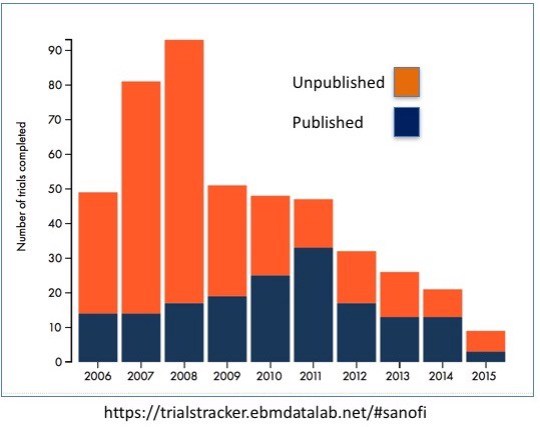
Selective Publication — Negative trials (those that show no benefit for the drugs) are likely to be suppressed. For example, in the case of antidepressants, 36/37 https://www.nejm.org/doi/full/10.1056/NEJMsa065779 studies that were favourable to drugs were published. But of the studies not favorable to drugs, a paltry 3/36 were published. Selective publication of positive (for the drug company) results means that a review of the literature would suggest that 94% of studies favor drugs where in truth, only 51% were actually positive. Suppose you know that your stockbroker publishes all his winning trades, but suppresses all his losing trades. Would you trust him with your money? But yet, we trust EBM with our lives, even though the same thing is happening.
KillingForProfitGraph

Let’s look at the following graph of the number of trials completed versus those that were published. In 2008, the company Sanofi completed 92 studies but only a piddly 14 were published. Who gets to decide which gets published and which does not? Right. Sanofi. Which ones do you think will be published? The ones that favor its drugs, or the ones that prove their drugs do not work? Right. Keep in mind that this is the only rational course of action for Sanofi, or any other company to pursue. It’s idiotic to publish data that harms yourself. It’s financial suicide. So this sort of rational behavior will happen now, and it will not stop in the future. But knowing this, why do we still believe the evidence based medicine, when the evidence base is completely biased? An outside observer, only looking at all published data, will conclude that the drugs are far, far more effective than they are in reality. Yet, if you point this out in academic circles, people label you a quack, who does not ‘believe the evidence’.
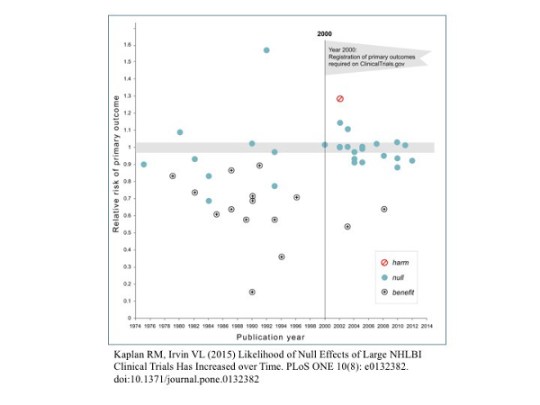
KillingForProfitGraph2Rigging of Outcomes — Or consider the example of registration of primary outcomes. Prior to year 2000, companies doing trials did not need to declare what end points they measured. So they measure many different endpoints and simply figured out which one looked best and then declared the trial a success. Kind of like tossing a coin, looking at which one come up more, and saying that they were backing the winning side. If you measured enough outcomes, something was bound to come up positive.

In 2000, the government moved to stop these shenanigans. They required companies to register what they were measuring ahead of time. Prior to 2000, 57% of trials showed a positive result. After 2000, a paltry 8% showed good results. More evidence of the evidence base being completely corrupted by commercial interest, and the academic physicians who were getting rich on it tacitly allowing corruption because they know that you don’t bite the hand that feeds you
KillingForProfitExcerpt

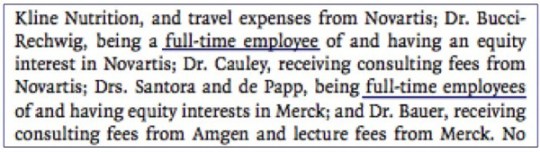
‘Advertorials’ — Or this example of a review paper in the NEJM https://www.nejm.org/doi/pdf/10.1056/NEJMoa1001086 that fracture rates caused by the lucrative bisphosphonate drugs were “very rare”. Not only did the drug companies pay lots of consulting fees to the doctors, three of the authors of this review were full time employees! To allow an advertorial to be published as the best scientific fact is scandalous. Doctors, trusting the NEJM to publish quality, unbiased advice have no idea that this review article is pure advertising. Yet, we still consider the NEJM to be the very pinnacle of evidence based medicine. Instead, as all the editors of the journals sadly recognize, it has become lucre-based publishing. Mo money = better results.

Money from Reprints — The reasons for this problem is obvious to all  https://www.ncbi.nlm.nih.gov/pmc/articles/PMC2964337/ — it’s insanely profitable for journals to take money from Big Pharma. Journals want to be read. So they all try to get a high Impact Factor (IF). To do this, you need to get cited by other authors. And nothing boosts ratings like a blockbuster produced by Big Pharma. They have the contacts and the sales force to make any study a landmark. A less obvious benefit is the fees that are generated by Big Pharma purchasing articles for reprint. If a company publishes an article in the NEJM, they may order several hundred thousand copies of the article to be distributed to unsuspecting doctors everywhere. These fees are not trivial. The NEJM publisher Massachusetts Medical Society gets 23% of its income from reprints. The Lancet — 41%. The American Medical Association — a gut busting 53%. No wonder these journals are ready to sell their readers (ordinary physicians) down the river. It pays. Who needs journalistic ethics when there’s a Mercedes in the driveway? Mo money, baby. Mo money.

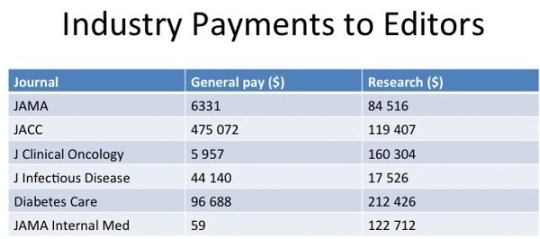
Bribery of Journal Editors — A recent study by Liu et al in the BMJ https://www.bmj.com/content/359/bmj.j4619 shed more light on the problem of crooked journals. Crooked journal editors. Editors play a crucial role in determining the scientific dialogue by deciding which manuscripts are published. They determine who the peer reviewers are. Using the Open Payments database, they looked at how much money the editors of the most influential journals in the world were taking from industry sources. This includes ‘research’ payments, which are largely unregulated. As mention previously, much ‘research’ consists of going to meetings in exotic locale. It funny how many conferences are held in beautiful European cities like Barcelona, and how few are done in brutally cold Quebec City.

Of all journal editors that could be assessed, 50.6% were on the take. The average payment in 2014 was $27,564. Each. This does not include an average $37, 330 given for ‘research’ payments. Other particularly corrupt journals include:
KillingForProfitPayToEditors

This is slightly horrifying. Each editor of the Journal of the American College of Cardiology received, on average $475 072 personally and another $119 407 for ‘research’. With 35 editors, that’s about $15 million in bribes to doctors. No wonder the JACC loves drugs and devices. It pays the private school bills. Mo money = we’ll publish your crooked studies for you. Mo money, baby, mo money.

Publication Bias — The evidence base that EBM depends upon is completely biased. Some people think I’m really anti-Pharma, but this is not really true. Big Pharma companies have a duty to their shareholders to make money. They have no duty to patients. On the other hand, doctors have a duty to patients. Universities have a duty to remain unbiased.

It is the failure of doctors and universities to keep their greedy paws out of the corrupting influence of Big Pharma money that is the problem. If Big Pharma is allowed to spend lots of $$$ paying off doctors and universities and professors, then it should do so to maximize profits. That is their mission statement. Doctors love to blame Big Pharma companies because it takes peoples gaze off the real problem — lots of doctors taking $$$ from anybody who will pay. The pharma industry is not the problem. Bribery of university doctors is the problem — one that is easily fixed if the political will exists.

Consider this study:  https://onlinelibrary.wiley.com/doi/pdf/10.1111/ene.13336  Looking at studies in the field of neurodegenerative disease, researchers looked at all the studies that were started but never finished or never published. Approximately 28% of studies never made it to the finish line. That’s a problem. If all the studies that don’t look promising for drug candidates are not published, then it appears that the drugs are way way more effective than they really are. But the published ‘evidence base’ would falsely support the drug. Indeed, Pharma sponsored trials were 5 times more likely to be unpublished.

Imagine you have a coin flipping contest. Suppose a player call ‘Big Pharma” chooses heads, and also pays the coin flipper. Every time the coin flipper pulls up tails, the results don’t count. Every time it comes up heads, it counts. This happens 28% of the time. Now, instead of a 50/50 split of heads and tails, it’s more like a 66/34 split of heads/tails. So the ‘evidence based medicine’ lover claims that heads is far more likely to come up than tails, and castigates people who don’t believe the results as ‘anti-science’.

Evidence based medicine depends entirely upon having a reliable base of evidence (studies). If the evidence base is tampered with, and paid for, then EBM as a science is completely useless. Indeed, the very editors whose entire careers have been EBM have now discovered it to be worthless. Does the CEO of Phillip Morris (maker of Marlboro cigarettes http://www.greenmedinfo.com/disease/tobacco-toxicity) smoke? That tells you all you need to know about the health risks. Do the editors of the NEJM and the Lancet believe EBM anymore? Not at all. So neither should we. We can’t believe evidence based medicine until the evidence has been cleaned up from the corrupting influence of commercial interests.

Financial conflicts of interest (COI), also known as gifts to doctors, is a well accepted practice. A national survey in the New England Journal of Medicine in 2007 https://www.nejm.org/doi/pdf/10.1056/NEJMsa064508 shows that 94% of physicians had ties to the pharmaceutical industry. This gravy train only rides in one direction. From Big Pharma to the wallets of doctors. Sure Big Pharma can simply pay doctors directly, and it does plenty of that. It’s no surprise that medical students with more exposure to pharmaceutical reps develop a more positive attitude towards them https://www.ncbi.nlm.nih.gov/pubmed/20672554. Many medical schools have limited exposure of medical students in response, but declined to get off the gravy train themselves. There is a simple relationship between how prominent a physician is (more articles published — almost always academic doctors and professors) and how much money they take from Big Pharma. Mo prominent = mo money. Further, there is a ‘clear and strong link’ between taking industry money and minimizing the risk of side effects of medications https://www.ncbi.nlm.nih.gov/pubmed/20299696.  What, you thought people teach at prestigious institutions like universities for the good of mankind? Maybe that’s why they went there, but that’s not why they stay. They came for the science. They stayed for the money.
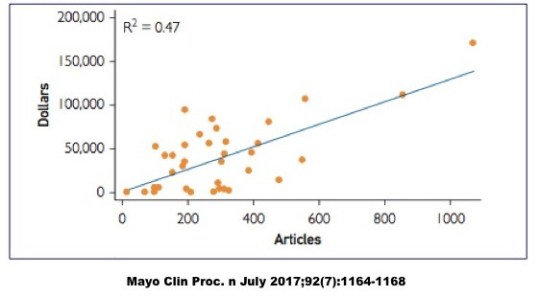
KillingForProfitGraph3

So here’s a damning list of all the problems of EBM

  1. Selective Publication
  2. Rigged outcomes
  3. Advertorials
  4. Reprint Revenues
  5. Bribery of Journal Editors
  6. Publication Bias
  7. Financial Conflicts of Interests

When the evidence base of medicine is bought and paid for, people die. That is how doctors have created this opioid crisis that kills thousands of people. Pharmaceutical companies want to pay off doctors, just as drug lord want to pay off judges and police officers. Doctors, being human, should put safeguards against this temptation. Unfortunately, doctors and universities have been willing participants in this game of killing for profit https://www.facebook.com/NathanGillOfficial/videos/2134121280141545/.   We need to end it now. End the corruption of the universities. Stop the bribery of doctors.

Dr. Aseem Malhotra will be speaking about this very issue to the European Parliament this Thursday:  https://www.dietdoctor.com/live-stream-big-food-big-pharma-killing-profit

Nephrologist. Special interest in type 2 diabetes reversal and intermittent fasting. Founder of Intensive Dietary Management Program.

Disclaimer: This article is not intended to provide medical advice, diagnosis or treatment. Views expressed here do not necessarily reflect those of GreenMedInfo or its staff.

“© [Article Date] GreenMedInfo LLC. This work is reproduced and distributed with the permission of GreenMedInfo LLC. Want to learn more from GreenMedInfo? Sign up for the newsletter here http://www.greenmedinfo.com/greenmed/newsletter.”

______________

**Comment**

I am so thankful people are speaking out about what’s happening to Science.  This is being seen across the board, but particularly with tick borne illness.  This complex illness has been riddled with fraud, collusion, and conflicts of interest from the get-go and hasn’t changed in over 40 years.

For more:  https://madisonarealymesupportgroup.com/2017/01/13/lyme-science-owned-by-good-ol-boys/

https://madisonarealymesupportgroup.com/2018/06/14/corruption-human-rights-violations-against-lyme-doctors-scientists-and-parents-now-on-united-nations-record/

https://madisonarealymesupportgroup.com/2017/08/19/dr-liegner-guidelines-used-by-managed-care-causing-lyme-deaths/

https://madisonarealymesupportgroup.com/2017/01/02/fake-science/

https://madisonarealymesupportgroup.com/2017/09/25/trump-should-eliminate-fake-science/

https://madisonarealymesupportgroup.com/2017/01/28/sit-down-science/

https://madisonarealymesupportgroup.com/2017/12/05/bought-documentary-on-pharma-vaccines-gmos/


NY Senate Approves $1 Million to Combat Lyme

https://www.nysenate.gov/newsroom/press-releases/senate-approves-1-million-investment-combat-lyme-across-new-york-state

Senate Approves $1 Million Investment to Combat Lyme Across New York State

June 19, 2018 ISSUE: LYME AND TICK-BORNE DISEASES

Historic Levels of Funding Build Upon the Senate’s Commitment to Increasing Public Awareness, Treatment, and Prevention of Lyme and Other Tick-Borne Illnesses
The New York State Senate today approved a resolution to provide a record $1 million to help fight the scourge of Lyme and other tick-borne diseases (TBDs) throughout the state. The new funding will help support a wide variety of local investments identified by the Senate’s Task Force on Lyme and Tick-Borne Diseases to increase education, research, prevention, and treatment options, and combat the ongoing increase in TBDs throughout New York.

The Senate Majority – and specifically the Task Force – led the charge in securing this historic level of funding in the 2018-19 state budget. Based on the Task Force’s recommendations, the final budget restores $400,000 in Executive Budget cuts and includes $600,000 in new funding for a total of $1 million.

Senator Sue Serino, Chair of the Task Force on Lyme and Tick-Borne Diseases, said,

“With the State Senate successfully securing an unprecedented $1 million in this year’s budget to bolster awareness, prevention and research initiatives, we are sending a strong message to New Yorkers who have spent years grappling with the devastating impacts of Lyme and tick-borne diseases. This critical funding will play a direct role in helping us to combat the spread of Lyme and TBDs in the state, and with the Hudson Valley sitting at the epicenter of this epidemic, I am especially proud to have secured funding that will go directly to our local community. I thank Senator Kemp Hannon, Chair of the Senate’s Health Committee, who has partnered with me to continue building momentum on this important issue. Working together with partners at all levels, we can ensure that New York has an effective statewide action plan in place to empower patients and better protect residents against the scourge of Lyme and TBDs.”

Senator Kenneth P. LaValle (R-C-I, Port Jefferson) said,

“I am pleased that the Senate was able to secure $1 million for Lyme and Tick Borne Disease (TBD) funding. My colleagues and I fought hard to secure this funding, recognizing the importance of fighting the spread of Lyme and TBD’s throughout the state. My district is particularly hard hit, especially on the East End of Long Island. This money will allow for the continuation of the highly successful Tick Borne Disease Center at Southampton Hospital, a four poster program on Shelter Island directly targeting the spread of ticks from the deer population, and the creation of a new state-of-the-art infectious disease lab at Stony Brook University.”

Senator Betty Little (R-C-I, Queensbury) said,

“I represent a beautiful region of New York State and we want people outdoors, enjoying nature. But the fear of contracting Lyme Disease is increasingly a deterrent and that’s a shame. My experience is that the statistics of reported cases fall short of what is actually happening. A mere mention of Lyme disease among a group of people and you immediately hear horror stories of misdiagnosis and costly long-term treatments. The good news is we are making progress and the Senate task force is playing a major role. We’ve secured funding and spearheaded legislation. We have taken our direction from the public we serve, from those leading the effort to improve diagnosis and treatment and from the incredible insight of patients themselves. This additional funding will make an impact in the North Country and I am very grateful to have helped secure it as part of this year’s budget.”

Highlights of the resolution passed today include:
  • Cary Institute of Ecosystem Studies, Inc. – $192,000 to research community-based prevention methods by continuing and expanding “The Tick Project,” a five-year research project. The funding will help determine whether neighborhood-based prevention can reduce human cases of Lyme and other TBDs.
  • Stony Brook University – $175,000 to open a state-of-the art infectious disease laboratory, which will have an insectary dedicated solely for work on ticks. The laboratory will be open to Stony Brook scientists and others as a regional facility with unique research capabilities. The funds will be used to support activities in the laboratory and new research on TBDs.
  • Cornell University – $130,000 to study the distribution of ticks and the diseases they carry in various parts of the state through the Tick Outreach and Surveillance Project for New York. Run through the New York State Integrated Pest Management (IPM) Program at Cornell University, the research will primarily focus on the spread of ticks by species within certain counties. Other areas of study include ways to reduce human exposure to TBDs, tick management workshops, and best practices in schools, camps, parks, and places where people gather outdoors.
  • New York State Association of County Health Officials (NYSACHO) – $112,000 to increase public awareness throughout New York through eight to 10 regional educational lectures. The informational seminars will focus on community awareness, best practices for TBD investigation, tick surveillance, and disease prevention to local parts of the state heavily impacted by the effects of Lyme and TBDs.
  • SUNY Adirondack – $100,000 for laboratory research on lesser-known TBDs, including infectious diseases known to be comorbid with Lyme disease, such as Babesia, Bartonella, Ehrlichia, Anaplasma, and Powassen virus. The work would help provide much needed information about the rates of these coinfections in people with Lyme disease in New York.
  • Southampton Hospital – $75,000 to fund the Tick-Borne Disease Resource Center, which helps doctors in multiple disciplines collaborate with researchers and community outreach experts to inform and treat individuals from across the region.
  • New York State Department of Health – $60,000 to increase the number of tick collection sites in New York, and the number of ticks tested for pathogens statewide. The funding will also be used to hire temporary staff to assist with sampling and testing, as well as targeting of educational messages in a more efficient manner.
  • SUNY College of Environmental Science and Forestry – $50,000 to monitor seasonal variations of ticks in Western and Central New York to help provide a better understanding of how disease transmission risks are changing. The study will also provide public information to better explain the risks of tick exposure.
  • Paul Smith’s College – $30,000 to study the emergence of TBDs in the North Country by continuing and expanding academic studies that monitor ticks and TBDs.
  • Cornell Cooperative Extension – $26,000 for a series of regional Lyme and TBD forums to be hosted throughout the state. The forums will help provide the public with information on tick identification, tick bite prevention, Lyme disease and co-infection awareness, impact on pets and livestock, and health resources that are available for individuals who have been bitten by a tick.
  • New York State Department of Health – $25,000 to continue database mining, which would include various projects associated with Lyme carditis, as well as deaths associated with Lyme and other TBDs.
  • Town of Shelter Island – $25,000 to help combat the spread of ticks on Shelter Island, which is one of the worst hit areas of the public health crisis. The town has developed a four-poster program to stem the spread of ticks associated with the deer population. The town has built and installed four-poster stations, to remove ticks from deer across the Island, and this funding would maintain and expand the efforts of this critical initiative.

In addition to the $1 million announced today, the Senate was instrumental earlier this year in passing apackage of bills aimed at combating Lyme and TBDs, based on the recommendations of the Senate’s Task Force on Lyme and Tick-Borne Diseases.

________________

Also see:  https://madisonarealymesupportgroup.com/2018/06/20/ny-governor-cuomo-announces-public-private-research-collaboration-to-advance-diagnosis-and-treatment-of-tick-borne-diseases/

Northern & Southern CA Cats have Bartonella and Rickettsia – Proven by 16S rRNA Next Gen Sequencing

https://www.ncbi.nlm.nih.gov/m/pubmed/29893631/

Assessing Cat Flea Microbiomes in Northern and Southern California by 16S rRNA Next-Generation Sequencing.

Vasconcelos EJR, et al. Vector Borne Zoonotic Dis. 2018.

Abstract
Flea-borne diseases (FBDs) impact both human and animal health worldwide. Because adult fleas are obligately hematophagous and can harbor potential pathogens, fleas act as ectoparasites of vertebrates, as well as zoonotic disease vectors. Cat fleas (Ctenocephalides felis) are important vectors of two zoonotic bacterial genera listed as priority pathogens by the National Institute of Allergy and Infectious Diseases (NIAID-USA): Bartonella spp. and Rickettsia spp., causative agents of bartonelloses and rickettsioses, respectively.

In this study, we introduce the first microbiome analysis of C. felis samples from California, determining the presence and abundance of relevant pathogenic genera by characterizing the cat flea microbiome through 16S rRNA next-generation sequencing (16S-NGS). Samples from both northern (NoCal) and southern (SoCal) California were assessed to expand current knowledge regarding FBDs in the state. We identified Rickettsia and Bartonella, as well as the endosymbiont Wolbachia, as the most abundant genera, followed by less abundant taxa. In comparison to our previous study screening Californian cat fleas for rickettsiae using PCR/digestion/sequencing of the ompB gene, the 16S-NGS approach applied herein showed a 95% level of agreement in detecting Rickettsia spp. There was no overall difference in microbiome diversity between NoCal and SoCal samples. Bacterial taxa identified by 16S-NGS in this study may help to improve epidemiological investigations, pathogen surveillance efforts, and clinical diagnostics of FBDs in California and elsewhere.

_____________

**Comment**

Bartonella and Rickettsia spp. are also diseases Lyme/MSIDS patients have to contend with.  There is no good, solid research studying the ability of ticks to transmit Bartonella, yet most of us out here in Lyme land have it.  Rickettsia’s out here too in plenty.  I would think this important issue would be dealt with.  Somehow patients are getting these diseases and its either happening by direct transmission or by being activated once they get Lyme and their immune systems become compromised.

Either way, this issue MUST be studied, resolved, and appropriately death with.

Mainstream medicine is completely lost when it comes to tick borne illnesses such as these.  Lyme is finally getting acknowledged due to shear numbers, but don’t kid yourself, thousands upon thousands have Bartonella and Rickettsia as well.  The one drug, one pathogen paradigm needs to be forgotten like a bad dream and researchers and doctors need to become educated on this complex 21st Century plague.

BTW:  Wolbachia is being widely used as a biocontrol.  Here’s why that may not be such a great idea:  https://madisonarealymesupportgroup.com/2017/07/10/wolbachia-the-next-frankenstein/

https://madisonarealymesupportgroup.com/2018/02/12/wolbachia-laced-mosquitoes-being-released-why-lyme-msids-patients-might-be-negatively-affected/

https://madisonarealymesupportgroup.com/2018/05/22/mosquito-spit-alone-may-significantly-alter-your-immune-system-for-days-after-a-bite/

https://madisonarealymesupportgroup.com/2018/05/02/tick-mosquito-and-flea-diseases-more-than-tripled-since-2004/

It is my strong opinion that ALL of these factors are a perfect storm of events causing human suffering and disease.  Researchers need to zoom out and look at the big picture and the interconnection of things or we are doomed.

NY Governor Cuomo Announces Public-Private Research Collaboration to Advance Diagnosis and Treatment of Tick-Borne Diseases

https://www.governor.ny.gov/news/governor-cuomo-announces-new-public-private-research-collaboration-advance-diagnosis-and

For Immediate Release: 6/19/2018

GOVERNOR ANDREW M. CUOMO

Wadsworth Center Laboratory and Regeneron Pharmaceuticals, Inc. Aim to Improve Diagnosis of Lyme Disease and Develop New Treatments

Governor Andrew M. Cuomo today announced a new, groundbreaking public-private research collaboration to advance the diagnosis and treatment of tick-borne diseases. The New York State Department of Health Wadsworth Center Laboratory and Regeneron Pharmaceuticals, Inc. – a leading biotechnology company that invents life-transforming medicines for people with serious diseases, will collaborate to potentially develop improved diagnostics, prophylactics, and therapeutics for the diagnosis and treatment of tick-borne diseases, starting with Lyme disease.

“This public-private collaboration harnesses the expertise of a world-leading biotech company to tackle one of the most pressing public health issues of our time,” Governor Cuomo said. “Together, Regeneron and the Wadsworth Center Laboratory have the potential to advance health research, develop life-saving treatments for Lyme disease, and address major gaps in our knowledge of tick-borne illnesses. New York is proud to help bolster our world-class, life sciences industry while investing in a safer, healthier Empire State for all.”

Tick-borne diseases, particularly Lyme disease, are among the fastest growing infectious diseases in the United States. When diagnosed correctly and treated, most Lyme disease patients recover within two weeks. However, proven diagnostic tests for Lyme disease have been mostly unchanged for the past 40 years and can have limitations when used at certain times during the course of illness, leaving patients and their providers frustrated, which may lead to missed opportunities for treatment.

Regeneron and the Wadsworth Center Laboratory will jointly research how the causative agent of Lyme disease, the bacterium Borrelia burgdorferi, replicates when a human is bitten by a tick carrying the bacterium, and how the host’s immune response is activated. This information will potentially advance the development of improved diagnostics, prophylactics, and new therapeutics. Over the course of five years, Regeneron will invest up to $48 million in this research and the state will reimburse 50 percent of Regeneron’s research costs up to a total reimbursement of $24 million through the New York State Life Sciences Initiative. Additionally, up to $6 million will be provided to Wadsworth Center Laboratory through the Life Sciences Initiative.

The groundbreaking collaboration between Regeneron and the Department of Health’s Wadsworth Center Laboratory builds on Governor Cuomo’s $750 million commitment to support construction of a new worldclass, stateoftheart Wadsworth Center Laboratory public health laboratory in the Capital Region that will promote collaborative public-private research. Redesigned as “A Lab for The 21st century,” Wadsworth will function as a magnet for future private sector investments where employees, visiting researchers, company executives, and academic partners cross paths to accelerate innovation and value creation. As one of the world’s largest public health research laboratories, this modern facility and committed co-investment will serve as a flagship project for the state, signaling a strong and long-term commitment to the Capital Region’s life sciences industry.

The Wadsworth Center Laboratory serves a vital role in the Department of Health’s efforts to protect and promote the health of New York residents. Building on more than a century of excellence as the state’s public health laboratory, the Wadsworth Center Laboratory continues as a premier biomedical institute that merges clinical and environmental testing with fundamental, applied and translational research. Today, laboratory scientists use both classical and contemporary approaches to study environmental and biological questions related to human health and disease, which will support the collaboration with Regeneron.

Regeneron is a science-driven, world-leading biopharmaceutical company headquartered in Tarrytown, New York that discovers, develops and manufactures innovative medicines. Regeneron was established as a biotech start-up in 1988 in New York City, and the following year, under the leadership of then-Governor Mario Cuomo, Empire State Development invested $250,000 to support the company’s growth. Within years, the state realized a 300-percent return on that investment. Regeneron is now the largest biotech company in New York State and one of the largest in the world, with several approved treatments and a robust pipeline of compounds all developed in New York laboratories.

Regeneron is progressing several important potential infectious disease treatments, all of which were built and tested using the company’s proprietary VelociSuite platforms. Regeneron’s Rapid Response capability speeds development of potential treatments by using their VelociGene and VelocImmune technologies to quickly develop fully human antibodies specific to a particular pathogen and create a genetically humanized model to test and validate these antibodies. The company recently delivered its investigational Ebola treatment, REGN-EB3, to the Democratic Republic of the Congo for potential use in the ongoing outbreak.

ESD President, CEO & Commissioner Howard Zemsky said, “Empire State Development is proud to incentivize this innovative partnership between Regeneron and the Wadsworth Center Laboratory that both advances human health and spurs the growth of a world-class life science research cluster in New York.”

Department of Health Commissioner Dr. Howard Zucker said, “The Department’s Wadsworth Center Laboratory is home to some of the nation’s premier research scientists, and by partnering with a first-class organization like Regeneron, we are taking a significant step forward in developing a more accurate and efficient test to diagnose and ultimately treat these devastating diseases. Governor Cuomo understands the important role research plays in improving the health and well-being of New Yorkers.”

“As a proud New York biotech company, we appreciate the continued commitment of Governor Cuomo’s administration to make New York the ideal location to progress innovative life science research,” said Leonard S. Schleifer, M.D., Ph.D., President and Chief Executive Officer of Regeneron. “We are looking forward to expanding the potential impact of our infectious disease program and collaborating with the Wadsworth Center Laboratory on potential solutions for tick-borne diseases, which are increasing in incidence and can be extremely difficult to diagnose and treat.”

Senator Sue Serino, Chair of the Task Force on Lyme and Tick-Borne Diseases said, “Since taking office, I have heard from countless New Yorkers who have suffered gravely as a result of an inaccurate Lyme Disease diagnosis and lack of advancement in this field. Last year, Senator Kemp Hannon and I held a joint hearing to help the state improve its response to the Lyme and tick-borne disease epidemic. At that time, we urged the state to lead the way and make a significant investment in this critical area. As Chair of the Senate’s Task Force on Lyme and Tick-Borne Diseases, I am proud that the voices of so many who have been suffering in silence for far too long are finally being heard. I thank the Governor for giving this issue the attention it deserves and I look forward to the day when false negatives and inaccurate results are a thing of the past and patients in New York can receive the effective, quality care they deserve.”

Senator Neil D. Breslin said, “The growth of health care treatments and services have become key economic drivers for New York’s economy. The Governor’s focus on expanding these industries provides a major boost to the Capital Region by supporting our academic institutions, attracting top scientists, and advancing treatments for diseases like Lyme that impact so many of our residents. I look forward to the continued development of treatments through this new collaboration, and thank Regeneron for working with the state of New York to provide stronger communities for the next generation.”

Assembly Member Patricia A. Fahy said, “The Governor’s comprehensive Life Sciences initiative is drawing world-class researchers Upstate to be part of the transformative health advances that are being discovered right here in the Capital Region. I am proud of the life-changing R&D that Wadsworth and Regeneron have already accomplished, and by partnering on this latest endeavor, New Yorkers across the state will reap the benefits of newly developed diagnoses and treatments.”

Assembly Member John T. McDonald III said, “Lyme Disease and tick-borne diseases are ongoing healthcare concerns especially in New York State. I applaud this public-private partnership that advances the research surrounding these diseases and will hopefully provide innovative solutions to this issue. The Governor’s new investment to support the partnership between Regeneron and Wadsworth Center Laboratory will take these efforts even further by leveraging the assets found in the Capital Region to develop new, potentially life-saving treatments for tick-borne illnesses. I proudly support projects that aim to keep the health of all New Yorkers a top priority.”

Albany County Executive Daniel P. McCoy said, “I commend Governor Cuomo for investing in the development of new treatments for Lyme disease here in the Capital Region at the Wadsworth Center. By supporting New York State’s growing life science research cluster, this partnership will help create jobs, develop new life-saving health services and support an improved quality of life for our residents.”

Albany Mayor Kathy Sheehan said, “As summer approaches, New Yorkers are reminded of the dangers of tick-borne illnesses. This collaborative public-private partnership will bring together world-class scientists and health researchers to uncover new treatments and preventative measures at the Capital Region’s premiere public health laboratory. Thank you to Governor Cuomo for supporting this critical public health project and investing in Albany’s Wadsworth Center Laboratory.”

New York State’s $620 Million Life Science Initiative

In the FY 2018 state budget includes a $620 million initiative to spur the growth of a world-class life science research cluster in New York, as well as expand the state’s ability to commercialize this research and grow the economy. The Governor’s multi-faceted initiative includes, $100 million to expand the Excelsior Jobs Program Tax Credit to the life sciences industry, $100 million for a life sciences research and development refundable tax credit program, and $320 million in other forms of investment.

To support the development of wet-lab and innovation space, the initiative includes state capital grants for operating support and investment capital for early stage life science companies that leverage an additional match of at least $100 million from the private sector.

The Life Science sector encompasses the fields of biotechnology, pharmaceuticals, biomedical technologies, life systems technologies, and includes organizations and institutions that devote the majority of their efforts to the various stages of research, development, technology transfer and commercialization. Every day, firms in this sector are developing new medical and pharmaceutical breakthroughs that have the potential to save lives, whether through new therapies or the early detection of diseases like autism and cancer. These firms are also making significant advancements in the realms of agriculture and environmental biotechnologies, helping create a cleaner and more sustainable future.

By strengthening incentives, investing in the facilities, and improving access to talent and expertise, New York will significantly increase its share of industry-funded research and development, support the commercialization of existing academic research, and usher in the next generation of advanced technologies. Beyond the advancements in science, this initiative will position New York as a magnet for emerging manufacturing- based enterprises to bolster regional economies and create thousands of jobs.