MADISON – It’s officially summer, and lawmakers are aiming to curb the growing problem of Lyme disease in the state through education and prevention efforts.
A bipartisan package of five bills would direct the state Department of Natural Resources to post signs about the tick-borne disease in public parks, sell bug spray with the powerful DEET repellent and conduct an awareness campaign each May.
The legislation would also create an epidemiologist position in the Department of Health Services focused on the disease and establish a 16-member study committee tasked with recommending to the Legislature policy changes regarding awareness, prevention and treatment of Lyme disease.
“Increasing awareness … will reduce the chances of people getting Lyme disease or other tick-borne illnesses and increase the chances that, if you do get it, it’ll be diagnosed properly and the treatment handed to you quickly,” Miller said.
Data from the Centers for Disease Control and Prevention show Wisconsin had the fourth highest number of reported cases of Lyme disease in the country in 2017. DHS data shows the number of cases of Lyme disease has increased over the past 30 years and estimated Wisconsin had 3,105 cases in 2018.
DHS spokeswoman Jennifer Miller said permanent damage from Lyme disease is “quite rare.” But she added that long-term damage to the nervous system is possible in patients who were not treated until the later stages of the disease.
Green Bay Republican Sen. Robert Cowles, who is also sponsoring the legislation, said he has friends who have suffered from the effects of Lyme disease. He predicted that, once the bills have a public hearing, many people will come forward in support of the legislation.
“These five bills we hope will promote this issue enough so people will have a good handle on this as time goes by,” Cowles said. “It is something the Legislature has to pay attention to.”
The bill of particular concern is bill#5 in that it:
“Establishes a sixteen-member Tick-Borne Disease Study Committee to create a report for the legislature on consensus-based recommendations for policy changes on awareness, prevention, surveillance, diagnosis, reporting, and treatment of Lyme Disease.”
Nothing about Lyme/MSIDS is agreed upon except the fact early detection and treatment is imperative. If this 16 member committee is only filled with CDC/IDSA believers, patients and the doctors who dare to treat them are doomed as it will be business as usual or perhaps will make things even worse as they could further restrict a doctor’s ability to treat this.
I’ve spoken with numerous WI LLMD’s and they feel this is huge government overreach and that this would never happen in the areas of cancer, diabetes, or other health issues.
Chronically infected patients need representation by qualified ILADS trained practitioners who understand the complexity of diagnosis, testing, and treatment.
If you’ve been keeping up, you are privy to the fact the TBDWG is being stacked against patients at the federal level with IDSA-types and hardly any patients & advocates. I do believe this was their plan from the get-go.
Another fact is that legislation often takes 5-10 years to pan out. Many patients aren’t healthy enough for that type of stress. Getting involved with politics is like running a marathon. You can’t quit half way through. Wording that can completely change the outcome can change at the eleventh hour requiring savvy and bullish persistence.
As well-meaning as patients are, they are often very, very sick as well as uneducated about the underhanded way this has all been handled from inception. They also often don’t understand the polarity in the medical community and how legislation they create& agree to could hurt the very doctors who are properly treating Lyme/MSIDS patients.
Please contact the authors of the bills with these concerns. They need to hear from you.
LYME DISEASE CURRICULUM AND EDUCATIONAL ACTIVITIES
It’s Time to Be Lyme Alert
It’s Time to Be Lyme Alert is a fun, interactive curriculum designed by GLA in partnership with educators to be shared in the classroom, at camp and other youth-focused organizations. The curriculum, available in three age-group levels, includes a student workbook that outlines the objectives and key talking points, along with a supporting teachers’ guide.
Ideal activities for use in classrooms – Grades: K – 12:
Basic Science
Health Education
Health Science
Social/Emotional Learning (Grades: 9-12)
For Teachers
Teacher’s Guide: provides educational objectives, key talking points to help you guide students thru the activity.
Word games and other activities test student’s knowledge to assess their progress.
Student Workbooks (K-12): teaches students about Lyme disease, all about ticks, and tick prevention.
Learners earn a “Lyme Alert” certificate upon successful completion of activity.
Bonus! Learners can share their certificate with friends and family on Facebook and Twitter.
For Students
Learn important facts about ticks, Lyme disease, and tick prevention, in a fun, interactive comic format.
Learn the importance of showing empathy to fellow classmates who may be dealing with a chronic illness.
Earn a Lyme Alert Certificate upon completing the course. Students and parents can share their accomplishment on Twitter and Facebook.
*Disclaimer: Be Tick AWARE Prevention Kits are intended to provide tick bite protection practices. Global Lyme Alliance does not guarantee tick bite protection or tick-borne disease prevention when implementing this information. GLA recommends doing a daily full-body tick check.
Children are at the greatest risk for Lyme and other tick-borne diseases. Help teach kids how to protect themselves from a tick bite with a Be Tick AWARE Prevention Kit. Great for families, schools, camps, and other youth-based organizations.
Parasitol Res. 2015 Feb;114(2):671-8. doi: 10.1007/s00436-014-4232-y. Epub 2014 Nov 22.
Pilot study assessing the effectiveness of factory-treated, long-lasting permethrin-impregnated clothing for the prevention of tick bites during occupational tick exposure in highly infested military training areas, Germany.
The protective effectiveness of factory-based permethrin-impregnated polymer-coated battle dress uniforms (PTBDUs) against tick bites was evaluated at four military training areas in southwestern and central Germany where tick bite incidence is known to be high. Data were analyzed by comparing tick bite incidence using non-permethrin-treated BDUs (NTBDUs) during 2009 versus PTBDUs during 2010 and 2011, the first two years after their formal introduction for in-country use in the German Bundeswehr. During 2009, 262 individual tick bites were reported at the four training sites, resulting in a tick bite incidence of 8.8 % per exposed person when wearing NTBDUs only. In 2010 and 2011, one tick bite case occurred under field conditions each year that PTBDUs were worn, corresponding to a protective effectiveness of 99.6 and 98.6 %. These data imply an annual tick bite incidence of 0.035 and 0.078 % per exposed person, respectively. Between 2010 and 2011, a 0.8 % decline in the protective effectiveness of PTBDUs was observed. Five tick bite incidents occurred while wearing non-impregnated parkas over correctly worn PTBDUs. Ixodes ricinus ticks were collected by standard tick drags from 2009 to 2011, with high mean annual densities ranging from 28.9 to 106.5 ticks per 100 m(2), while single drags revealed tick densities between zero and 381 ticks per 100 m(2).
Overall, 4596 I. ricinus ticks (54 ♂, 82 ♀, 1776 nymphs, and 2684 larvae) were collected, of which 128 (2.8 %; mean annual range, 0-10.1 %) were Borrelia burgdorferi s.l. positive. The Borrelia genospecies distribution was as follows: 112 (87.5 %) Borrelia afzelii, 10 (7.8 %) B. burgdorferi s.s., and 6 (4.7 %) Borrelia garinii. Neither the tick density means from 2009 to 2011 nor associated B. burgdorferi s.l. prevalences differed significantly among the military locations investigated.
The documented tick bite reductions clearly demonstrate the powerful protective effectiveness of properly worn PTBDUs against tick bites. Nevertheless, all apparel worn over PTBDUs should also be impregnated with permethrin in order to prevent tick infestation and subsequent bites.
Ticks are out for the summer: How can bites be prevented?
People who have experienced symptoms related to tick-borne disease generally say they wouldn’t wish these illnesses on anyone. Despite the educational information tick-borne disease patients repeatedly provide in the media and to their friends, many people do not act to prevent tick bites when participating in activities that may put them at risk.
The Tick-Borne Disease Working Group report released earlier this year (we reported on it here) stated that health care providers and the public do not understand the risks of tick-borne disease. Even when they do, information about prevention may not be easily accessible. Recreational parks and trails in Lyme-endemic areas of the United States, like New York state, are more likely to have signs that warn visitors about the dangers of tick exposure. However, tick-borne disease is reported around the country and these warnings are often missing in areas where it is not as prevalent.
Currently only four products are approved as tick repellents in the US. Two of these are categorized as “natural.” Other products that have shown promise in the laboratory are not making progress to market as quickly as they could. Fortunately, there is more that can be done to prevent tick bites.
Physical
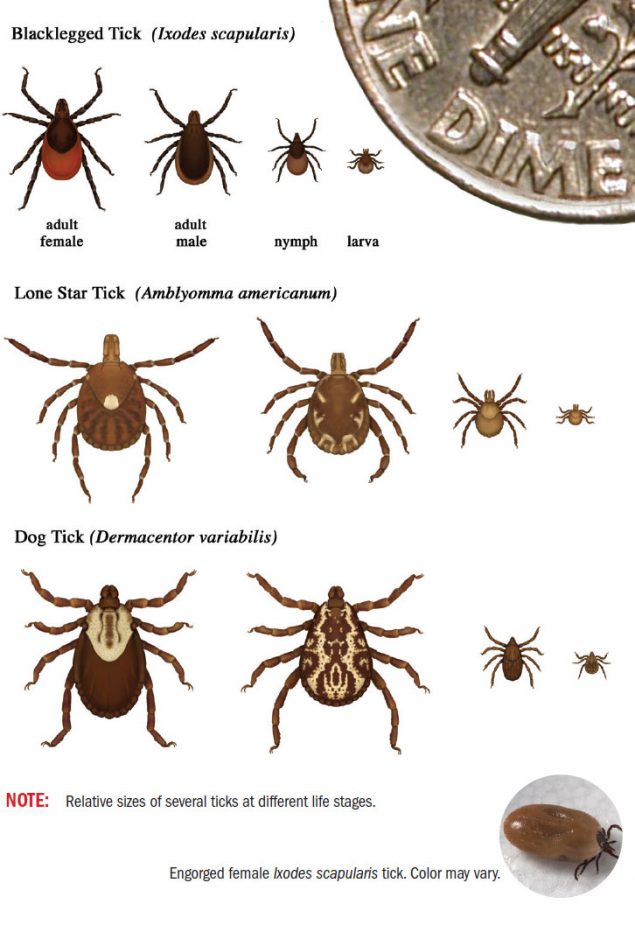
Prevention starts with wearing clothing that covers the skin. Tuck pants into socks and wear light colors so ticks can easily be seen. When spending time in an environment where ticks may be present, do a whole-body check for ticks at least once every 24 hours. Ticks vary in size depending on their life stage and species, but deer tick nymphs can be as small as a fleck of black pepper. Therefore, it is essential to pay close attention to spots that may appear as new freckles or moles.
The relative sizes of a few common tick species at different life stages (Source: CDC).
Bryon Backenson, New York’s deputy director of communicable disease control, relies on these steps for himself and his team. More than 300 times per year they enter tick-infested environments to collect ticks for surveillance. They cannot wear repellents since they’re actually trying to collect ticks. So far, no one on his team has contracted a tick-borne disease.
Repellents
The two chemical tick repellents that are approved for human use in the US are Permethrin and DEET.
Permethrin has been developed to be similar to an extract from the chrysanthemum flower. Because of the variety of vector-borne diseases that it can help prevent, it is on the World Health Organization’s List of Essential Medicines.
While it is neurotoxic to arachnids, insects and cats, humans and dogs break it down quickly. Furthermore, less than 1% is absorbed through the skin in humans. Women who have had whole-body exposure to permethrin for scabies treatment during pregnancy have had good outcomes. However, permethrin can cause tumors in rats when eaten. It can also cause skin irritation, which is why it is generally used on clothing. It can sicken cats who get a secondary exposure from dogs or humans that have used the product.
When using topical preventatives containing permethrin on dogs, it is important to follow the usage directions on the label. Most preventatives require dogs to not be bathed within 24-48 hours of application because the natural oils the skin produces must be present for maximum efficacy. Preventing ticks on dogs helps keeps them out of homes and away from people.
An advantage of permethrin is that it can remain effective for more than 21 days after application to clothing. In addition, it does not seem to be toxic to young children. (Always check with your health care provider.)
DEET (tiethyltoluamide) is often used when the skin needs protection. A common commercial product contains 25% DEET and is effective for about four hours. DEET should not be used on infants under two months old, and DEET concentration and frequency of use should be limited on children under 12 years old. Too frequent and too heavy applications of DEET can cause poisoning even in adults, though most adults use DEET without problems. The US EPA has documented four deaths related to DEET. DEET can cause damage to some clothing.
So why do people still use DEET? Exposure to ticks in high-risk areas may make DEET risks lower than the risk of disease. For example, 5% of Appalachian Trail through-hikers contract Lyme disease.
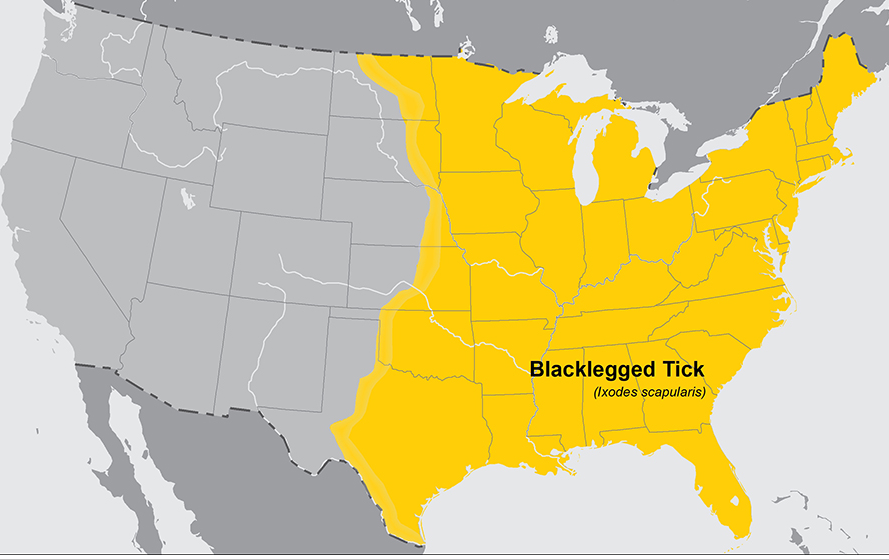
Ixodes scapularis, the primary tick vector for Lyme borreliosis, is widely distributed across the eastern half of the United States (Source: CDC).
There are also two “natural” tick repellents registered with the US Environmental Protection Agency (EPA) and one in the review process. These repellents should not be used on children under three years old. An overview of these repellents:
2-undecanone is derived from wild tomato. In laboratory testing, this chemical was more effective than DEET at repelling Ixodid species ticks, including those that carry Lyme disease. However, it can cause a skin reaction, especially after repeated applications.
Mixed Essential Oils (rosemary, lemongrass, cedar, peppermint, thyme, geraniol) are available in a variety of formulations. In testing, some formulations have proven more effective than others and effective for different lengths of time. Essential oils have been associated with allergic reactions, respiratory issues, chemical burns and other adverse reactions and may not be safe around babies or during pregnancy.
Nootkatone is an essential oil that can be derived from several sources and is currently under EPA review for development as a marketed product. In laboratory testing, an advantage of this product was that repelled ticks even at low concentrations, possibly reducing the risk of side effects.
Other products show promise as tick repellents, but none have been approved as marketed products in the US. For example, tea tree oil has been found to be effective in repelling ticks from cattle in a peer-reviewed published study, but it has not been studied and approved for human use in the US.
Conclusion
The biggest message in prevention is that tick bites are not inevitable. Tick-bite prevention works if done properly. The biggest barrier to prevention is awareness of the risk of tick-borne disease. If people do not understand the risk of tick-borne diseases, proper clothing seems like too much trouble, and thinking about the safety of tick repellents seems pointless.
This summer, let your friends and relatives know that even if they do not want to use tick repellents, they can use protective clothing. Repellents, in balance with the risk of tick-borne disease, should also be considered. With public education it is possible to reduce the number of people infected with tick-borne diseases.
New York State Department of Environmental Conservation. (2010). Registration of a major change in labeling for 2-Undecanone as contained in Bite Blocker BioUD insect repellent and clothing treatment (EPA Reg. No. 82669-2) (Active Ingredient Code 044102) [Official letter signed by Maureen Serafini, Director, Bureau of Pesticides Management]. Retrieved from: http://pmep.cce.cornell.edu/profiles/insect-mite/propetamphos-zetacyperm/undecanone/biteblk_mcl_0810.pdf
Yim, W. T. et al. (2016). Repellent effects of Melaleuca alternifolia (tea tree) oil against cattle tick larvae (Rhipicephalus australis) when formulated as emulsions and in β-cyclodextrin inclusion complexes. Veterinary Parasitology, 225, 99-103. doi:10.1016/j.vetpar.2016.06007. https://www.ncbi.nlm.nih.gov/pubmed/27369582
As to the map of the black-legged tick, please remember, it’s not the only tick spreading disease and every single state has been affected by tick-borne illness. The South and places like California have fought hard to be recognized and thousands have gone undiagnosed because authorities state a certain tick or illness doesn’t exist there. For examples of this:
Based on our findings, health-care providers should be aware that migratory songbirds widely disperse B. burgdorferi-infected I. scapularis in Canada’s North, and local residents do not have to visit an endemic area to contract Lyme disease.
Our findings substantiate the fact that migratory songbirds transport neotropical ticks long distances, and import them into Canada during northward spring migration. Health care practitioners need to be aware that migratory songbirds transport pathogen-laden ticks into Canada annually, and pose an unforeseen health risk to Canadians.
So neotropical ticks are ending up in Canada. Doesn’t have a thing to do with climate change. Birds are transporting ticks in places they’ve never been before and bringing their pathogens along for the ride to infect animals and humans.


 Madison Area Lyme Support Group