Archive for the ‘Alpha Gal Meat Allergy’ Category

Lone Star Tick, Known to Cause Red Meat Allergy, Found in Northern Wisconsin: Report

https://www.foxnews.com/health/lone-star-tick-wisconsin-red-meat-allergy

Lone Star tick, known to cause red meat allergy, found in northern Wisconsin: report

By Madeline Farber for Fox News. You can follow her on Twitter @MaddieFarberUDK.

The Lone Star tick, a type of tick that’s known to cause some people it bites to develop an allergy to red meat, has reportedly been found in northern Wisconsin — a rare occurrence as these small arachnids aren’t typically found in the state. 

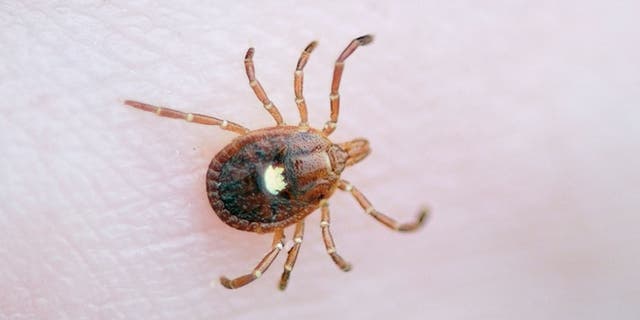
The tick was purportedly spotted near Eau Claire County, per local news Channel 3000. Lone Star ticks, which are not native to the state and are named for the white spot on the back of adult females, are sometimes reported in the southern half of Wisconsin, if at all, according to the Department of Entomology at the University of Wisconsin-Madison.

Susan Paskewitz, the chair of the Entomology Department at the university, told Channel 3000 the Lone Star tick reported likely found its way north by attaching itself to a bird or other animal that later made its way to the area.

Last summer, Scott Commins — an allergist and associate professor of medicine at University of North Carolina, Chapel Hill and one of the first physicians to discover the connection between Lone Star tick bites and the alpha-gal meat allergy —  told Fox News the allergy caused by a Lone Star tick bite is relatively rare. That said, the number of cases has sharply increased from the roughly two dozen he and his colleagues first studied in 2009.

LONE STAR TICK BITES TRIGGERING RED MEAT ALLERGIES IN MORE PEOPLE ACROSS US, PHYSICIAN SAYS

Commins offered a few different reasons for the increase.

First, doctors can now perform a blood test that detects the allergy, “which has made the diagnosis much easier,” he said.

A Lone Star tick. (iStock)

A Lone Star tick. (iStock)

Additionally, the “range of the Lone Star tick is increasing and expanding,” Commins said, which ultimately increases the chance of getting bitten. Higher costs of living could partly be to blame, causing more people in recent years to trade urban life for the suburbs. This movement results in closer contact with tick-carrying deer, which subsequently increases the chance for tick bites.

Commins also said a heightened awareness about the allergy has led those with symptoms to talk to their doctor and investigate if a Lone Star tick bite could be the cause.

Though it’s not totally clear how Lone Star tick bites sometimes result in the allergy, Commins said the tick’s saliva may be a factor.

“There’s a common pathogen in all of these ticks,” he said at the time.  “It could be a protein or enzyme in tick spit. We’re working on that in the lab at the moment.”

Not unlike the symptoms of a peanut, egg, tree nut or a shellfish allergy, many people who are allergic to red meat may experience hives, a skin rash or anaphylaxis.

Commins warned many also experience “severe GI [gastrointestinal] distress,” such as stomach pain, indigestion, vomiting and diarrhea. Some people have described their gastrointestinal symptoms as “stabbing pain or [being stuck with] a hot poker,” he added.

COLORADO GIRL, 7, DIAGNOSED WITH RARE TICK PARALYSIS AFTER OVERNIGHT CAMP

That said, the symptoms of a red meat allergy are not always immediate. In fact, Commins said, it usually takes hours after eating red meat for the symptoms to appear.

There is no cure for the allergy at this time; the most those with the allergy can do is to avoid red meat, which includes beef, lamb, pork, veal, and goat, among others.

But the news isn’t all bad.

“There is a bright spot in this; this is one of these food allergies that will resolve over time,” he said, though he noted additional tick bites may prolong the condition.

**Comment**
Another example of a tick in a place it’s not supposed to be.
BTW: this isn’t the first time it’s been found in Northern Wisconsin:  https://madisonarealymesupportgroup.com/2017/01/12/tick-related-red-meat-allergy-found-in-minnesota-wisconsin/  Excerpt:
According to Dr. Alaaddin Kandeel, an allergist at Essentia Health in Duluth, he’s diagnosed 18 patients with alpha-gal allergy – 10 from northeast Minnesota and 8 from northwest Wisconsin – hardly accepted Lone Star territory.  In the audio he states he diagnoses approximately 1 patient per month with Alpha-gal allergy and that the reactions can be severe, from passing out to life-threatening reactions.
One patient a month.  NOT RARE.

And while tick borne diseases are reportable by law, allergies like the alpha-gal allergy are not, so nobody truly knows prevalence.

Doctors should NEVER use a map to turn a patient away who is presenting with symptoms. If they do, turn them in to the authorities.
Many people do not know it isn’t just meat those with Alpha Gal have to avoid.
Anything derived from animals can cause the allergic symptoms including gelatin, daily vitamin supplements, shampoos & conditioners, lotions, & vaccines.
This woman limits her diet and uses vegan supplements, medications and personal care products:  https://madisonarealymesupportgroup.com/2018/05/04/arkansas-woman-develops-deadly-meat-allergy-after-tick-bite/
This is about the worst news possible for Wisconsinites whom can handle pain like nobody on the planet, and keep a stiff upper lip that many would collapse under, but take away our meat, cheese, and beer, and we are an absolute mess!
iu-19

How a Tick Bite Can Give You a Red Meat Allergy

https://www.consumerreports.org/outdoor-safety/how-a-tick-bite-can-give-you-a-red-meat-allergy/

How a Tick Bite Can Give You a Red Meat Allergy

Scientists think that lone star ticks can induce an allergy to red meat. Here’s how to protect yourself.

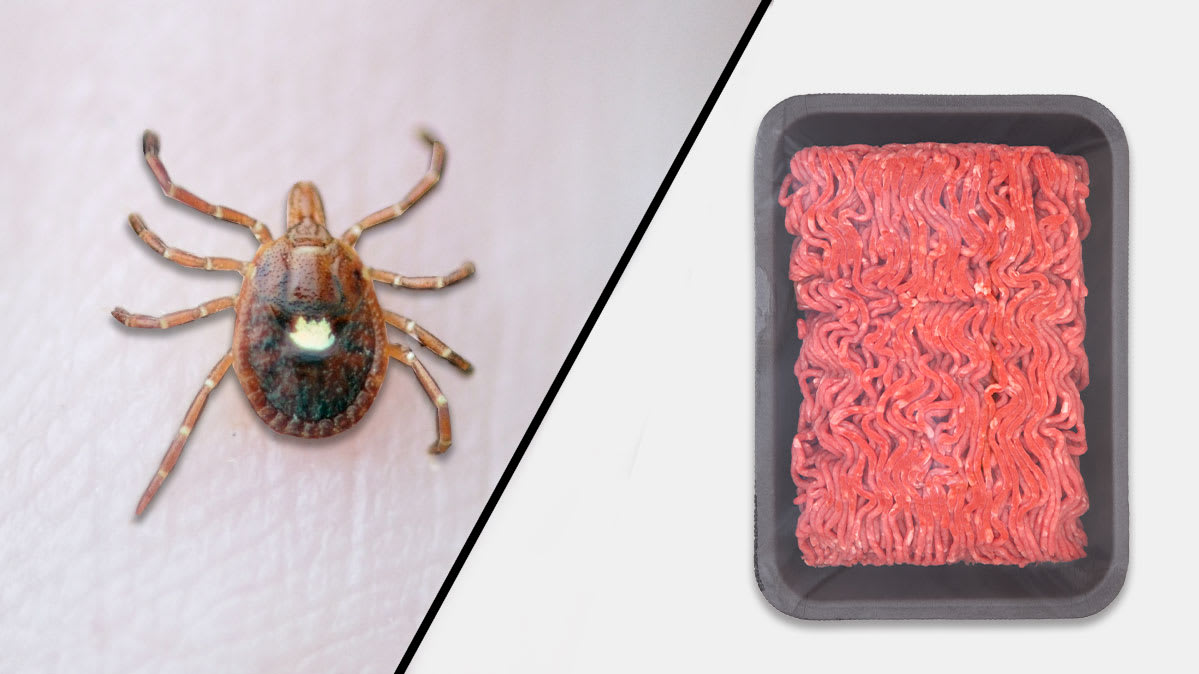
A close-up of a lone star tick, and an image of ground beef.

Most of us worry about Lyme disease or Rocky Mountain spotted fever when getting a tick bite. But different species of ticks can transmit a variety of diseases—and at least one very unusual ailment, scientists have learned: an allergy to red meat.

A growing body of evidence shows that the lone star tick—most prevalent in the southeastern U.S.—could be the cause of an allergy to a carbohydrate known as alpha-gal, which is found in red meat.

Scientists aren’t sure just how common this allergy is. But lone star ticks are spreading—their habitat now extends from the Southeast almost all the way to the Canadian border—which means more people may encounter them. Scientists who study the alpha-gal allergy estimated back in 2013 that more than 5,000 people in the Southeast U.S. alone could have the allergy.

2018 study in the Annals of Allergy, Asthma & Immunology suggests that a meat allergy caused by ticks may be more common than previously known, and could explain some previously unexplained cases of severe allergic reactions.

Here’s what you need to know about this allergy.

What Recent Research Reveals

Initially, scientists connected the dots between lone star ticks and meat allergies because of overlap between the geographic areas where the tick and the allergy were most common, according to an analysis published earlier this year in Annals of Allergy, Asthma & Immunology. Other studies showed that people who had the allergy tended to have a history of being bitten by ticks, or worked in jobs where they were likely to be exposed to ticks.

And in two recent cases reported in The Journal of Allergy and Clinical Immunology: In Practice, people who had an allergic reaction to red meat developed hives around the area where they had been previously bitten by a tick.

The 2018 study looked at just one allergy clinic in Tennessee, and found that in cases where they were able to pinpoint the cause, the alpha-gal allergy was behind about a third of anaphylaxis (severe allergic reaction) cases seen there between 2006 and 2016. That’s more than were caused by food allergies to peanuts, shellfish, or others, the researchers found.

Study author Jay Lieberman, M.D., associate professor at the University of Tennessee Health Science Center and vice chair of the American College of Allergy, Asthma and Immunology Food Allergy Committee, is quick to point out that these results do not mean that a third of severe allergic reactions nationwide are due to the effects of lone star tick bites, or that alpha gal is the number one cause of anaphylaxis in the country.

But Lieberman says the clinic has performed similar analyses in previous years, before the alpha-gal red meat allergy was discovered. In those earlier studies, doctors weren’t able to determine a cause for a greater percentage of anaphylaxis cases.

The newer study suggests that a significant number of those earlier cases with an unknown cause may actually have been due to this recently discovered allergy.

Understanding Meat Allergies

It’s not entirely clear to scientists why a bite from a tick could cause a person to develop an allergy to red meat, Lieberman says, or how common such an allergy is. And it doesn’t happen to everybody who’s bitten.

Only some people who’ve been bitten by lone star ticks will develop the antibodies that indicate a possible allergy to alpha-gal, a substance in red meat. Of the people who do develop those antibodies, Lieberman says, some won’t ever show symptoms of an allergic reaction to red meat.

There’s also an intriguing difference between the alpha-gal red meat allergy and every other type of food allergy. Typically, allergic reactions to food occur immediately after exposure, within a few minutes. With an alpha-gal allergy, however, a reaction typically doesn’t start until several hours after eating red meat—which can make it challenging to pinpoint the culprit.

Researchers first linked tick bites to red meat allergies almost a decade ago. But there are still a lot of questions left to answer about why some people develop the allergy and some don’t, how many people have been affected, and why the reaction to red meat is delayed, rather than immediate.

What to Watch For

Early signs of anaphylaxis may include a metallic taste, burning, tingling, or itching of the tongue or mouth, headache, and feelings of fear or confusion. A reaction can progress quickly, and severe symptoms include throat swelling, difficulty breathing, vomiting, diarrhea, and more.

If you think you may be experiencing anaphylaxis, even if you’ve never had an allergic reaction before, you should call 911. (If you know you have an allergy to food, and you experience symptoms of anaphylaxis, especially trouble breathing, wheezing, or throat swelling, you should use an epinephrine auto-injector if you have one.)

When the reaction is under control, talk to your doctor about whether red meat could have been the cause of your symptoms, since some doctors may not be aware of the alpha-gal allergy, suggests Princess Ogbogu, M.D., division director of allergy and immunology at The Ohio State University Wexner Medical Center.

There’s no cure for red meat allergy, so if you’re diagnosed, you’ll need to avoid the foods that trigger a reaction. Commonly, that includes various kinds of red meats. But some people can also become sensitive to other items that contain alpha-gal, including dairy, and even, rarely, sweets that contain gelatin or medications derived from animal byproducts.

In some cases, Lieberman says, if people who’ve developed alpha- gal allergies avoid all future tick bites from lone star ticks (or the varieties that cause the allergy in other countries), their levels of the antibodies to alpha-gal may diminish, and the allergy could subside. It’s unknown how common this is, however.

About the Lone Star Tick

Lone star ticks, so named for the white splotch on the backs of adult females, are most common in southern and eastern states. Like other ticks, however, their geographic distribution is expanding, according to Ellen Stromdahl, a retired entomologist from the tickborne disease laboratory of the U.S. Army Public Health Center in Aberdeen Proving Ground, Md.

Lone star ticks don’t cause Lyme disease, as a recent analysis that Stromdahl conducted shows. But along with spreading the alpha-gal allergy, they can also transmit the bacteria that cause another disease called ehrlichiosis. Ehrlichiosis can cause fever, muscle pain, nausea, vomiting, and, rarely, rash. It’s fatal in about 1.8 percent of cases, according to the Centers for Disease Control and Prevention, although it can be treated with antibiotics.

A lone star tick is much less likely to carry ehrlichiosis than a blacklegged tick is likely to carry Lyme disease, notes Stromdahl. But lone star ticks are much more aggressive than other common types of ticks in the U.S. “You’re more likely to be mobbed by lone star ticks,” she says, and finding multiple bites is common if you’ve been in their habitat.

Protect Yourself From Ticks

As with any tick bite, it’s important not to panic if you discover one, Lieberman says. “The vast majority in this country and elsewhere who get bitten by ticks don’t develop alpha-gal allergy,” he says.

Still, you can take reasonable precautions to protect yourself from ticks and the diseases—or allergies—they can cause. Here’s what to do:

Wear an effective bug spray if you’re going to be in an area where ticks are common. Lone star and other types of ticks prefer wooded areas, brush, and long grass. Consumer Reports’ insect repellent testing has found that products containing 25 to 30 percent deet provide the most reliable protection. (Check out our top-rated repellents.)

Dress carefully. Wear long pants and long sleeves, and tuck your pants into your socks. Wearing clothing commercially treated with the pesticide permethrin, or treating your clothes and gear with permethrin yourself, is also a good option for additional protection.

Check yourself for ticks at the end of every day you’ve been out in their territory. Taking a shower soon after you come in is a good opportunity to wash away any ticks that may be crawling on your skin without having yet bitten you, and to carefully look for any that have attached. If you find them on you, remove them properly.

Be careful with the clothes you were wearing in tick habitats, Stromdahl recommends. Run them through a cycle in a hot dryer to kill any ticks that may be clinging on, and leave your shoes outside in the sun.

Allergic Reaction Sparks Award-winning Science Fair Project For Missouri Teen

https://www.wpsdlocal6.com/2019/04/10/allergic-reaction-sparks-award-winning-science-fair-project-for-missouri-teen/  News Video Within Link

Allergic reaction sparks award-winning science fair project for Missouri teen

JACKSON, MO — It all started with a tick bite for one southeast Missouri teenager. That bite caused a life-threating food allergy. It resulted in an award-winning science fair project.

Grant Roseman is a home-schooler in Jackson, Missouri. Grant will represent southeast Missouri in Arizona at the Intel International Science and Engineering Fair in May.

“For me, personally, I usually get hives that can last up to two weeks, and I’ve had anaphylactic shock before,” Grant says.

A  bite from a tick made him allergic to red meat.

“It made me really want to figure out how these ticks were getting on humans so much,” he says.

If you check out Grant’s science fair board, you can see he experimented with six different ticks. His goal was to show which one is attracted to carbon dioxide gas the most.

He used dry ice, frozen carbon dioxide gas, to represent the carbon dioxide gas produced by humans.

“I would set the ticks down, and release them with the dry ice on the other end, and see which ones got the farthest,” Grant says.

Here’s what he discovered.

“The Lone Star Tick — the one that causes an allergy — it’s the most aggressive,” Grant says.

Bottom line? The Lone Star Tick seeks out you and your family all because you produce carbon dioxide gas.

“So, the way it detects you is with two organs called the Haller’s organ. Those can detect carbon dioxide, heat, and movement,” he explains.

His research earned him first place at the SEMO Science Fair. Next stop, the Intel International Science and Engineering Fair.

__________________

**Comment**

I’m telling you – it’s the tsunami of the infected who are going to move this mountain!

Well done Mr. Roseman! I’m rooting for you!


Study Shows Most Common Cause of Anaphylaxis is Alpha Gal

https://www.news-medical.net/news/20180730/Study-finds-tick-bite-meat-allergy-as-most-common-cause-of-anaphylaxis.aspx

Study finds tick bite meat allergy as most common cause of anaphylaxis

An increase in the Lone Star tick population since 2006, and the ability to recognize the ticks as the source of “alpha gal” allergy to red meat has meant significantly more cases of anaphylaxis being properly identified.

A new study in Annals of Allergy, Asthma and Immunology, the scientific publication of the American College of Allergy, Asthma and Immunology (ACAAI) showed that at the University of Tennessee Health Science Center, alpha-gal ( a complex sugar found in red meat from beef, pork, venison, etc.) was the most common known cause of anaphylaxis. In previous studies of anaphylaxis, researchers were often unable to identify the source of the severe allergic reaction.

“Of the 218 cases of anaphylaxis we reviewed, 33 percent were from alpha gal,” says Debendra Pattanaik, MD, lead author of the study. “When we did the same review in 1993, and again in 2006, we had a great many cases where the cause of the anaphylaxis couldn’t be identified. That number of unidentified cases dropped from 59 percent in 2006 to 35 percent in this report – probably from the number of identified alpha gal cases. Our research clearly identified alpha gal as the cause of anaphylaxis in the majority of cases where the cause was detected. Food allergies were the second leading cause, accounting for 24 percent.”

The people in the study were seen between 2006 and 2016. The study notes that alpha gal allergy was first identified in 2008, so previous reviews wouldn’t have taken it into consideration. Due to increased awareness of red meat allergy, and more diagnostic testing available, alpha gal allergy went from an unknown entity to the most commonly identified cause of anaphylaxis at this center.

“We understand that Tennessee is a state with a big population of Lone Star ticks, and that might have influenced the large number of alpha gal cases we identified,” says allergist Jay Lieberman, MD, vice chair of the ACAAI Food Allergy Committee and a study co-author. “The Lone Star tick is predominantly found in the southeastern United States and we would expect a higher frequency of anaphylaxis cases in this region would be due to alpha gal. However, the tick can be found in many states outside this region and there are already more cases being reported nationwide.”

The remainder of the cases of anaphylaxis in the study were attributed to insect venom (18 percent) exercise (6 percent) systemic mastocystosis (6 percent) medications (4 percent) and other (3 percent).

A bite from the Lone Star tick can cause people to develop an allergy to red meat, including beef, pork and venison. The allergy is best diagnosed with a blood test. Although allergic reactions to foods typically occur rapidly, within 60 minutes of eating the food, in the case of allergic reactions to alpha-gal, symptoms often take several hours to develop. Because of the significant delay between eating red meat and the appearance of an allergic reaction, it can be a challenge to connect the culprit foods to symptoms. Therefore, an expert evaluation from an allergist familiar with the condition is recommended.

Allergists are specially trained to test for, diagnose and treat allergies. To find an allergist near you who can help create a personal plan to deal with your allergies and asthma, use the ACAAI allergist locator.

__________________

For more on Alpha Gal:  https://madisonarealymesupportgroup.com/2017/01/12/tick-related-red-meat-allergy-found-in-minnesota-wisconsin/  Yes, Martha, it’s here in Wisconsin.

https://madisonarealymesupportgroup.com/2018/07/28/what-the-mystery-of-the-tick-borne-meat-allergy-could-reveal/

https://madisonarealymesupportgroup.com/2018/06/27/alpha-gal-perioperative-management/

https://madisonarealymesupportgroup.com/2018/01/16/a-strange-itch-trouble-breathing-then-anaphylactic-shock/

https://madisonarealymesupportgroup.com/2018/05/04/arkansas-woman-develops-deadly-meat-allergy-after-tick-bite/  As Meritt points out on the Allergy & Asthma Clinic of Northwest Arkansas’ website, the alpha-gal allergy extends to beef, pork, gelatin and products that contain mammalian ingredients.  “That includes dairy products,” Burton said. “Mammal biproducts are in everything — daily vitamin supplements, shampoo, conditioners, hand and body lotions … all those things were keeping my system agitated. Pork or beef would just put it over the edge.”
A lot of vaccines are either made with animal products or have gelatin in it.

Tickology Video Series – Everything You Want to Know About Ticks & Prevention

Entomologist Larry Dapsis, Deer Tick Project Coordinator, of Cape Cod Cooperative Extension presents information about numerous types of ticks and the diseases they carry in the following Tickology video series.

Tickology

 Approx. 9 Min

Tick Identification & Ecology

Take aways:

  1. Female American Dog Tick is easy to spot as she has a creamy white wide spot up by the head.
  2. Female Lone Star tick has a bright white spot in the center of her back.
  3. Female Deer Tick has a bright red abdomen.
  4. A lot of this info is shared again in part 3 below where I have more notes.

 Approx. 12:30 Min.

Tick Borne Diseases

Take aways:

  1. He considers the American Dog Tick more of a nuisance than a threat.  I disagree.  Just ask anyone who’s ever had RMSF or Tularemia, both of which can kill you.
  2. The Deer Tick (Black legged tick) is endemic in 80 countries and has been here for thousands of years.
  3. Lyme is found in 49 out of 50 states in the U.S. (absent only in Hawaii)
  4. In 2016 the CDC adjusted Lyme prevalence to 300,000 new cases of Lyme a year.
  5. Martha’s Vineyard has more cases than anywhere in the universe.
  6. Risk of infection is year round.
  7. Largest risk is from the nymph as they are smaller and the bite is difficult to detect.   He is finding about 25% to be infected with Lyme.  50% of adults are infected.
  8. In Massachusetts, children ages 5-9 have the highest rates of infection.  Adults aged 50-70 has a surge of infection as well.
  9. Babesiosis, similar to Malaria, can be passed via blood transfusion with 50% of Massachusetts cases found in the south eastern part of the state and virtually found in some degree in every county in the state.
  10. Anaplasmosis (HGA) can look similar to Lyme and is more broadly distributed in Mass.
  11. All these diseases are steadily increasing.  95% of cases are aged 65 and older.
  12. Borrelia miyamotoi, related to Lyme, is a relapsing fever.  3% of Cape Cod ticks have it but is expected to increase.
  13. Powassan can put you in the hospital with brain swelling.  They did surveillance and found Powassan in 4 out of 6 site sites with infection rates as high as 10% in the tick population.  In reading the literature, he feels it has been on Cape Cod for thousands of years but it hasn’t been on medical radar.

  Approx. 8 Min.

Lone Star Tick – The New Tick in Town

Part 3 of the Tickology video project.

Take aways:

  1. The Lone Star Tick, normally considered a Southern tick, is in Cape Cod, and has moved North, and yes, is in Wisconsin.
  2. The adult female has a white dot on her back
  3. These ticks can run and are aggressive, fast & will actually chase you.  
  4. While he mentions a warming climate, independent Canadian tick researcher, John Scott, states emphatically temperature has nothing to do with tick expansion:  https://madisonarealymesupportgroup.com/2018/08/13/study-shows-lyme-not-propelled-by-climate-change/
  5. He claims Lone Star ticks have been established in Sandy Neck Beach Park and Shining Sea Bike Trail for a long time – it’s just nobody was looking for them.  I suspect this to be true for many other areas as well.
  6. He claims these areas are “perfect flyways” for migratory birds for transporting ticks.
  7. Lone Star ticks prefer intermediate size hosts.  He put out video surveillance and picked up wild turkeys in areas where these ticks were established.  Rabbits & coyotes are good hosts as well
  8. The adult female lays a cluster of 4,000-5,000 eggs,  which leaves a high concentration of larvae in late summer.  He claims when you find one, it could be a matter of minutes and you could have 200-300 bites.
  9. He claims Lone Star tick larvae do not transmit pathogens.
  10. The adults; however, can transmit Erlichiosis, STARI, Tularemia and Alpha Gal or meat allergy (all animal products).
  11. He claims you will not find deer ticks in an open lawn.  I was told otherwise by Susan Paskewitz, chair of the Department of Entomology at UW–Madison, whose crew is finding them in fields where kids are playing sports, and it’s here as well: https://newyork.cbslocal.com/2018/05/07/ticks-lyme-disease-cdc-putnam-county/
  12. He is finding Lone Star ticks in open spaces.  They don’t mind the heat.  Deer ticks will seek out leaf litter and/or snow when conditions are harsh.

 Approx. 13:22 Min

Permethrin Treated Clothing & Footwear

Take aways:

  1. Natural Pyrethrum is from the Aster Family, & is an extract from a type of chrysanthemum.  It has quick knockdown against insects but no residual control.  Breaks down in sunlight quickly.
  2. They manipulated it so now it has 4 weeks of residual control.
  3. You only use it on clothing and footwear.  He feels treating footwear to be crucial.  If a tick is on a treated surface with permethrin for 60 seconds it will die.  He feels strongly that using this product will reduce your exposure tick bites by upwards of 90%.  It is active thru 6 washings or 45 days which ever comes first.
  4. Pre-treated tick repellent clothing is also available.  EPA testing has shown it is active through 70 washings.  You can also send your clothing to “Insect Shield,” and they will treat your clothing and send it back with the 70 washing claim.  He says it’s about $10 per clothing item.
  5. It’s not the molecule that makes the poison, it’s the dosage.  As far as permethrin goes, there is low mammal toxicity except for cats.  It is 2,250 times more toxic to ticks than to humans.  According to the EPA, permethrin-treated clothing poses no harm to infants, children, pregnant women, or nursing mothers.
  6. Permethrin has low skin absorption and is metabolized quickly.
  7. National Research Council looked at long term exposure on the military wearing permethrin saturated clothing from head to foot for 18 hours a day for 10 years and found no reason for an adverse effect.
  8. The active ingredient is the same ingredient used for treating scabies and head lice and parents smear it on their kids from head to toe.
  9. He demonstrates how to apply it onto clothing and footwear.  Scroll to 10:00.  Make sure to wash these treated cloths away from other clothes.  Remember sunlight breaks it down so it lasts through 6 washings for 45 days, which ever comes first.
  10. He sprays the inside of the legs in case a tick gets underneath.  I tuck my pants into my white sprayed socks so ticks can not get inside.

 Approx. 6 Min

Skin Repellents

Take aways:

  1. The big distinction between repellents is the EPA registration.  Deet, Picaridan, IR 3535, and Oil of Lemon Eucalyptus have EPA registration with data on file for any claim being made.
  2. Go here for the EPA selection guide:  https://www.epa.gov/insect-repellents/find-repellent-right-you  (Fill in the questionnaire)
  3. Go to www.npic.orst.edu for pesticide information.
  4. Go to capecodextension.org for short factual answers on products.
  5. Naturals are not EPA registered so there is no data proving effectiveness.  Not all repel ticks.  Buyer beware.

__________________

For more on tick prevention:  https://madisonarealymesupportgroup.com/2017/05/11/tick-prevention-and-removal-2017/

https://madisonarealymesupportgroup.com/2018/06/06/mc-bugg-z/

https://madisonarealymesupportgroup.com/2018/05/27/study-conforms-permethrin-causes-ticks-to-drop-off-clothing/  “All tested tick species and life stages experienced the ‘hot-foot’ effect after coming into contact with permethrin-treated clothing,” Eisen said. 

https://madisonarealymesupportgroup.com/2018/04/03/fire-good-news-for-tick-reduction/  Study found a 78-98% reduction in ticks.
http://journals.plos.org/plosone/article?id=10.1371/journal.pone.0112174 These data indicate that regular prescribed burning is an effective tool for reducing tick populations and ultimately may reduce risk of tick-borne disease.