
By Project Lyme
Federal Roundtable Reflections
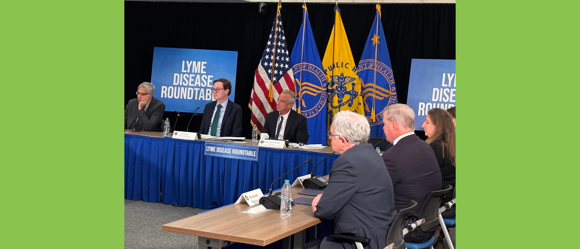
On December 15, 2025, the U.S. Department of Health and Human Services (HHS) convened a public roundtable, “Invisible Illness: Leading the Way with Lyme Disease,” bringing renewed federal attention to Lyme disease and related tick-borne illnesses. The discussion was moderated by HHS Secretary Robert F. Kennedy Jr., who shared personal family experiences with Lyme disease—including his own uncomplicated recovery, a son who experienced Lyme-induced Bell’s palsy, and another who continues to live with chronic Lyme disease.
Secretary Kennedy’s statement that the “gaslighting of Lyme patients is over” marked a notable shift in tone and approach, signaling a federal commitment to patient-centered care, scientific rigor, and collaboration across government, medicine, and advocacy. For a community that has long struggled to be seen and believed, this visibility matters.
Participants included senior HHS leadership such as CMS Administrator Dr. Mehmet Oz and NIH Director Dr. Jay Bhattacharya; Members of Congress, including Senator Susan Collins (ME), Congressman Morgan Griffith (VA), and Congressman Chris Smith (NJ); as well as patients, advocates, clinicians, researchers, and innovators. Project Lyme was represented by Executive Director Michelle Cuevas and Board Chair Ali Moresco.
The conversation emphasized Lyme disease as an often-overlooked invisible illness, highlighting persistent challenges related to diagnosis, access to care, and the validation of patient experiences. Key announcements included the renewal of the LymeX Innovation Accelerator—a major public-private partnership with the Steven & Alexandra Cohen Foundation focused on advancing diagnostic tools—and clarification that Medicare coverage includes Lyme-related care, including guidance on chronic care management.
HHS reaffirmed four core priorities closely aligned with Project Lyme’s mission: strengthening medical education, investing in innovation, expanding prevention and public awareness, and improving insurance coverage. There was explicit recognition of the complexity and persistence of Lyme disease, including infection-associated chronic conditions, alongside a call to address stigma and misinformation.
HHS also unveiled an updated centralized federal Lyme disease website, signaling increased national coordination. As we look ahead, this moment presents an opportunity to align priorities, partnerships, and resources to advance focused, actionable solutions that drive meaningful and lasting change.
Lyme Disease Roundtable
Dec. 15, 2025
Secretary Kennedy Convenes Lyme Disease Patients and Providers to Announce New Diagnostic Efforts
 Madison Area Lyme Support Group