
https://www.thefocalpoints.com/p/new-study-seed-oil-fats-fuel-aggressive?
NEW STUDY – Seed Oil Fats Fuel Aggressive Breast Cancer Growth
Omega-6 fatty acids increase triple-negative breast cancer growth through mTORC1 pathway; population data links high omega-6/omega-3 ratio to increased all-cause and cancer mortality.
The study titled, Direct sensing of dietary ω-6 linoleic acid through FABP5-mTORC1 signaling, was recently published in the journal Science:
RATIONALE
ω-6 linoleic acid (LA) is the most abundant unsaturated fat in Western-style diets and is derived from animal products [grain-fed instead of grass-fed] and processed foods containing vegetable oils, such as safflower oil. Many case-controlled retrospective and prospective studies have been conducted that explore associations between ω-6 LA intake and breast cancer incidence, but the conclusions are often contradictory. Adding to this complexity is breast cancer heterogeneity: Patients are stratified into four main clinical subtypes on the basis of expression of hormone receptors or lack thereof, each with distinct molecular characteristics and therapeutic sensitivities. Because ω-6 LA is an essential nutrient, we hypothesized that the mTOR pathway senses and is activated by its availability, leading to increased breast cancer cell proliferation in a subtype-specific manner.
RESULTS
By leveraging an extensive panel of breast cancer cell lines and patient-derived xenograft (PDX) tumors, we observed that ω-6 LA could activate mTORC1 but only in models of triple-negative breast cancer (TNBC), which is the most aggressive subtype that lacks any targeted therapy. We found that levels of the lipid chaperone fatty acid–binding protein 5 (FABP5) were significantly higher in TNBC compared with hormone receptor–positive tumors and that FABP5 directly interacted with mTORC1 to regulate complex formation, substrate binding, and subcellular localization. Notably, we demonstrated the relevance of this FABP5-mTORC1 signaling pathway in vivo by feeding animals a diet enriched for safflower oil that promoted TNBC tumor growth. FABP5 and ω-6 PUFAs appear to trigger a “perfect storm” of nutrient-driven signaling events, and both factors are also elevated in the serum of newly diagnosed TNBC patients.
CONCLUSION
Accumulating evidence suggests that dietary patterns may influence cancer outcomes, and there is substantial clinical interest in understanding the molecular mechanisms behind these associations to better inform nutritional recommendations. Our findings not only provide a mechanistic explanation for the heterogeneous responses of distinct breast cancer subtypes to dietary fats but also reveal an important perspective on how interactions between ω-6 LA intake and breast cancer need to be studied. Future nutritional studies might consider stratifying patients on the basis of FABP5 expression and triple-negative status.
Seed Oils: Toxic & Inflammatory
It takes EIGHT years to completely detox from linoleic acid! Soybean oil causes the most damage to the body, followed by corn oil, sunflower oil, and canola oil. Healthier cooking oils for frying include avocado oil, coconut oil, palm oil, olive oil, beef tallow, butter, and ghee. It’s best to cook over low or medium heat. Pan-frying, air-frying, and stir-frying are healthier options than deep-frying over high heat.
_______________
https://imahealth.substack.com/p/heres-a-thought-what-if-everything?
Here’s A Thought… What If Everything We Were Told About Sunscreen Was a Lie?
While sunscreen does reduce the risk of some non-lethal skin cancers, the promise that it is the holy grail of preventing the killer ones is questionable at the very, most generous best.
Perhaps more importantly, sunscreen—not to mention the fear of the sun that keeps some folks indoors or completely covered up—can also reduce vitamin D production and lead to a deficiency of the vitamin, which itself has been linked to higher incidence of cancer. In fact, a study published in 2016 in the Journal of Internal Medicine found that avoiding the sun might be as bad for you as chain-smoking on the beach. Nonsmokers who shunned sunlight had the same life expectancy as smokers who soaked up the rays, suggesting that dodging the sun could be as dangerous as regularly lighting up.
Not only has sunscreen never been conclusively proven to prevent melanoma, some studies even suggest that excessive sunscreen use might increase the odds of developing the deadly cancer by encouraging longer sun exposure.
But the reality is, most sunscreens focus on blocking UVB rays, which cause sunburn, but don’t offer much protection from UVA rays, which penetrate deeper into the skin and can trigger oxidative stress, potentially contributing to melanoma risk. This means you might spend longer in the sun (because you’re not burning!) while still suffering DNA damage and increasing your chances of developing melanoma. (See link for article)
______________
**Comment**
As I have been in a battle for over 6 months with basal cell carcinoma on my face and inner thigh, this topic is something I’ve been forced to learn about.
You won’t find it in mainstream media but many in alternative health and several cancer researchers have concluded that increasing omega-6 linoleic acid (PUFAs) intakes better explain the phenomenon of rising melanoma rates than increases in sun exposure over the same period. These oils have been linked to inflammation and chronic disease.
What dermatologists and mainstream medicine isn’t telling you is that full spectrum sunlight is probably the most important nutrient for the human body. We are now bombarded with unhealthy blue light from technology as well as damaging fake, narrow spectrum lighting in LED lights that have completely replaced incandescent lighting.
Besides the importance of grounding, I’ve learned the importance of taking off all glasses and letting natural light into the eyes daily.
In fact, Dr. Richard Weller’s research suggests that sunlight exposure may trigger the release of nitric oxide in the skin, providing cardiovascular benefits and potentially other health advantages. When the skin is exposed to sunlight, it triggers the release of nitric oxide, which has various health benefits:
- Lowered blood pressure: Nitric oxide helps to dilate blood vessels, reducing blood pressure and promoting better cardiovascular health.
- Improved immune system function: Nitric oxide modulates immune responses and protects the body against infections.
- Enhanced wound healing: Nitric oxide is involved in various stages of wound healing, such as inflammation, tissue regeneration, and remodeling.
Weller and other researchers have hypothesized that not wearing sunglasses could enhance the skin’s natural photoprotection mechanisms, leading to increased melanin production. This hypothesis is based on the idea that our eyes play a role in signaling our skin to produce melanin in response to sunlight. This work substantiates Dr. Otts work.
A 20-year study of nearly 30,000 Swedish women found that those who avoided the sun had a 60% higher risk of death than those who regularly got sunlight. Non-smokers who avoided the sun had the same mortality risk as smokers who got sun exposure.
The Myth That Sun Exposure Causes Deadly Skin Cancer
The numbers say otherwise:
- Most skin cancers aren’t deadly. Basal cell carcinoma (BCC) and squamous cell carcinoma (SCC) are common but rarely life-threatening.
- Melanoma, the deadliest skin cancer, isn’t primarily caused by sun exposure.
- Outdoor workers get 3–10 times more UV exposure than indoor workers—yet have lower rates of melanoma.
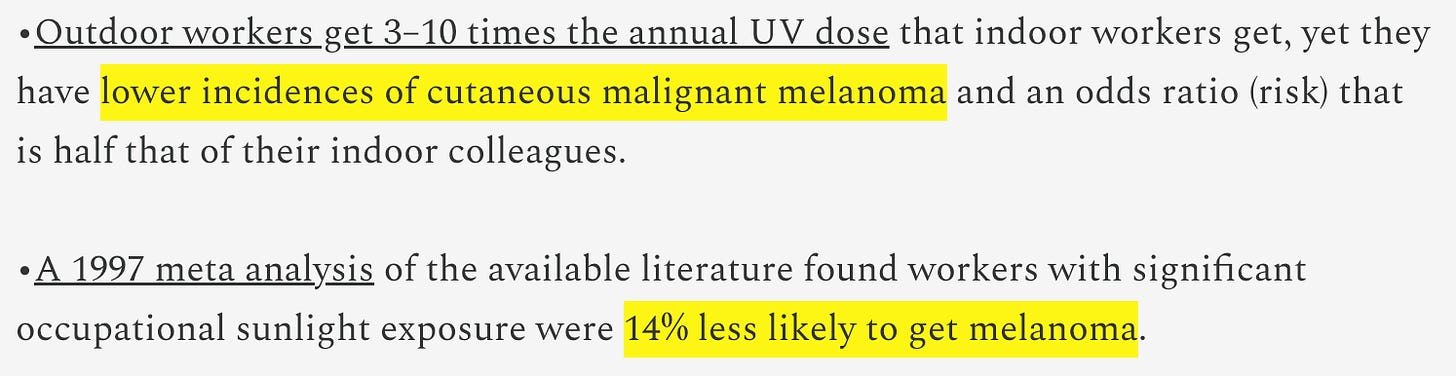
A Midwestern Doctor calls out this contradiction:
“SCC (squamous cell carcinoma) and BCC (basal cell carcinoma) occur in sun-exposed areas, but melanoma is overwhelmingly found in areas that get almost NO sunlight.”
Go here to listen to Jimmy Dore discuss AMD’s article on dermatology’s war against the sun.
Also read AMD’s Hundreds of Studies Show DMSO Transforms the Treatment of Cancer as well as how DMSO Revolutionizes skin care and Dermatology
Personally I’ve had two MOHS surgeries on my face (not fun) where they cut out cancer, send samples to pathology and keep cutting until every cell is removed. You are then sent home with a wound you must keep open and wet which means you look pretty gruesome for a spell. It’s painful, takes time to heal, and can leave scars. When done on the face it can interfere with blinking and producing tears. Go here for my article on MSM and DMSO, and here for how people are using ivermectin and fenbendazole for many types of cancer.
Now, I am using CURADERM BEC5, an eggplant based cream that targets and destroys cancer cells and salicylic acid sloughs off the dead skin eventually leaving new virgin skin. This process, I’m not going to lie, is also painful. Think of burning acid ….. but it does not involve removing skin from vulnerable places or leaving scars. It can also take time depending on how deep the cancer goes. There can also be pus and sores until the cancer cells are all removed. Depending upon the size of the area you can also really go through the tiny tubes which are $200 a pop. Go here for a video on my process: https://madisonarealymesupportgroup.com/2018/03/02/dmso-msm-for-lyme-msids/
Since this self-experiment using CURADERM I’ve read some promising testimonials on Dr. Makis’ Substack where people are using ivermectin paste successfully on cancers that are topical. Unlike CURADERM, this paste isn’t painful to use. This will be my next experiment.
NOTE: If you have a scab or skin area that will not heal, have it checked out. All of my basal cell carcinomas where little areas that wouldn’t heal over time. In nearly every case the cancer was deeper and wider than the initial spot. Now, if I have a suspicious spot, I simply apply a tad of CURADERM and wait. If it becomes red and inflamed I know I’m dealing with cancer.
 Madison Area Lyme Support Group