
https://www.lymedisease.org/rapid-diagnose-lyme-disease-nih/
Researchers get closer to rapid diagnostic test for Lyme disease
A study published in the Journal of Clinical Microbiology describes a new rapid assay for Lyme disease that could lead to a practical test for use by healthcare providers.
The researchers found the assay, which uses several biomarkers to detect Lyme disease infection, was more sensitive than current laboratory-based tests when diagnosing Lyme disease early after suspected infection.
The research was supported by the National Institute of Allergy and Infectious Diseases (NIAID), part of the National Institutes of Health.
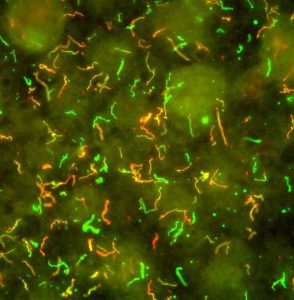
Lyme disease is caused by Borrelia burgdorferi, a spiral-shaped bacterium transmitted by deer ticks. Many cases of Lyme disease can be treated effectively with a short course of antibiotics.
However, Lyme disease can be difficult to diagnose because it causes a wide range of symptoms, from fever and rash to neurologic and cardiac symptoms and joint pain. Current Lyme disease tests also can miss an infection if performed too early.
The Centers for Disease Control and Prevention recommends a two-step blood test for diagnosing Lyme disease that looks for antibodies against Lyme disease. These tests require specialized laboratory equipment and can require days or weeks to return results.
Faster, more sensitive Lyme test?
The authors of the paper plan to develop a simpler, faster, more sensitive test that could be used at the point of care during a single visit to a healthcare provider.
The researchers first screened a set of known Lyme disease biomarkers for their ability to indicate infection. They then tested for the top three biomarkers on samples from people with early Lyme disease, from healthy individuals from areas where Lyme disease is endemic, and from people with Lyme arthritis.
This was compared to results obtained using the standard two-step testing procedure.
Overall, the new set of biomarkers was more sensitive than standard Lyme disease tests. These biomarkers were better at picking up signs of Lyme disease infection in early stage samples—possibly because they were able to detect antibodies that peak in the first two to six weeks after a person is infected with Lyme disease.
These results open the possibility of developing a point-of-care test for Lyme disease. The assay will require more refinement and testing before it can be approved by the Food and Drug Administration. However, the researchers say that these results show great potential.
SOURCE OF PRESS RELEASE: National Institutes of Health
Click here for more about Lyme disease testing.
_________________
**Comment*
Please note a few things about this test:
- It’s for EARLY detection – NOT for those who have struggled with symptoms for weeks to years.
- It ONLY tests for Borrelia burgdorferi – ONE strain of Lyme disease. To the best of my knowledge there are still 300 strains of borrelia and counting worldwide and 100 strains of borrelia and counting in the U.S. These strains are influx as new strains are continually being discovered.
- It DOES NOT test for coinfections which can cause symptoms identical to Lyme. It’s also common for patients to be infected with numerous pathogens. For instance a person might be infected with Lyme, Babesia, Bartonella, and Mycoplasma. There are nearly 20 diseases transmitted by ticks.
Lyme disease has ALWAYS been something that demands a clinical diagnosis by a trained health care provider.
While I appreciate new technology and efforts to simplify a complex illness – this illness is NOT for dummies. The best advice I can offer health care workers is to get educated! Do not be lazy. People are literally suffering untold agony, and dying from this.
For more information on how to get educated on tick borne illness: https://madisonarealymesupportgroup.com/2018/06/06/lyme-education-for-healthcare-professionals/
 Madison Area Lyme Support Group