The Lyme + Cancer Connection: How Surprising Similarities May Revolutionize Treatment
Ever notice how new research on cancer causes and treatments is published every week, whereas studies on chronic Lyme disease are few and far between? That’s in large part because many members of the medical community don’t believe chronic Lyme even exists — a serious problem that’s prolonging the quest for answers.
Now for the encouraging news: Experts are finding striking similarities in how cancer and Lyme disease impact the immune system, which opens up new avenues for targeted Lyme therapies.
The role of pathogens in Lyme disease, cancer, and all chronic illness
Why the immune system doesn’t recognize chronic infection, and what you can do about it
New progress on detecting and diagnosing Lyme disease
Innovative immunotherapies and botanical medicine for treating Lyme disease
Numerous insights during the live Q&A with Dr. Rawls and Dr. Spector
Presented by Dr. Bill Rawls, Dr. Neil Spector & Carin Gorrell
To learn more about these exciting discoveries and what it means for you, tune in to this live webinar with two physicians who are leading the conversation:
Dr. Bill Rawls, author of the best-selling book Unlocking Lyme
Dr. Neil Spector, a cancer researcher and associate professor of medicine at Duke University School of Medicine and author of his memoir, Gone in A Heartbeat: A Physician’s Search for True Healing, on Wednesday, July 17th at 8pm EDT.
Both doctors have the unique perspective of physician-turned-patient: After decades of practicing medicine, severe chronic Lyme symptoms forced Dr. Rawls to put his career in obstetrics/gynecology on hold, and misdiagnosed Lyme ultimately cost Dr. Spector his heart.
From these two doctors who’ve been there, you’ll get new insights into what causes chronic illness, how to avoid it, and new treatment approaches on the horizon. Plus, have your questions ready for a LIVE Q&A with Dr. Rawls and Dr. Spector.
This story is part of “Tickpocalypse,” a multi-part special report.
Joseph Elone just felt tired at first, like he wasn’t sleeping well. Soon, however, Joseph developed cold symptoms — a cough, a sore throat, head and body aches, digestive problems, and a low-grade fever.
The doctor saw little reason for concern. Joseph likely had the flu, he said. He prescribed the standard regimen — rest, fluids, and the like — and suggested they give it time.
But a few days later, Joseph’s symptoms worsened. He was feeling light-headed and said he was sensitive to bright light. He returned to the same doctor, who ordered blood tests for strep throat, Lyme disease, and another tick-borne illness called anaplasmosis. The results were all negative.
It would take at least four months and several incorrect diagnoses to determine the cause of Joseph’s death, but ultimately, examinations revealed the presence of Lyme bacteria in several of his organs, including his heart.
Well, if this isn’t heartbreaking, I don’t know what is.
There are numerous points that should be mentioned:
The media, researchers, and doctors need to refrain from the word “RARE” on pretty much anything regarding tick-borne illness. Notice out of one side of his mouth, the author states the same year Elone died, the CDC released a report of three other deaths related to Lyme, “which led to further inquiries that uncovered numerous additional instances in New York state…leading experts to wonder if Lyme deaths might actually be more common than previously thought.”Then, out of the other side of his mouth he announces with certainty that it’s rare. This is illogical and undermines the seriousness of this. All I can say is Zika was handled very differently.
Please take note that spirochetes riddled his body.They were all over. How many dead bodies have to pile up before the CDC/IDSA/NIH believe Lyme is serious and that those with persistent symptoms just might be chronically infected, with spirochetes riddling our bodies? Instead, we have bone-heads saying we have MUS (medically unexplained symptoms), which essentially means he believes we are psychosomatic: https://madisonarealymesupportgroup.com/2019/06/11/dr-eugene-shapiro-medically-unexplained-symptoms/ Video of Shapiro stating he believes our symptoms are completely unrelated to Lyme, i.e. – MUS. He also states the parents weren’t happy with his findings….gee, I wonder why?
Again, regarding only 20% of patients being in the PTLDS group: https://madisonarealymesupportgroup.com/2019/02/25/medical-stalemate-what-causes-continuing-symptoms-after-lyme-treatment/, microbiologist Holly Ahern states that number is incorrect and only includes those patients diagnosed and treated early. When you add the 10-20% in this category with the 30-40% NOT diagnosed and treated, you get a whopping potential 60% of ALL patients who go on to develop chronic/persistent symptoms. This is HUGE and downplayed. Little to no research exists on this patient group and yet they are in the majority.
A red meat allergy seemed to come out of nowhere and suddenly made eating painful for Janine Baumiller. And the cause is truly shocking. A lone star tick bite is behind all of the mom’s agony!
Mother of two Janine Baumiller of Long Island, New York sits watching her family enjoy juicy burgers. But she can’t take part herself. And it’s all because of a red meat allergy she never had before.
All of a sudden, any time Janine ate red meat, she’d later break out in hives all over, as well as experience severe burning under her skin. But what was even more shocking than Janine’s sudden reaction to red meat was why it was happening.
The allergy developed all because, at some point, Janine got bit by a lone star tick. A bite from this particular tick can activate an allergy to red meat, and in some cases, dairy, too.
WATCH: Lone Star Tick Bite Causes Red Meat Allergy
Janine now has to abstain from all red meat, sticking instead to poultry, fish, and veggies. And she’s not alone.
Kristie Downen of Springfield, Missouri, had the same experience.
“Food started hurting. It got to the point where my stomach would swell up, I was vomiting,” she said. “It’s still unbelievable that a tick would make you allergic to food.”
Experts call it the alpha-gal allergy and alarmingly, it’s on the rise. Up from 3,500 cases three years ago, there are now 5,000 known cases just in the U.S.
“It does seem like it’s really growing,” said Dr. Scott Commins, allergist and associate professor at the University of North Carolina at Chapel Hill School of Medicine.
More On The Lone Star Tick
The alpha-gal allergy comes from a bite from the lone star tick — “a very aggressive tick that bites humans” according to the Centers for Disease Control and Prevention.
“It appears the range of this tick is expanding,” Dr. Commins went on to say. “I also think it’s driven by folks are just encouraged to go outside more and perhaps they have more tick bites.”
The lone star tick is primarily found in the southeastern and eastern U.S., but is also starting to move further north. A white spot on the back of the lone star tick is what helps distinguish it from other ticks.
Dr. Thomas Platts-Mills, of allergy and clinical immunology at the University of Virginia, is the one who helped make the link between the lone star tick and the alpha-gal allergy. He, too, was bit and suffers from the red meat allergy.
Dr. Platts-Mills believes we’re seeing more of these ticks and the allergy it carries because of the increased deer population. A deer can carry up to 500 ticks and Dr. Platts-Mills says most of those are going to be the lone star tick.
“We’ve got deer on the lawns and they’re dropping these ticks everywhere,” Dr. Platts-Mills says.
Another interesting fact Dr. Platts-Mills points out is that most ticks are specific to a particular animal and prefer biting the animal to humans. But that’s not the case for the lone star tick.
“The lone star tick really does like humans,” Dr. Platts-Mills said.
More On The Tick-Induced Red Meat Allergy
Experts aren’t sure if the alpha-gal allergy is caused by one bite or multiple bites from a lone star tick. But they do know anyone can develop the reaction, even children.
Symptoms of the allergy often occur several hours after consuming red meat like beef, pork or lamb. Sometimes the allergy also includes a sensitivity to dairy, especially heavy-fat dairy like ice cream.
Someone suffering from the allergy can break out into hives, redness, itching and swelling, and even strong stomach cramping. Some can even have an anaphylactic reaction, which is life-threatening and requires the use of an Epi-pen.
The good news is the allergy typically goes away after two or three years. And those who suffer from it can still eat meat from fish, chicken, and turkey.
“If it swims or flies, it’s fine,” Dr. Commins said.
Doctors are also working on a vaccine, though it will be several more years before it’s ready.
Expert Tips For Avoiding Tick Bites
Ticks prefer heavier vegetation. So try to keep the grass in your yard from getting too tall. Avoid hiking or playing in heavily wooded areas as much as possible.
Try to keep skin covered with long sleeves and pants when venturing into the woods or thick grasses.
Try using a safe bug spray that repels ticks.
After spending time outdoors, do a thorough check of both your clothes and body, then take a shower.
Use a plastic baggie to save any ticks you find on your body, especially if you suspect you’ve been bitten. Look for the white dot on the back to identify a lone star tick.
If you suspect you’ve been bitten, keep an eye out for symptoms and keep in mind the reaction from the red meat allergy occurs several hours after eating. Doctors can perform a simple blood test to confirm the allergy.
Please be sure to share this story with others to raise awareness of the lone star tick and the red meat allergy.
Apoorva Mandavilli celebrates her son’s recovery from Lyme disease. But while the vast majority of those diagnosed with Lyme and other tick-borne diseases are cured with antibiotics, up to 20 percent of more than 427,000 newly diagnosed Americans go on each year to suffer devastating long-term chronic effects — even if they are treated early, like her son.
These patients can become afflicted with neurocognitive disorders, disabling fatigue, extreme joint pain, heart problems and so on. Sadly, with their lives severely disrupted if not destroyed, too many commit suicide. A recent study published by the journal BMC Public Health predicts the number of people suffering post-treatment Lyme could increase to almost two million by 2020.
Rather than minimizing the risks of Lyme disease by stating it is easy to diagnose and easy to cure — which is not the case — and lulling the public into a false sense of security, let’s pull together to address the great public health risk that irrefutably exists.
Robert Kobre
Scott Santarella
Stamford, Conn.
The writers are, respectively, chairman and chief executive of the Global Lyme Alliance
Click here to see entire New York Times Letter to the Editor, including letter from Lyme patient Sarah Young.
Click here to see expanded response by GLA to the article by Apoorva Mandavilli.
What are lymph nodes? How do they respond to a Bartonella species infection?
Lymph nodes have been called the “upper management” of the immune system by journalist Matt Richtel. Some of the more impressive aspects of the immune system, such as the ability to recognize pathogens that may have been encountered years earlier, occur in the lymph nodes.
Lymph nodes are scattered throughout the body. Some are as small as a poppy seed. Others are much larger. Tonsils are lymph nodes in the throat. The spleen is a specialized structure of the lymph system that is similar to a lymph node.
The lymph system circulates a fluid called lymph between all the cells in the body. Scientists used to think that the brain was isolated from the lymph system, but in 2017 researchers discovered that the brain drains lymphatic fluid into the lymph system.This means that the immune has contact with antigens that may be drained from the brain. How the immune system and the brain interrelate is a productive area of research that is leading to developments in understanding of a variety of psychiatric conditions.
Lymph fluid travels very slowly through the body. Unlike blood, there is no pump circulating the fluid. The total circulation of lymph fluid is only a little over a gallon per day. Nonetheless, a person would die quickly without this vital flow removing debris from cells and informing the immune system of everything that is going on in the body. Lymph fluid consists of:
macrophages, which remove debris
lymphocytes, a white blood cell
some red blood cells
chyle, a fatty fluid produced by the small intestine
other specialized immune cells.
The lymph nodes are continually exposed to all of the proteins circulating in the body, including proteins that are shed from the surfaces of pathogens. As these proteins pass through the lymph nodes, they encounter a variety of T cells with antigen receptors for previously encountered pathogens.
If prior experience with an antigen was long ago or did not create a strong immune response, there may only be a few T cells in the lymph system that match that antigen. Age and immune suppression may also reduce the number of T cells produced. Nonetheless, a few T cells with the correct antigen receptor can still be effective. If the antigen encounters one of those T cells, the T cell activates and sets off a response from the adaptive immune system.
This immune response may cause lymph nodes to swell (lymphadenitis). The immune response may be to something that would otherwise be harmless- an in an allergic reaction. The immune response may be to a harmful pathogen. T-cells also attack cancer cells, and this function of the immune system to fight cancer is being used in new treatments such as CAR-T immunotherapy.
There can be other causes of lymph node swelling such as a blockage or cancer of the lymph system itself. Furthermore, because waste is continually flowing through the lymph nodes, they are susceptible to metastasized cancer from other areas of the body.
A swollen lymph node near the skin may cause redness and pain, and swollen lymph nodes in the head and neck may cause pain and even difficulty breathing. However, swollen lymph nodes in other locations may have more diverse symptoms that are difficult to pinpoint.
If the swollen lymph node is in response to an infection, swelling will generally go down within a few weeks of the infection being resolved. In some cases chronic lymph node swelling results.
Whether lymph node swelling and tenderness occurs with a Bartonella species infections depends on a lot of factors. Cat scratch disease, an acute Bartonella henselae infection most frequently seen in children, is usually characterized by lymph node swelling near the site of the scratch.
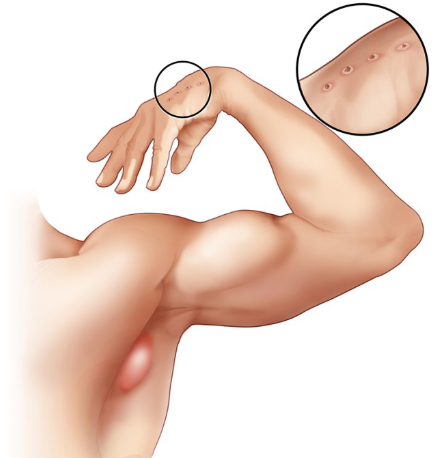
Lymphadenitis may occur after a scratch from an infected cat (Source: CDC).
However, other Bartonella species infections may have no lymph node swelling at all.One study of 913 patients with Bartonella henselae infection found that patients with musculoskeletal pain were less likely to have lymph node swelling than patients with other symptoms.
While lymph node swelling is not diagnostic of vector-borne disease, it can help point to an infectious cause in hard-to-diagnose cases. For example, a child with bone inflammation (osteomyelitis) caused by Bartonella henselae also had pancreatic duodenal lymphadenitis. In another case, a woman had a retinal vessel occlusion, erythema on her legs, and an enlarged lymph node. These additional symptoms helped physicians find the infectious cause of her vision loss.
Lymph nodes have contact with every part of the body via the circulation of lymph fluid. They send very specific signals to the body in terms of antigen response and these signals can be measured through serology blood tests. However other signals, such as swelling and pain, are very difficult to interpret because they could have a number of causes originating from any body part. As researchers develop more understanding of the lymph system, care providers will have more tools to diagnose and treat illness.
Stepanić, M. et al. (2019). First isolation and genotyping of Bartonella henselae from a cat living with a patient with cat scratch disease in Southeats Europe. BMC Infectious Diseases, 19(1), 299. doi:10.1186/s12879-019-39290z https://www.ncbi.nlm.nih.gov/pubmed/30940084
Woo, M. et al. (2018). A case of retinal vessel occlusion caused by Bartonella infection. Journal of Korean Medical Science, 33(47), e297. doi:10.3346/jkms.2018.33.e297 https://www.ncbi.nlm.nih.gov/pmc/articles/PMC6236082/
My husband and I were both ones infected with Bartonella without the lymph node swelling, but we had plenty of musculoskeletal pain. We also had the excruciating bottom of the foot pain that felt like someone beat our feet with a hammer. There were times when ligaments in our ankles would hurt and make us limp. Also, remember Bartonella has been behind many psychological symptoms:https://madisonarealymesupportgroup.com/2019/03/24/cat-scratch-disease-caused-teens-schizophrenia-like-symptoms-report-says/





 Madison Area Lyme Support Group