Archive for June, 2019

Doctors at Many Stem-Cell Clinics Don’t Have Relevant Training

https://www.nature.com/articles/d41586-019-01999-6?

Doctors at many stem-cell clinics don’t have relevant training

Few US clinics offering unproven treatments employ physicians with expertise in all the conditions they offer to treat, finds survey.
Photo of a syringe containing cells prepared for stem cell therapies for a patient

A clinician prepares a syringe containing stem cells used for therapy.Credit: Patrick T. Fallon/Getty

Many companies offering unproven stem-cell therapies in the United States do not employ clinicians with relevant medical training, an analysis has found.

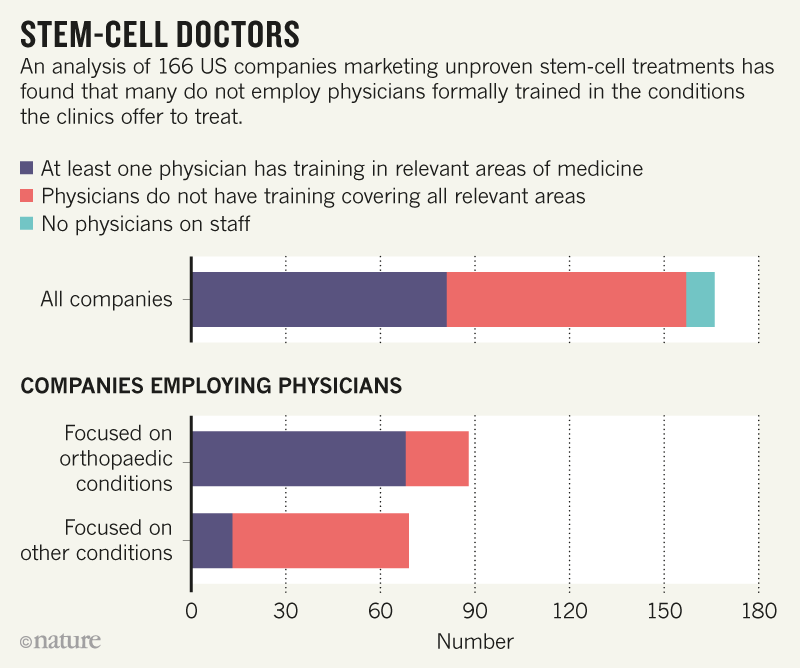
Fewer than half of the 166 businesses analysed in the study employed physicians whose formal medical training covered the conditions the company claimed to treat, according to the paper, which was published on 25 June in JAMA1.

“This study highlights that patients need to be aware that many physicians who advertise stem-cell treatments are not only operating outside the bounds of scientific evidence, but outside their own professional qualifications,” says Douglas Sipp, a researcher at the RIKEN Center for Biosystems Dynamics Research in Kobe, Japan.

The only stem-cell-based products that are approved by the US Food and Drug Administration (FDA) as medical treatments are blood-forming cells used to treat certain blood and immune-system disorders. Stem cells taken from healthy bone marrow are also used in transplants to treat some cancers. Yet in the past decade or so, hundreds of clinics have sprung up in the country offering stem-cell treatments for a wide range of other conditions, including muscular dystrophy, Alzheimer’s disease and vision loss.

In the United States, stem cells can be extracted and reinjected into people without FDA approval as long as the cells have been only “minimally manipulated”. Companies have argued that their procedures therefore do not need approval — but many bioethicists disagree, claiming that many of the procedures they offer should be classified as drugs, biologics or medical devices, which the FDA must approve for use.

Background checks

The analysis looked at the websites of 166 companies that were advertising their services in January 2018 and that listed their clinical staff online.

Nine companies did not list any physicians. Five of these were staffed entirely by podiatrists; two by naturopaths, who use interventions such as homeopathy and acupuncture; and one by dentists.

Of the companies that employed doctors, just 81 listed physicians who had medical training that the researchers deemed was necessary to cover all of the conditions the firms’ clinics offered to treat (see ‘Stem-cell doctors’).

Source: Ref. 1

Businesses offering unproven stem-cell treatments for orthopaedic conditions — among the most common conditions for which such therapies are offered — were more likely to employ trained doctors: 77% listed one or more physicians with formal training in orthopaedics. But only 19% of practices offering to treat non-orthopaedic conditions employed physicians with relevant specialist training.

“Patients need to ensure they look at trusted sources of information and consider the backgrounds of physicians when considering medical care, including regenerative care,” says Zubin Master, a bioethicist at the Mayo Clinic in Rochester, Minnesota, who led the study.

Master acknowledges that some of the physicians employed by the companies might have gained relevant further qualifications beyond their formal medical training.

doi: 10.1038/d41586-019-01999-6

References

  1. Fu, W. et al. J. Am. Med. Assoc. 321, 2463–2464 (2019)

___________________

**Comment**

As always, “Buyer Beware,” when it comes to treatments.

https://www.treatlyme.net/guide/stem-cell-therapy-lyme  Great article by Dr. Ross.  Excerpt:

What The Data Says

However, most with Lyme disease do not appear to benefit from stem cell therapy as it is currently practiced. My Lyme Data, an ongoing research project of lymedisease.org, shows only three percent of patients receiving stem cell therapy report improvements. For more information about this study see: What Alternative Treatments Work for Lyme Disease? What Are Their Side Effects? at lymedisease.org

On the other hand, there are some case reports in the literature which show marked improvement in Lyme disease by people who undergo stem cell therapy using human embryonic stem cells (HESC).

My Lyme Data’s findings are instructive, but could be limited by the small number of people who have had stem cell therapy. Also, not all stem cell therapies are equal. And My Lyme Data does not indicate what type of stem cell therapy people received.

My Observation

Before stopping my Seattle clinical practice in late 2018, I did not observe major improvements in most of my patients who tried stem cell therapy either before or after having treatment with me. I did not have any of my active patients pursue this type of therapy while they were under my care.

https://www.publichealthalert.org/stem-cell-therapy-for-lyme-disease.html

https://lymediseaseguide.net/stem-cell-treatment-for-lyme-disease

I know few who have used stem cell therapy for Lyme disease, but it’s expensive and make sure if you are considering it ask many, many questions. Patients can spend thousands and not be informed up front of the lengthy & costly follow up treatments that were not included in the original price.

Unfortunately, those I know did not improve.

‘Horns’ Are Growing on Young People’s Skulls. Phone Use is to Blame, Research Suggests

https://www.washingtonpost.com/nation/2019/06/20/horns-are-growing-young-peoples-skulls-phone-use-is-blame-research-suggests/

‘Horns’ are growing on young people’s skulls. Phone use is to blame, research suggests.

Researchers at the University of the Sunshine Coast in Queensland, Australia, have documented the prevalence of bone spurs at the back of the skull among young adults. (Scientific Reports)

June 25, 2019

Update 6/25: After publication of this story, concerns were raised about an undisclosed business venture of one of the researchers, who works as a chiropractor. This story has been updated to reflect questions about a possible conflict of interest involving his business. The journal that published the main study in question said it was investigating the concerns. The researchers say they are making minor changes to their paper, but stand by their work.

Mobile technology has transformed the way we live — how we read, work, communicate, shop and date.

But we already know this.

What we have not yet grasped is the way the tiny machines in front of us may be remolding our skeletons, possibly altering not just the behaviors we exhibit but the bodies we inhabit.

New research in biomechanics suggests that young people are developing hornlike spikes at the back of their skulls — bone spurs caused by the forward tilt of the head, which shifts weight from the spine to the muscles at the back of the head, causing bone growth in the connecting tendons and ligaments. The weight transfer that causes the buildup can be compared to the way the skin thickens into a callus as a response to pressure or abrasion.

The result is a hook or hornlike feature jutting out from the skull, just above the neck.

A pair of researchers at the University of the Sunshine Coast in Queensland, Australia, has advanced the idea in several peer-reviewed journals that the prevalence of the bone growth in younger adults, which they have observed in X-rays, reflects distorted posture. The cause, they hypothesize, is prolonged use of smartphones and other handheld devices, which require users to bend their heads forward to make sense of what’s happening on the miniature screens.

Michael Nitabach, a professor of physiology, genetics and neuroscience at Yale University, was unconvinced by the findings.

“Without knowing about the cellphone use of any of the people whose head X-rays were analyzed, it is impossible to draw conclusions about correlation between cellphone use and skull morphology,” he said.

The researchers behind the striking claims are David Shahar, a chiropractor who recently completed a PhD in biomechanics at Sunshine Coast, and his supervisor, Mark Sayers, an associate professor of biomechanics at Sunshine Coast who has more than 60 peer-reviewed publications in academic journals.

Shahar, who runs a clinical practice on the coast of Queensland, near Brisbane, is also the owner of Dr Posture, an online store recommending strategies to improve posture, including the use of his Thoracic Pillow. He said he has “not engaged in selling of the product for a few years,” during the time when he was publishing in related fields.

The principal study where he and his supervisor suggest that the bone growth among young people may be the result of “aberrant posture” resulting from phone usage was published last year in Nature Research’s peer-reviewed, open-access Scientific Reports. The journal requires authors to “declare any competing financial and/or non-financial interests in relation to the work described.”

Shahar declared no conflict in the study, just as he stated there were no competing interests in papers published in the Journal of Anatomy and Clinical Biomechanics, both peer-reviewed journals that require the disclosure of possible conflicts.

Experts interviewed by The Washington Post said they found that decision problematic.

“It’s beyond any debate that other scientists and the public and legislators and journalists ought to know whether or not there are any competing interests for people who are working in an area where they are professing to be independent,” said Simon Chapman, an emeritus professor of public health at the University of Sydney and an editor of the peer-reviewed Tobacco Control journal for 17 years.

Shahar maintained there was no conflict because he had not recommended a particular course of treatment in the research but rather advanced a more general theory about the need to improve posture.

Scientific Reports declined to make an editor available for comment, offering a statement from a spokesperson that the journal was “looking into issues” with the paper and would “take action where appropriate.”

“Should we become aware of undisclosed competing interests not compliant with our policies, we will look into the matter carefully and update the literature when appropriate to ensure the scientific record is correct,” the spokesperson added.

If a further need emerges to state a conflict of interest, said the co-author, Sayers, “I’m happy to put my hand up and say that’s potentially a mistake.”

He added: “It’s not been my experience of seeing it done, but the reality is that David is a chiropractor.” Sayers said he remained “confident” in the data, which has been “freely available in the research bank of our university.”

For a different study published this year, assessing the effectiveness of a device designed to relieve pressure on the spine, Shahar did disclose a possible conflict. The paper, which appears in the peer-reviewed Spine Journal, states that the author “is the developer of the Thoracic Pillow.”

According to specialists in research ethics, the distinction between testing a specific product and suggesting a more general intervention is less significant than it might seem.

In a 2012 review, Chapman found an across-the-board failure by Australian universities to hold academic staff accountable for compliance with standards for declaring competing interests. The problem is just as acute, he said, for academic journals, few of which have the resources to independently investigate possible conflicts.

Standing to gain from one’s research does not necessarily discredit it, said Nancy Berlinger, a research scholar at the Hastings Center, a bioethics research institute in New York.

“Plenty of clinician investigators are, for instance, working on a patent,” she said. Disclosure allows the academic community and the public at large to decide whether the presentation is still trustworthy, she said.

Brian Earp, the associate director of the Yale-Hastings Program in Ethics and Health Policy, said readers may want to apply “heightened care in evaluating the methods of the research” if they know an author has a vested interest in the availability of evidence for a certain conclusion.

The research published in Scientific Reports, which gained widespread attention following coverage last week in The Post, was subject to significant criticism. Skepticism centered on the source and size of the sample and the ability to draw conclusions about the use of smartphones from X-ray evidence, some of which was drawn from patients experiencing mild neck problems.

John Hawks, a biological anthropologist at the University of Wisconsin at Madison, offered other explanations for the bone growth at the back of the skull and argued that the protrusions were actually minimal. Shahar said an outgrowth was only factored into their research if it measured 10 millimeters, or about two-fifths of an inch.

Although the study came out last year, it first drew fresh notice following the recent publication of a BBC story that considers, “How modern life is transforming the human skeleton.” The unusual formations captured the attention of Australian media, and have variously been dubbed “head horns” or “phone bones” or “spikes” or “weird bumps.” Each is a fitting description, Shahar said.

“That is up to anyone’s imagination,” he said. “You may say it looks like a bird’s beak, a horn, a hook.”

Much of the interest generated by the study focused on the use of the term “horns,” causing Shahar to clarify that he used the term in interviews as an analogy, a way of understanding what the formations look like. He argued that structures and conditions are often named because of how they appear, rather than what they chemically represent. He cited Occipital horn syndrome, a connective tissue disorder, as an example.

The researchers said their discovery marks the first documentation of a physiological or skeletal adaptation to the penetration of advanced technology into everyday life.

Health experts warn of “text neck,” and doctors have begun treating “texting thumb,” which is not a clearly defined condition but bears resemblance to carpal tunnel syndrome. But prior research has not linked phone use to bone-deep changes in the body.

Their work began about three years ago with a pile of neck X-rays taken in Queensland, some at Shahar’s own clinic. The images captured part of the skull, including the area where the bony projections, called enthesophytes, form at the back of the head.

Contrary to conventional understanding of the hornlike structures, which have been thought to crop up rarely and mainly among older people suffering from prolonged strain, Shahar noticed that they appeared prominently on X-rays of younger subjects, including those who were showing no obvious symptoms.

The pair’s first paper, published in the Journal of Anatomy in 2016, enlisted a sample of 218 X-rays, of subjects ages 18 to 30, to suggest that the bone growth could be observed in 41 percent of young adults, much more than previously thought. The feature was more prevalent among men than among women.

The effect — known as enlarged external occipital protuberance — used to be so uncommon, Sayers said, that one of its early observers, toward the end of the 19th century, objected to its title, arguing that there was no real protrusion.

That’s no longer the case, according to the researchers.

Another paper, published in Clinical Biomechanics in the spring of 2018, used a case study involving four teenagers to argue that the head horns were not caused by genetic factors or inflammation, pointing instead to the mechanical load on muscles in the skull and neck.

And the Scientific Reports paper, published the month before, zoomed out to consider a sample of 1,200 X-rays of subjects in Queensland, ages 18 to 86. The researchers found that the size of the bone growth, present in 33 percent of the population, actually decreased with age. That discovery was in stark contrast to existing scientific understanding, which had long held that the slow, degenerative process occurred with aging.

The danger is not the bone spur itself, Sayers noted. Rather, the formation is a “portent of something nasty going on elsewhere, a sign that the head and neck are not in the proper configuration. ”

“These formations take a long time to develop, so that means that those individuals who suffer from them probably have been stressing that area since early childhood,” Shahar explained.

To understand what was driving the effect, they looked to recent developments — circumstances over the past 10 or 20 years altering how young people hold their bodies.

The sort of strain required for bone to infiltrate the tendon pointed him to handheld devices that bring the head forward and down, requiring the use of muscles at the back of the skull to prevent the head from falling to the chest. “What happens with technology?” Shahar said. “People are more sedentary; they put their head forward, to look at their devices. That requires an adaptive process to spread the load.”

That the bone growth develops over a long period of time suggests that sustained improvement in posture can arrest it and prevent its associated effects, the authors said.


Sayers said the answer is not necessarily swearing off technology. There are less drastic interventions.

“What we need are coping mechanisms that reflect how important technology has become in our lives,” he said.

Shahar, in his work as a chiropractor, is pressing people to become as regimented about posture as they became about dental hygiene in the 1970s, when personal care came to involve brushing and flossing every day. Schools should teach simple posture strategies, he said. Everyone who uses technology during the day should get used to recalibrating their posture at night.

As motivation, he suggested reaching a hand around to the lower rear of the skull. Those who have the hornlike feature can probably feel it.

__________________

**Comment**

With all the problems Lyme/MSIDS patients can have with their necks and spines, please consider the issue of proper alignment and habits that can add up to pain over time.

https://madisonarealymesupportgroup.com/2016/04/19/dr-isom-on-upper-cervical-chiropractic-care/

https://madisonarealymesupportgroup.com/2016/02/28/chiropractic-care-and-msids/

https://madisonarealymesupportgroup.com/2018/05/09/rheumatological-presentation-of-bartonella-koehlerae-henselae-a-case-report-chiropractors-please-read/  Comment after article:

Please note the joint popping with each articulation and continual joint subluxation issue.  

Chiropractors need to be told about this.  Please educate!  Send them this article.

I too had this bizarre popping of the joints with a lot of instability in the knees.  Treatment completely ameliorated this issue so treatment is primo important.


Lone Star Tick, Known to Cause Red Meat Allergy, Found in Northern Wisconsin: Report

https://www.foxnews.com/health/lone-star-tick-wisconsin-red-meat-allergy

Lone Star tick, known to cause red meat allergy, found in northern Wisconsin: report

By Madeline Farber for Fox News. You can follow her on Twitter @MaddieFarberUDK.

The Lone Star tick, a type of tick that’s known to cause some people it bites to develop an allergy to red meat, has reportedly been found in northern Wisconsin — a rare occurrence as these small arachnids aren’t typically found in the state. 

The tick was purportedly spotted near Eau Claire County, per local news Channel 3000. Lone Star ticks, which are not native to the state and are named for the white spot on the back of adult females, are sometimes reported in the southern half of Wisconsin, if at all, according to the Department of Entomology at the University of Wisconsin-Madison.

Susan Paskewitz, the chair of the Entomology Department at the university, told Channel 3000 the Lone Star tick reported likely found its way north by attaching itself to a bird or other animal that later made its way to the area.

Last summer, Scott Commins — an allergist and associate professor of medicine at University of North Carolina, Chapel Hill and one of the first physicians to discover the connection between Lone Star tick bites and the alpha-gal meat allergy —  told Fox News the allergy caused by a Lone Star tick bite is relatively rare. That said, the number of cases has sharply increased from the roughly two dozen he and his colleagues first studied in 2009.

LONE STAR TICK BITES TRIGGERING RED MEAT ALLERGIES IN MORE PEOPLE ACROSS US, PHYSICIAN SAYS

Commins offered a few different reasons for the increase.

First, doctors can now perform a blood test that detects the allergy, “which has made the diagnosis much easier,” he said.

A Lone Star tick. (iStock)

A Lone Star tick. (iStock)

Additionally, the “range of the Lone Star tick is increasing and expanding,” Commins said, which ultimately increases the chance of getting bitten. Higher costs of living could partly be to blame, causing more people in recent years to trade urban life for the suburbs. This movement results in closer contact with tick-carrying deer, which subsequently increases the chance for tick bites.

Commins also said a heightened awareness about the allergy has led those with symptoms to talk to their doctor and investigate if a Lone Star tick bite could be the cause.

Though it’s not totally clear how Lone Star tick bites sometimes result in the allergy, Commins said the tick’s saliva may be a factor.

“There’s a common pathogen in all of these ticks,” he said at the time.  “It could be a protein or enzyme in tick spit. We’re working on that in the lab at the moment.”

Not unlike the symptoms of a peanut, egg, tree nut or a shellfish allergy, many people who are allergic to red meat may experience hives, a skin rash or anaphylaxis.

Commins warned many also experience “severe GI [gastrointestinal] distress,” such as stomach pain, indigestion, vomiting and diarrhea. Some people have described their gastrointestinal symptoms as “stabbing pain or [being stuck with] a hot poker,” he added.

COLORADO GIRL, 7, DIAGNOSED WITH RARE TICK PARALYSIS AFTER OVERNIGHT CAMP

That said, the symptoms of a red meat allergy are not always immediate. In fact, Commins said, it usually takes hours after eating red meat for the symptoms to appear.

There is no cure for the allergy at this time; the most those with the allergy can do is to avoid red meat, which includes beef, lamb, pork, veal, and goat, among others.

But the news isn’t all bad.

“There is a bright spot in this; this is one of these food allergies that will resolve over time,” he said, though he noted additional tick bites may prolong the condition.

**Comment**
Another example of a tick in a place it’s not supposed to be.
BTW: this isn’t the first time it’s been found in Northern Wisconsin:  https://madisonarealymesupportgroup.com/2017/01/12/tick-related-red-meat-allergy-found-in-minnesota-wisconsin/  Excerpt:
According to Dr. Alaaddin Kandeel, an allergist at Essentia Health in Duluth, he’s diagnosed 18 patients with alpha-gal allergy – 10 from northeast Minnesota and 8 from northwest Wisconsin – hardly accepted Lone Star territory.  In the audio he states he diagnoses approximately 1 patient per month with Alpha-gal allergy and that the reactions can be severe, from passing out to life-threatening reactions.
One patient a month.  NOT RARE.

And while tick borne diseases are reportable by law, allergies like the alpha-gal allergy are not, so nobody truly knows prevalence.

Doctors should NEVER use a map to turn a patient away who is presenting with symptoms. If they do, turn them in to the authorities.
Many people do not know it isn’t just meat those with Alpha Gal have to avoid.
Anything derived from animals can cause the allergic symptoms including gelatin, daily vitamin supplements, shampoos & conditioners, lotions, & vaccines.
This woman limits her diet and uses vegan supplements, medications and personal care products:  https://madisonarealymesupportgroup.com/2018/05/04/arkansas-woman-develops-deadly-meat-allergy-after-tick-bite/
This is about the worst news possible for Wisconsinites whom can handle pain like nobody on the planet, and keep a stiff upper lip that many would collapse under, but take away our meat, cheese, and beer, and we are an absolute mess!
iu-19

Lawmakers Want to Combat Lyme Disease With More Signs, Insect Repellent in Public Parks

https://www.jsonline.com/story/news/politics/2019/06/24/lyme-disease-lawmakers-want-signs-insect-repellent-public-parks/1501986001/

Lawrence Andrea, Milwaukee Journal Sentinel

Published  June 24, 2019 

MADISON – It’s officially summer, and lawmakers are aiming to curb the growing problem of Lyme disease in the state through education and prevention efforts.

A bipartisan package of five bills would direct the state Department of Natural Resources to post signs about the tick-borne disease in public parks, sell bug spray with the powerful DEET repellent and conduct an awareness campaign each May. 

The legislation would also create an epidemiologist position in the Department of Health Services focused on the disease and establish a 16-member study committee tasked with recommending to the Legislature policy changes regarding awareness, prevention and treatment of Lyme disease.

Democratic Sen. Mark Miller of Monona, one of the sponsors of the bills, said raising awareness about Lyme disease is important not only for the public, but also for health care professionals. He said the disease often goes misdiagnosed.

“Increasing awareness … will reduce the chances of people getting Lyme disease or other tick-borne illnesses and increase the chances that, if you do get it, it’ll be diagnosed properly and the treatment handed to you quickly,” Miller said.

Data from the Centers for Disease Control and Prevention show Wisconsin had the fourth highest number of reported cases of Lyme disease in the country in 2017. DHS data shows the number of cases of Lyme disease has increased over the past 30 years and estimated Wisconsin had 3,105 cases in 2018.

Lyme disease is contracted through a bite from an infected deer tick. If left untreated, the infection can spread to joints, the heart and the nervous system, according to the CDC. Symptoms include fever, headache, fatigue and a skin rash, typically in a bull’s-eye pattern.

DHS spokeswoman Jennifer Miller said permanent damage from Lyme disease is “quite rare.” But she added that long-term damage to the nervous system is possible in patients who were not treated until the later stages of the disease.

Green Bay Republican Sen. Robert Cowles, who is also sponsoring the legislation, said he has friends who have suffered from the effects of Lyme disease. He predicted that, once the bills have a public hearing, many people will come forward in support of the legislation.

“These five bills we hope will promote this issue enough so people will have a good handle on this as time goes by,” Cowles said. “It is something the Legislature has to pay attention to.”

RELATED: The Tick App offers resources to identify, remove ticks as part of Lyme disease study

_________________

**Comment**

Permanent damage from Lyme is NOT RARE. It can kill you.

For a refresher on the actual bills:  https://madisonarealymesupportgroup.com/2019/05/29/lawmakers-create-bills-to-bite-back-against-lyme-disease-wisconsin/

The bill of particular concern is bill #5 in that it:

Establishes a sixteen-member Tick-Borne Disease Study Committee to create a report for the legislature on consensus-based recommendations for policy changes on awareness, prevention, surveillance, diagnosis, reporting, and treatment of Lyme Disease.”

Nothing about Lyme/MSIDS is agreed upon except the fact early detection and treatment is imperative. If this 16 member committee is only filled with CDC/IDSA believers, patients and the doctors who dare to treat them are doomed as it will be business as usual or perhaps will make things even worse as they could further restrict a doctor’s ability to treat this. 

I’ve spoken with numerous WI LLMD’s and they feel this is huge government overreach and that this would never happen in the areas of cancer, diabetes, or other health issues.

Chronically infected patients need representation by qualified ILADS trained practitioners who understand the complexity of diagnosis, testing, and treatment. 

If you’ve been keeping up, you are privy to the fact the TBDWG is being stacked against patients at the federal level with IDSA-types and hardly any patients & advocates. I do believe this was their plan from the get-go.

Another fact is that legislation often takes 5-10 years to pan out. Many patients aren’t healthy enough for that type of stress. Getting involved with politics is like running a marathon. You can’t quit half way through. Wording that can completely change the outcome can change at the eleventh hour requiring savvy and bullish persistence.

As well-meaning as patients are, they are often very, very sick as well as uneducated about the underhanded way this has all been handled from inception. They also often don’t understand the polarity in the medical community and how legislation they create & agree to could hurt the very doctors who are properly treating Lyme/MSIDS patients.

Please contact the authors of the bills with these concerns.  They need to hear from you.

As hard as it is – think like the enemy. 


Under The Skin – BBC One, Series 1

https://www.bbc.co.uk/programmes/m000640l  News Video here

BBC iPlayer only works in the UK.

Fiona Stalker travels around Scotland to investigate the spread of Lyme sisease. One tiny tick under the skin can cause chronic illness but GPs are often slow to diagnose and to give treatment. Fiona hears from sufferers who feel let down by the health service and asks what more can be done to combat this debilitating disease.