Archive for the ‘Anaplasmosis’ Category

Ticks From U.S. Cats: Patterns of Infestation & Infection With Pathogens

https://www.sciencedirect.com/science/article/pii/S0304401718301596?via%3Dihub

Ticks from cats in the United States: patterns of infestation and infection with pathogens

Under a Creative Commons license
open access

Highlights

Tick infestations were documented on 332 cats from 18 states in the United States.

Adult and immature stages of IxodesAmblyomma, and Dermacentor were recovered.

Molecular assays documented infection with at least one pathogen in 17.1% of ticks.

One in 5 cats with ticks spent ≤30% time outdoors; 10 were reportedly indoor only.

Results show cats at risk of tick infestation and exposure to tick-borne pathogens.

Abstract

Ticks are an important but under recognized parasitic threat to cats in many areas of the United States. To characterize the species and stages of ticks most commonly recovered from cats and determine the prevalence of disease agents in the ticks, we conducted a survey of ticks removed from cats at veterinary practices in 18 states from April 2016 – June 2017.

A total of 796 ticks were submitted from 332 cats from 41 different veterinary practices. A single tick was submitted from the majority of cats, with a mean infestation intensity of 2.4 (range 1–46). The most common tick was Ixodes scapularis, accounting for 422/796 (53.0%) ticks submitted, followed by Amblyomma americanum (224/796; 28.1%) and Dermacentor variabilis (131/796; 16.5%); a few I. pacificusI. banksiD. occidentalisA. maculatumRhipicephalus sanguineus, and Otobius megnini were also submitted.

A majority of ticks were adults (593/796; 74.5%); females predominated in all adult tick submissions including I. scapularis (277/327; 84.7% female), A. americanum(66/128; 51.6% female), and D. variabilis (75/126; 59.5% female). Immature ticks included 186 nymphs and 17 larvae and were primarily I. scapularis and A. americanum.

Adult I. scapularis were most reported to be attached to the dorsal head and neck; A. americanum to the abdomen and perianal region; and D. variabilis to the back and ear. Ticks were collected in every month; the largest number of submissions were in May and June (42.5% of ticks) and October and November (35.9% of ticks). Adults of I. scapularis were most commonly submitted October through DecemberA. americanum March through June, and D. variabilis May through July.

Cats with ticks were predominantly male (58.8%) and altered (76.2%), and most reportedly spent >30% of time outdoors, although 64/294 (21.8%) for which lifestyle estimates were provided were reported to live primarily (≤30% of time outside; n = 54) or entirely (100%; n = 10) indoors.

Assay of ticks removed from cats revealed I. scapularis were infected with Borrelia burgdorferi (25.7%) and Anaplasma phagocytophilum(4.4%); A. americanum were infected with Ehrlichia chaffeensis (1.3%); and D. variabilis were infected with spotted fever group Rickettsia spp. (3.1%). No ticks in this study tested positive for Cytauxzoon felis.

Pet cats, including those that live primarily indoors, are at risk of tick infestation, potentially exposed to tick-borne disease agents, and would benefit from routine tick control.

_______________

**Comment**

Some interesting points:

  1. Ticks were found on cats year-round
  2. The majority of ticks were ADULTS
  3. This study points out we need to essentially throw out the idea you can only get a tick bite in the spring and fall.  It also points out that adult ticks are to be taken just as seriously as nymphs.
  4. According to the study, molecular assays were used and the following pathogens found.  It says nothing of Bartonella, which is unfortunate.  We really need to determine why so many humans are infected with it.

Table 4. Pathogens detected in adult ticks recovered from cats.

Tick Pathogen % positive (No. positive/No. tested)
Ixodes scapularis Anaplasma phagocytophilum 4.4% (12/272)
Borrelia burgdorferi 25.7% (70/272)
Amblyomma americanum Cytauxzoon felis 0% (0/121)
Ehrlichia chaffeensis 1.7% (2/121)
Ehrlichia ewingii 0% (0/121)
Dermacentor variabilis Cytauxzoon felis 0% (0/123)
Rickettsia spp. 3.1% (4/123)

Tick & Mosquito-borne Diseases: Trends in the U.S.

https://www.gideononline.com/2018/05/04/tick-and-mosquito-borne-diseases-trends-in-the-united-states/

May 4th 2018

TICK AND MOSQUITO-BORNE DISEASES: TRENDS IN THE UNITED STATES

The following data are abstracted from Gideon and the Gideon e-book series. [1] Charts were created using an interactive tool driven by over 30,000 base graphs in the program. [2]

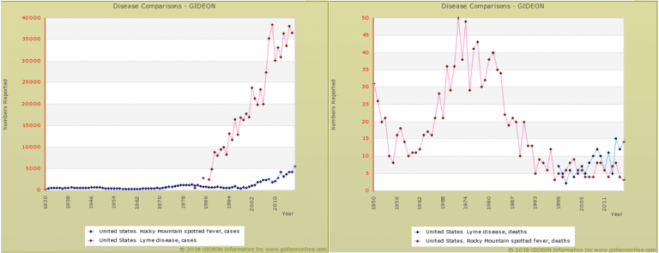
Chart 1 contrasts trends for reported incidence of Lyme disease and Rocky Mountain spotted fever (RMSF). Note that while rates of Lyme disease in 2016 are 15-fold those reported in 1987, those of RMSF increased by a factor of seven. The number of fatal cases for both diseases have remained similar in recent years (i.e., the relative case-fatality rate of Lyme disease has decreased)

LymeSF-768x295

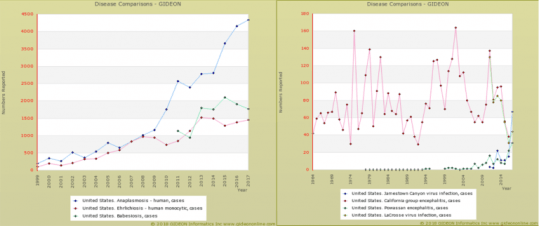
Chart 2 summarizes incidence data for a variety of tick-borne and mosquito-borne infections. Note that rates of Ehrlichiosis, Anaplasmosis, Babesiosis, Jamestown Canyon virus infection and Powassan encephalitis have increased since the year 2000. The incidence of LaCrosse encephalitis has decreased, while that of California encephalitis is largely unchanged.

MiscArbo-768x322

Charts 3 and 4 demonstrate that incidence and reported deaths for Western equine encephalitis, Eastern equine encephalitis, St. Louis encephalitis and West Nile fever have changed little in recent years.

Enceph-768x296

References:

Berger S. Infectious Diseases of the United States, 2018. 1,254 pages, 510 graphs, 16,672 references. Gideon e-books, https://www.gideononline.com/ebooks/country/infectious-diseases-of-the-united-states/
Gideon e-Gideon multi-graph tool, https://www.gideononline.com/cases/multi-graphs/

In Tick Management, Species Matters

https://entomologytoday.org/2018/05/03/tick-management-species-matters-blacklegged-lone-star-american-dog-ticks/https://entomologytoday.org/2018/05/03/tick-management-species-matters-blacklegged-lone-star-american-dog-ticks/

In Tick Management, Species Matters

three tick species
No single tick-management method works perfectly, and one factor plays a key role in how well any particular tick-management method might work: Which tick species is it best suited for? A new guide in the Journal of Integrated Pest Management reviews research on tick management tools and their effectiveness on three tick species (shown here, left to right): the blacklegged tick (Ixodes scapularis), the lone star tick (Amblyomma americanum), and the American dog tick (Dermacentor variabilis). (Image credits, L to R: Lennart Tange/Flickr, CC BY 2.0; Dr. Amanda Loftis, Dr. William Nicholson, Dr. Will Reeves, Dr. Chris Paddock, CDC Public Health Image Library; James Gathany, CDC Public Health Image Library)

In any part of the United States where ticks are present, awareness and personal protection are the first steps to avoiding tick bites and the potential disease pathogens they transmit: Using repellent and conducting frequent tick checks, especially after venturing into wooded or brushy areas, will help in avoiding ticks of all varieties.

But, for managing ticks more broadly, such as in yards and park spaces or at the community or regional level, the problem gets more complicated. No single method works perfectly, and one simple factor plays a key role in how well any particular tick-management method might work: Which tick species is it best suited for?

As part of a new special collection on Integrated Tick Management in the open-access Journal of Integrated Pest Management, Alexis White and Holly Gaff, Ph.D., of Old Dominion University have written a guide to tick control technologies that delineates their varying levels of effectiveness against the three dominant disease-carrying tick species in the eastern half of the United States: the blacklegged tick (Ixodes scapularis), the lone star tick (Amblyomma americanum), and the American dog tick (Dermacentor variabilis).

To the casual observer, a tick is a tick, but entomologists and public health professionals know different tick species behave in different ways.

“Most of the host-targeted methods … are tailored more toward one or two specific species of ticks because of tick-host preferences,” says White. “For example, lone star ticks are not known to feed on rodents, so bait boxes and tick tubes would not be an effective control measure for this species.

Host-targeted methods aim to reduce the tick population by recruiting the animals that ticks feed on to the effort. For instance, bait boxes attract rodents and bring them into contact with acaricide (a tick-targeted pesticide), while tick tubes provide acaricide-laden nesting material for rodents. Both are tailored well to blacklegged ticks and American dog ticks, which commonly feed on rodents.

Lone star ticks, meanwhile, commonly feed on larger animals such as deer. A device known as the “4-poster” works similar to the rodent bait box, attracting deer with food placed in the center of four posts with rollers laden with acaricide that the deer rub against while feeding.

White and Gaff examined existing research on these tick-management methods as well as several others: habitat modification, controlled burns, broadcast acaricides, deer removal, deer fences, and even a semi-autonomous robot known as “TickBot” that lures ticks toward acaricide as it patrols a prescribed path.

“Based on current literature, broadcast acaricides consistently reduce human and domestic animal tick encounters at least for a short period of time,” says Gaff. “However, these chemicals are known to be harmful to other invertebrates in the environment and cannot be applied in all areas because of legal restrictions.”

For the typical homeowner in tick-prone regions, though, White says a few methods offer the best combo of practicality and effectiveness across species. “Our recommendation is for homeowners with property adjacent to woods to maintain regular mowing and leaf litter removal throughout the yard and also install a mulch barrier between the edge of their yard and the forest to serve as a reminder of the tick dangers along that edge,” she says.

In the course of their review of existing research, they noted that, due to its role as the primary vector of the bacterium that causes Lyme disease, the blacklegged tick has been the subject of far more research than other species. However, as the U.S. Centers for Disease Control and Prevention notes in a new report released Tuesday, both the volume and variety of tick-borne diseases is on the rise, with afflictions such as anaplasmosis/ehrlichiosis, babesiosis, Powassan virus, spotted fever rickettsiosis, and tularemia added to the list alongside Lyme disease.

Gaff says more research is needed, and integrated tick management (ITM) efforts must aim to employ a variety of practices to reduce the threat of tick-borne diseases.

“ITM needs to focus on creating areas with reduced tick populations rather than eliminating all ticks from the environment. Ticks do serve a purpose in the ecosystem, but we do not have to be their next blood meal,” she says.

________________

**Comment**

Being involved with Integrated Pest Management (IPM) I’ve heard recent discussions about this “mulch barrier” actually drawing ticks similarly to leaf litter.  The mulch retains moisture, which ticks like.  Unfortunately, ticks have been found right in play grounds that use mulch as the flooring. Due to this, I would not advise using mulch as a plan for controlling ticks.


The Companion Animal Parasite Council Predicts Increase in Lyme & Heart Worm

https://www.veterinarypracticenews.com/capc-forecasts-problematic-heartworm-lyme-in-2018/

CAPC forecasts problematic heartworm, Lyme in 2018

“This year, there are significant shifts in prevalence”

Close up of the tick on the white fur

The Companion Animal Parasite Council, or CAPC, has released its annual 2018 parasite forecasts, and the news isn’t good. The agency reported there will be an increase in prevalence of heartworm and Lyme disease, and heartworm is predicted to continue its aggressive spread across the U.S., with the growth of Lyme disease focused east of the Rockies.

The spread of heartworm is attributed to the hot and wet weather over a two-year span and shifting weather patterns that allow for ideal mosquito breeding conditions, and the relocation of unknown heartworm-positive dogs across the country are to blame, according to CAPC. have created ideal breeding conditions for mosquitoes across the country.

CAPC also predicts the spread of Lyme disease into nonendemic areas, including the Dakotas, Iowa, Missouri, southern Illinois, Ohio, Kentucky, Tennessee, and North Carolina.

“Our annual forecasts provide critical and important information to help veterinarians and pet owners understand parasites are a true risk to both pets and people,” said Dwight Bowman, MS, Ph.D., CAPC board member and professor of parasitology at Cornell University College of Veterinary Medicine. “This year, there are significant shifts in prevalence, making our maps a critical educational tool for veterinary hospitals, and allowing veterinarians and pet owners to see that parasites are ever changing and widespread, sometimes surprisingly so.”

The forecasts support CAPC’s recommendation for annual testing and keeping pets on preventative treatment year-round.

For 2018, CAPC predicts the following risk areas for parasite-related diseases:

  • The forecast also predicts the hyperendemic prevalence seen in the lower Mississippi River region will be even more active than normal. Veterinarians in the northern tier states from Washington State to Vermont should be on alert, as this area may see a problematic rise in heartworm infections among their patients.
  • Lyme disease. Lyme is a high threat again this year and is now seen to be entering nonendemic areas. Veterinarians living close to Lyme’s endemic boundary line (the Dakotas, Iowa, Missouri, Southern Illinois, Ohio, Kentucky, Tennessee, and North Carolina) should be on high alert. Western Pennsylvania, eastern Ohio, West Virginia, and the Appalachian region in Virginia need to prepare for an active year. Washington, D.C., to Philadelphia and eastward (including the Delmarva area), and the Boston/Cape Cod area, are expected to see relief this year.
  • Transmission of the agents of anaplasmosis is forecasted to be average for much of the U.S. However, northwestern Minnesota is forecasted to have an active year. The Wisconsin/Minnesota border area and the Boston/Cape Cod region are expected to see less activity than normal.
  • This geographically challenging disease can be nonexistent to rampant within 200 miles. Southern Virginia and northern North Carolina are forecasted to be more active than normal. The rest of the U.S. is expected to see about normal prevalence in 2018.

CAPC offers prevalence data that localizes reported parasitic disease activity at the county level for veterinarians to use in their discussions about annual testing and year-round protection. This information is available for free at the CAPC website petsandparasites.org.

The forecasts represent the collective expert opinion of academic parasitologists who engage in ongoing research and data interpretation to better and monitor vector-borne disease agent transmission and changing life cycles of parasites, and are based such factors as temperature, precipitation, and population density.


Panel Says TBI’s Have Reached Epidemic Levels

https://m.medicalxpress.com/news/2018-04-tick-borne-diseases-epidemic-panel.html

Tick-borne diseases reach epidemic levels, panel says

April 16, 2018
by Delthia Ricks, Newsday
Lyme disease
Adult deer tick, Ixodes scapularis. Credit: Scott Bauer/public domain

Tick-borne infections have reached epidemic proportions on Long Island, where children are disproportionately affected by Lyme disease and other infections transmitted by the eight-legged creatures, a panel of top scientists announced recently.

“Lyme disease is mostly a disease of children and curiously mostly a disease of boys,” Jorge Benach said at a recent symposium at Stony Brook University School of Medicine. Benach, who discovered the bacterium that causes Lyme disease, is a molecular geneticist at Stony Brook University School of Medicine.

His observation that Lyme disease is mostly an  of children was corroborated by Dr. Christy Beneri, a pediatrician at Stony Brook Children’s Hospital. She said her institution encountered a wide range of tick-borne illnesses annually and that boys tended to outnumber girls in the number of infections. The most likely reason for the disparity, Beneri said, is the tendency among boys to play outdoors in wooded areas where ticks thrive.

In the extensive pediatric research Beneri presented at the symposium was evidence of some children developing Bell’s palsy, a temporary facial paralysis that occurs when the Lyme bacterium affects a cranial nerve. The paralysis resolves with antibiotic treatment, Beneri said.

Beyond the Lyme bacterium, ticks on Long Island have been found to harbor babesia and anaplasma.

Babesia are protozoa, or parasitic, infectious agents that hone in on red blood cells, similar to the way a malaria parasite invades the same cells.

Anaplasmosis is an infection caused by the bacterium Anaplasma phagocytophilum. It can trigger aches, fever, chills and confusion.

Beneri and Benach were among five leading Stony Brook experts, including university president Dr. Samuel Stanley, who addressed what they described as a mounting epidemic of infections caused by the ever-expanding range of ticks. Stanley, who was the first speaker, is a specialist in infectious diseases.

“New York bears a disproportionate impact from tick-borne diseases,” Stanley said at the symposium, which was held in a lecture hall in the university’s health sciences building. “This is a regional and state problem.”

New York has the highest number of confirmed Lyme  cases nationwide, according to the U.S. Centers for Disease Control and Prevention, which has cataloged more than 95,000 Lyme infections in the state since 1986. Suffolk County has long been ground zero for the ailment on Long Island, studies consistently have shown.

“Cases in Suffolk County hover between 500 and 700 and this is just for the reported cases,” Benach said, noting that Suffolk has among the highest rates of many tick-transmitted infections because of the dense infiltration of the insects in county.

Typical Lyme symptoms include fever, headache, fatigue, and a characteristic skin rash called erythema migrans, said Dr. Luis Marcos, a specialist in internal medicine and infectious diseases.

Marcos presented data showing the wide range of illnesses caused by ticks throughout the region, including Borrelia miyamotoi, a corkscrew-shaped bacterium identified in recent years as the cause of a relapsing fever.

Dr. Eric Spitzer, a pathologist, discussed the many laboratory tests that Stony Brook used to arrive at a diagnosis of a tick-transmitted illness. He said that for years, doctors nationwide sent specimens to the university for analysis because of its well-known precision. Testing of those specimens earned the university $32 million over a 20-year period, he said.

Panelists identified the most prevalent ticks on Long Island as the American dog tick; the invasive lone star tick, which migrated from Southern states; and the blacklegged tick, known as deer tick.

_______________

For more:  https://madisonarealymesupportgroup.com/2016/02/13/lyme-disease-treatment/

https://madisonarealymesupportgroup.com/2016/01/16/babesia-treatment/

https://madisonarealymesupportgroup.com/2016/03/08/anaplasmosis/

http://danielcameronmd.com/best-antibiotics-treat-borrelia-miyamotoi/ The study authors demonstrated that B. miyamotoi is susceptible to doxycycline, azithromycin, and ceftriaxone but resistant to amoxicillin in vitro. The next step would be to show whether these drugs work in patients.


]