There is bipartisan support in Delaware for two bills that are designed to prevent the spread of LD, raise awareness, and improve treatment and coverage. Delaware’s Lyme Disease Task Force consists of healthcare professionals, DNREC officials, and Delaware residents suffering with LD.
House Bill 290 would give the Department of Natural Resources authority to mitigate ticks. House Bill 291 would establish an oversight board to help educate and develop balanced content regarding LD continuing education courses for medical professionals.
Wonderful 26 minute documentary put out by student filmmakers from SUNY Broome Community College in New York exploring the impact of Lyme disease in their local area.
A few comments: they state that 70-80% of those bitten by a tick will get a bullseye rash, but according to ILADS (International Lyme and Associated Diseases Society), that number is less than 50%. Hardly anyone I talk to (and I talk to many) has seen a tick or a rash. In fact, I would go as far to say seeing a bullseye rash is the exception, not the norm.
52% of patients with chronic Lyme disease are negative by ELISA but positive by Western blot (Donta 2002). Between 20-30% of patients with confirmed Lyme disease are seronegative (Aguero-Rosenfeld 1996, 1993; Donta 1997). The College of American Pathologists (CAP) found that ELISA tests to not have adequate sensitivity to be used for screening purposes (Bakken 1997). LLMDs consider the specificity of the particular bands that test positive for a patient. The NIAID views the Western blot as the best method for detecting Borrelia antibodies. Although the CDC requires 5 of 10 bands to IgC surveillance purposes, 2 of 5 bands have specificity of 93-96% and a sensitivity of 100% (Engstrom 1995).
Two-Tier Testing The most common diagnostic tests for Lyme disease are indirect ones. They measure the patient’s antibody response to the infection, not the infection itself. The two most-used antibody tests are the enzyme-linked immunosorbent assay (ELISA) and the Western blot. The CDC recommends that doctors first order an ELISA to screen for the disease and then confirm the disease with a Western blot.
During the first four-to-six weeks of Lyme infection, these tests are unreliable because most people have not yet developed the antibody response that the test measures. Even later in the illness, the two-tiered testing is highly insensitive
missing roughly half of those who have Lyme disease.
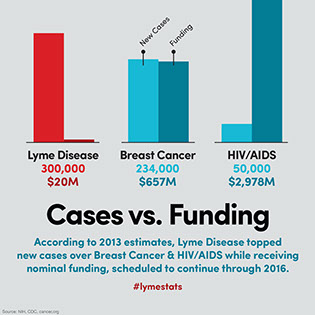
HIV/AIDS is diagnosed with tests that are both highly sensitive and highly specific. They are accurate more than 99% of the time. How well would AIDS patients accept testing that was accurate less than half the time?
I felt they were also generous in their dialogue about whether Lyme Disease is chronic or not.
Recap of the Evidence Based Health Policy Project held at the Wisconsin Capital yesterday:
Dr. Osorio, Associate Professor and Researcher, Department of Pathobiological Sciences, UW Madison spoke on Zika. If you are unfamiliar with this virus, please read: https://madisonarealymesupportgroup.wordpress.com/2016/02/05/zika-sexually-transmitted/ The most important take aways from his slide show was : 1) 80% of those infected with Zika don’t even know they have it. 2) 1 in 5 will have mild symptoms (fever, rash, joint pain, or conjunctivitis) lasting up to a week, and while those in Africa and South America are experiencing high infection rates, WI isn’t even on the radar (my words). One of the most important things he emphatically stated was that Zika caused the deaths of two babies due to two tissue samples that had Zika in them. (please hold this thought, I will deal with this later)
Next, Susan Paskewitz, Professor and Researcher, Medical Entomology Laboratory, UW Madison spoke primarily on West Nile Virus and Lyme Disease – with an emphasis on ticks and mosquitos. They have found some West Nile in mosquitos in WI but that the Northern mosquitos can not even carry Zika. She also stated that in regards to Lyme (borrelia), the two notorious carriers are the Dog tick (wood tick) and the deer tick (black legged tick), and that there is between 30,000 and 40,000 reported cases of Lyme (borrelia) in Wisconsin. She also stated that Wisconsin is a hot spot for Anaplasma with over 500 cases. She affirmed that ticks in WI are everywhere and on the move and that due to this, the disease has expanded as well. There is a nifty website where you can check out great information on ticks here: labs.russell.wisc.edu/wisconsin-ticks/.
After the slide shows they gave time for questions.
These are the things I spoke about:
*Since the EBHPP’s purpose and goals are to give timely, high quality information for evidence based decision making to increase UW research and teaching in topical issues of state public policy, I asked if it wasn’t perhaps more beneficial to discuss and act on something that Wisconsinites can get in their backyard, bedroom, and can spread congenitally?
*In regards to Zika I pointed out the statistics mentioned above as well as the fact that results of 2 tissue samples showing Zika is NOT evidence that the virus caused microcephaly that that we have viruses all over us, some good, some bad, but that doesn’t mean we are experiencing symptoms or active infection. Correlation is simply not the same as causality. There needs to be in depth studies on thousands of babies – those with and those without microcephaly, with pregnant women enrolled prospectively being monitored throughout the pregnancy with conclusive laboratory evidence.
*I also proposed two events that happened in the past year that more probably could have caused this microcephaly: 1) Brazil’s National Vaccine Schedule with DTap for Pregnant women to be given in the 27th week, 36th week, and up to 20 days prior to the expected date of birth – regardless of the lack of safety or effectiveness of Boostrix being established in pregnant women and that the Brazilian government has been vaccinating perhaps hundreds of thousands of pregnant women.
Published on Mar 29, 2016 Published on Mar 29, 2016 (15 min)
NVIC’s Barbara Loe Fisher reviews the medical literature that reveals that pertussis vaccines are not effectively preventing pertussis infection. To learn more continue to watch this commentary or read the fully referenced version at www.NVIC.org. Join NVIC’s Advocacy Portal to protect vaccine choice at www.NVICadvocacy.org.
2) A report published by the Physicians in the Crop-Sprayed Villages of Argentina that discounts the theory that the increase in microcephaly is due to Zika and that a chemical known as pyriproxyfen (C20 H19 NO3), a pyridine-based pesticide to eradicate mosquitoes has been applied by the State on drinking water used by the affected population for 18 months. Then I reminded them of our own experience of using DDT which caused birth defects and even deaths. Both of these events were about the length of the gestational period – just in time to see microcephaly. (Zika has been around for over 40 years and never caused problems before)
http://www.thevaccinereaction.org/2016/05/new-york-aerial-sprays-altosid-and-vectobac-pesticides-to-combat-zika/ Yet, despite Médicos de Pueblos Fumigados arguing that an insect growth regulator used in Brazil might actually be the reason for the microcephaly, the New York City Department of Health and Mental Hygiene is releasing similar growth regulators, Altosid and VectoBac, in pellet form from low-flying helicopters in Brooklyn, Queens, Staten Island, and The Bronx.
*I also spent considerable time discussing the plight of Lyme patients. That we are co-infected with numerous pathogens which make our cases far more complex than most realize. I spoke of borrelia, alone, and that it is pleomorphic with three shapes it can change into at will and that proper treatment needs to address this complexity and that 21 days of doxycycline, the current CDC standard of care is like throwing sand into the ocean. I spoke of 3 generations of Wisconsinites living under the same roof – all infected with MSIDS (multi systemic infectious disease syndrome). I explained that the myth that Lyme (borrelia) only causes a little joint pain and fatigue needs to be dispelled and that there is significant cognitive and psychological impairment with some suffering with severe anxiety, rage, confusion, depression, and memory loss.
Sorry for the short notice, but I just found out about this myself.
Tomorrow (Thurs., March 3, 2016) there will be an Evidence Based Health Policy Project at the Wisconsin capital (room 411 South). It starts at 8:30am and lasts until 11. There will be a briefing on Lyme, West Nile, and Zika.
It is free and open to the public, with breakfast and sign-in beginning at 8:15am.
*Provide policymakers, in both the public and private sectors, with timely, non-partisan, high-quality information for evidence-based decision-making. *Increase the involvement of UW faculty research and teaching activities in topical issues of state public policy.
Methods and Venues
The project includes four methods by which to provide public and private sector policy makers with timely, non-partisan, high quality information for evidence-based decision-making:
*Issue-specific invitation-based forums for off-the record safe harbor dialogue; Speaker/Panel Symposiums;
*Just-in-Time topic briefings of legislative committees; and
*Methods exchange meetings between policy makers and researchers.
Speakers:
Jorge Osorio, Associate Professor and Researcher, Department of Pathobiological Sciences, UW Madison
Susan Paskewitz, Professor and Researcher, Medical Entomology Laboratory, UW Madison
Moderator: Representative David Craig, WI Assembly District 83
Turn the Corner Foundation: The Fight Against Lyme Disease
This short 6 minute video was uploaded in 2008 and includes excerpts from “Under Our Skin,” the best primer on Lyme Disease out there. It’s important to see our past to understand our present. We have far to go, but many courageous and gifted people have done so much for the Lyme community. My favorite part is when Dr. Corson, obviously infused with life changing direction from Dr. Burrascano, announced,
“I feel like I need to educate an army. I need to train an army because that’s what it’s gonna take to treat all of the patients that need to be cared for.”
Eight years have come and gone with Dr. Corson’s prophetic words. The good news is slowly more doctors are becoming trained by *ILADS to effectively treat MSIDS (multi systemic infectious disease syndrome), but she’s right, so many more are needed.
*International Lyme and Associated Diseases Society
ILADS is a nonprofit, international, multi-disciplinary medical society, dedicated to the diagnosis and appropriate treatment of Lyme and its associated diseases. ILADS promotes understanding of Lyme through research and education and strongly supports physicians and other health care professionals dedicated to advancing the standard of care for Lyme and its associated diseases.


 Permission from

